

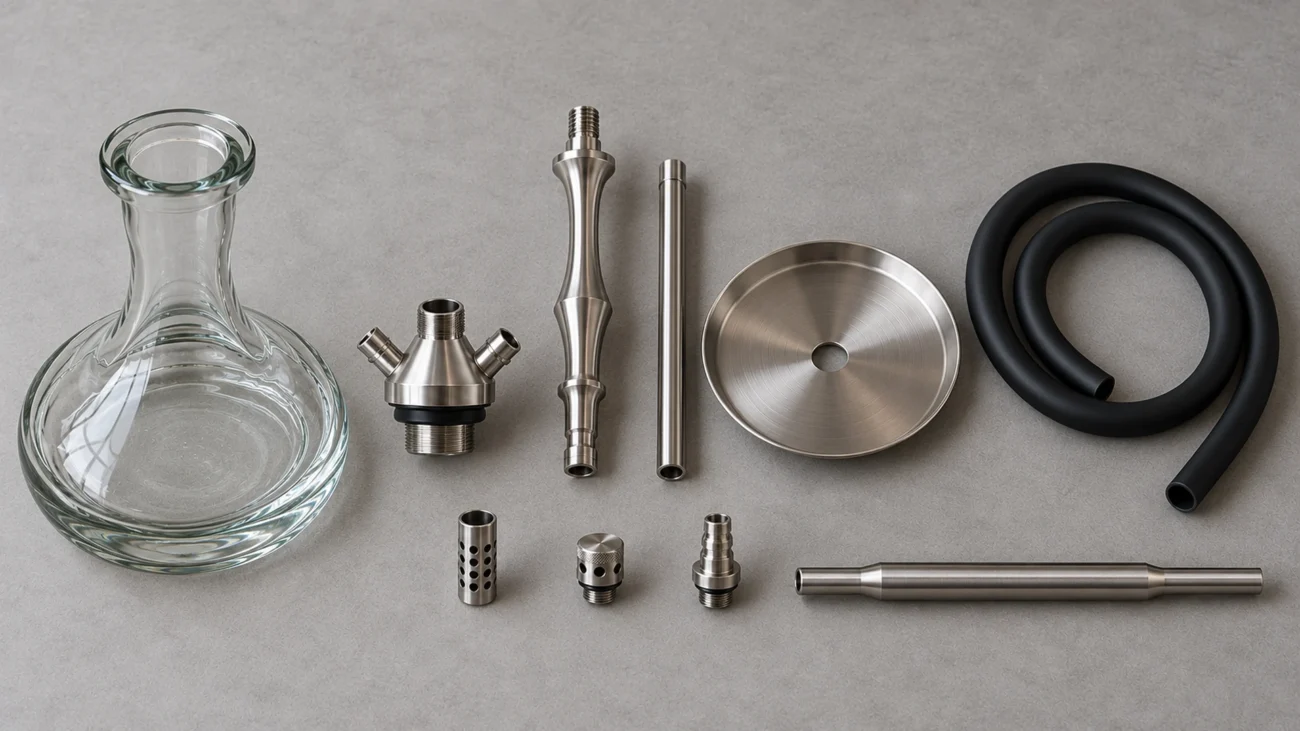
Hookah Parts and Their Names – What Do These 10 Parts Do?

Summarize this article with AI
Discover the key points with your preferred tool.
The title, article link and text context are sent to your chosen tool.
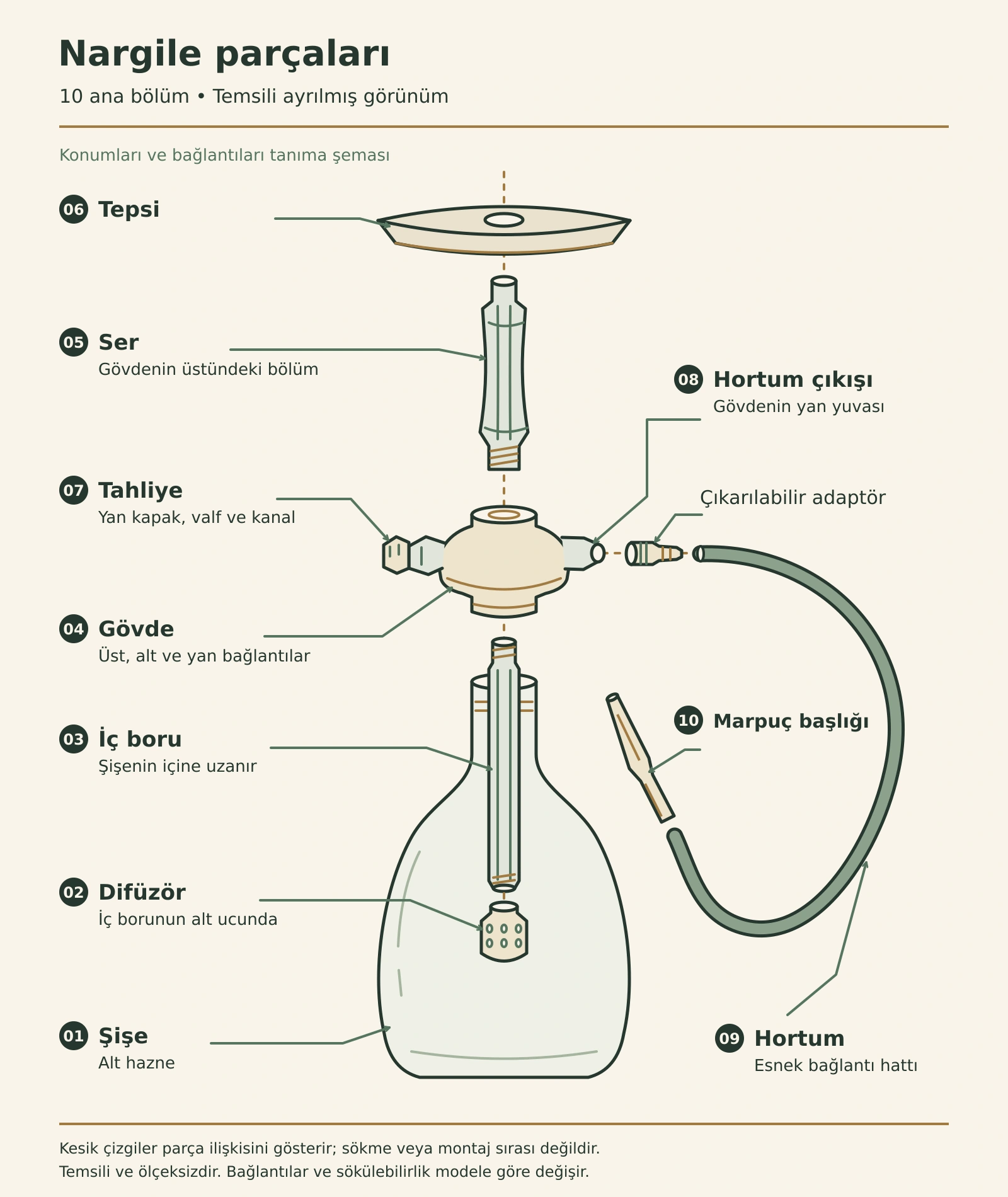
Hookah set parts can be identified in the following order, starting with the base: base, diffuser, downstem, body, stem, tray, purge, hose port, hose, and hose head. The explanations primarily refer to the construction of modern, modular stainless steel sets. The body and stem are treated as separate sections; in sets with other designs, the parts may be integrated. The outlet where the hose connects, the flexible hose, and the mouthpiece on the user's end are also distinguished from one another.
Knowing a part’s name alone may not be enough. Two bases sold under the same name may have different connections, and two similar-looking grommets may have different dimensions. To understand whether a product fits a set, consider what the part does, where it connects, and which of its features vary by model together.
This guide examines the hookah section by section. First, you can find the part names in a single table, then move on to descriptions of each part. Later sections cover connection types, reading dimensions, parts lists, and examples for technical support requests. The goal is to help you understand where a part belongs in the set and how it relates to other components once you learn its name.
What are the parts of a hookah? Names and functions
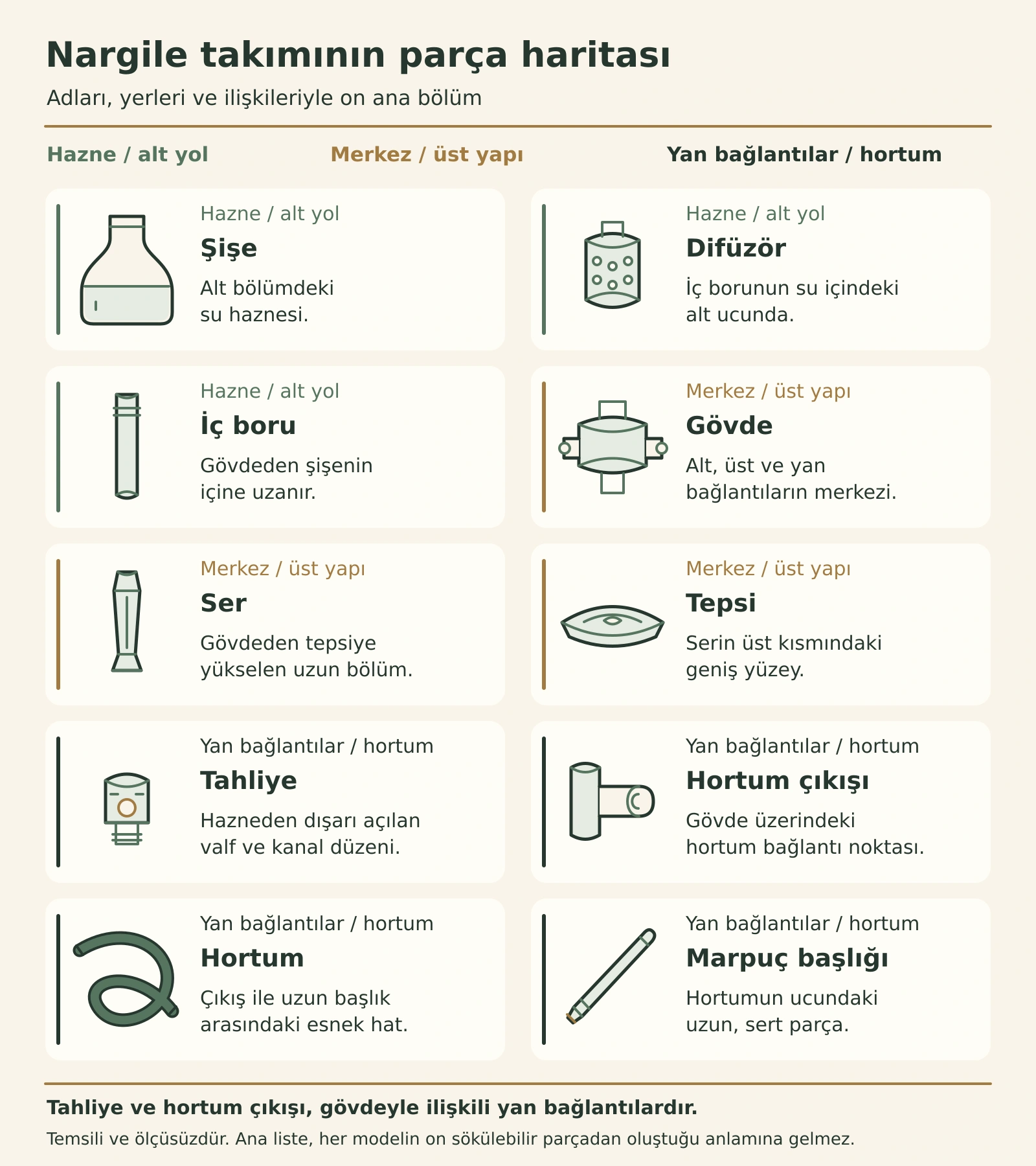
To get to know a hookah set, it helps to start with the base at the bottom, trace the inner tube and main connection sections, then move to the upper and side components. The list below names ten sections separately. This does not mean every model consists of exactly ten removable parts; some designs combine several sections in a single piece. The purge valve and hose outlet are side connections associated with the body, rather than a continuation of the vertical sequence.
| Part | Function | The section where it is located or connects | Information to check |
|---|---|---|---|
| 1. Bottle | The chamber holding the water and the space above it | Bottom of the set | Opening dimensions and body connection |
| 2. Diffuser | The part that distributes the underwater outlet through holes | The lower end of the inner tube | Whether it is separate or integrated |
| 3. Inner tube | The section extending from the body into the base | Lower body connection | Length, diameter, and connection type |
| 4. Body | The main section where the lower, upper, and side connections meet | The connection area at the top of the base | Base, stem, and side port connections |
| 5. Stem | The long section rising from the body toward the tray | Top of the body | Bottom connection and upper head structure |
| 6. Tray | Surface that collects ash and small debris | The stem's upper section | Center Opening and Securing Method |
| 7. Eviction | The mechanism that allows smoke to escape the chamber | The body's purge passage | Valve seat and moving parts |
| 8. Hose outlet | The connection point where the hose attaches to the set | The body's side connection | Socket, adapter, and grommet arrangement |
| 9. Hose | The flexible line between the set and the hose handle | Between the hose port and handle | Connection features of both ends |
| 10. Hose handle | The end piece on the user's side of the hose | The free end of the hose | Size of the section that fits the hose |
This sequence is intended to explain what the parts do; it is not a disassembly or assembly guide. The names and connection layout in the set's own manual may vary by model. Additional components such as the bowl, grommet, and connection adapter are explained in the sections following the main parts. This helps distinguish locations on the set from small connection components.
Hookah base and water chamber
The base is the water chamber at the bottom of the set. In classic designs it is usually glass; other models may use different materials or chamber shapes. The term "base" therefore does not indicate one particular shape, capacity, or connection standard. Its upper connection, as well as its exterior shape, must suit the set's construction.
The base has two separate functions: holding water and forming part of the set's foundation. The body's weight, connection type, and the surface the base rests on must be considered together. Appearance alone cannot establish balance or durability. The manufacturer's compatibility information and connection dimensions should be taken into account, especially when switching to a different base.
Does every base fit every hookah?
No. A push-fit connection and a threaded connection are not the same. Two models using the same connection type may still have different opening sizes, seating depths, or grommet designs. Similar base colors, patterns, and overall heights do not make these characteristics identical. Compatibility is verified at the connection point.
If the old base has broken, checking the parts record using the model name or product code provides more reliable information than trying to estimate measurements from a photo of the remaining piece. A photo can certainly help, but measurements taken from a broken surface may be misleading. Check the base's technical drawing to confirm its model and connection system.
The technical function of the water chamber should not be interpreted differently in terms of health. Smoke passing through water does not make hookah safe; harmful substances remain after it passes through the water. This distinction must be maintained when explaining how the equipment works. CDC hookah information provides clear information on this topic.
What is a diffuser, and how does it differ from the inner tube?
On models that have one, the diffuser distributes the outlet at the lower end of the downstem across multiple holes. It is not the same as the downstem. The tube forms the main section extending from the body into the water chamber, while the diffuser concerns the outlet arrangement at its lower end. On some models, it attaches separately; on others, it is integrated into the lower end.
Not every set necessarily has a removable diffuser. Seeing a perforated part at the lower end in a product photo does not always mean it can be removed. Check the model description for removability information before replacement or cleaning. Trying to twist off an integrated section as though it were a separate part can cause damage.
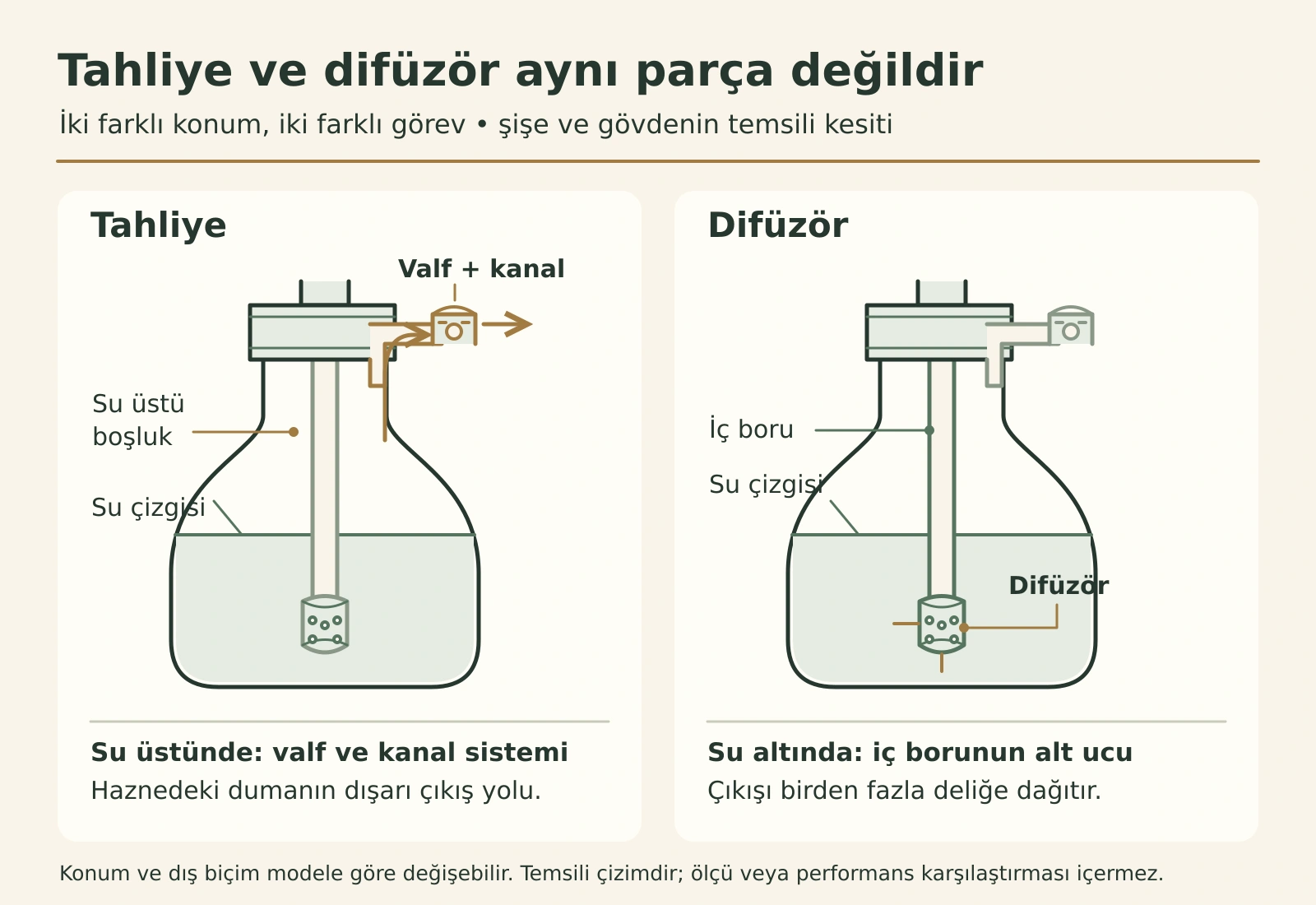
The diffuser and purge do not perform the same function
The diffuser is at the underwater outlet of the downstem; the purge system involves the valve and channels opening outward from the chamber. Technical documents distinguish between designs without diffusers, integrated diffusers, and separately attached diffusers. A diffuser therefore cannot be described as an independent part found on every model.
When assessing a diffuser's connection, look at how it fits the lower end of the inner tube. If threaded, both diameter and thread design matter; if push-fit, examine how it seats. The mere presence of this part should not be used to infer superior quality, health benefits, or measured performance.
What is the downstem, and which details matter?
In this guide, the downstem is the lower section that extends from the stem into the base. This section, with a tube running through the center of the stem and down into the base, may consist of separate parts depending on the model. The total visible height of the set is not the same measurement as the downstem’s length. Designs may pair a long stem with a short downstem or use different proportions. Product descriptions should therefore make clear which part a measurement in centimeters refers to.
Three details are especially important when identifying the downstem: its length, the section where it connects to the body, and the structure of its lower end. On some models, the tube is removable; on others, it is an integral part of the body assembly. A separate diffuser at the lower end can also make the tube's own length different from its total installed length.
How do you compare downstem lengths?
Before comparing two products' dimensions, make sure the measurements start and end at the same points. The threaded section may be included, or the description may specify only the exposed section. Measurements with the diffuser attached and removed should not be used interchangeably either. Being "the same length" alone does not prove compatibility when the measurement method is unclear.
When the base is replaced, the position of the downstem inside the chamber must also be considered. Even if the new base looks similar externally, the distance between the point where the body sits and the bottom may differ. The tube’s suitability for the chamber is assessed as part of this whole. Rather than cutting the tube or modifying the connection to fit the product to the set, obtain information about parts compatible with the model.
When requesting a spare part, it is useful to provide the set's model and a photo of the upper connection along with the term “inner tube.” Do not attempt removal until you have confirmed that the existing tube is removable; a visible seam does not always indicate a screw connection.
What Is the Body, and Which Connections Does It Bring Together?
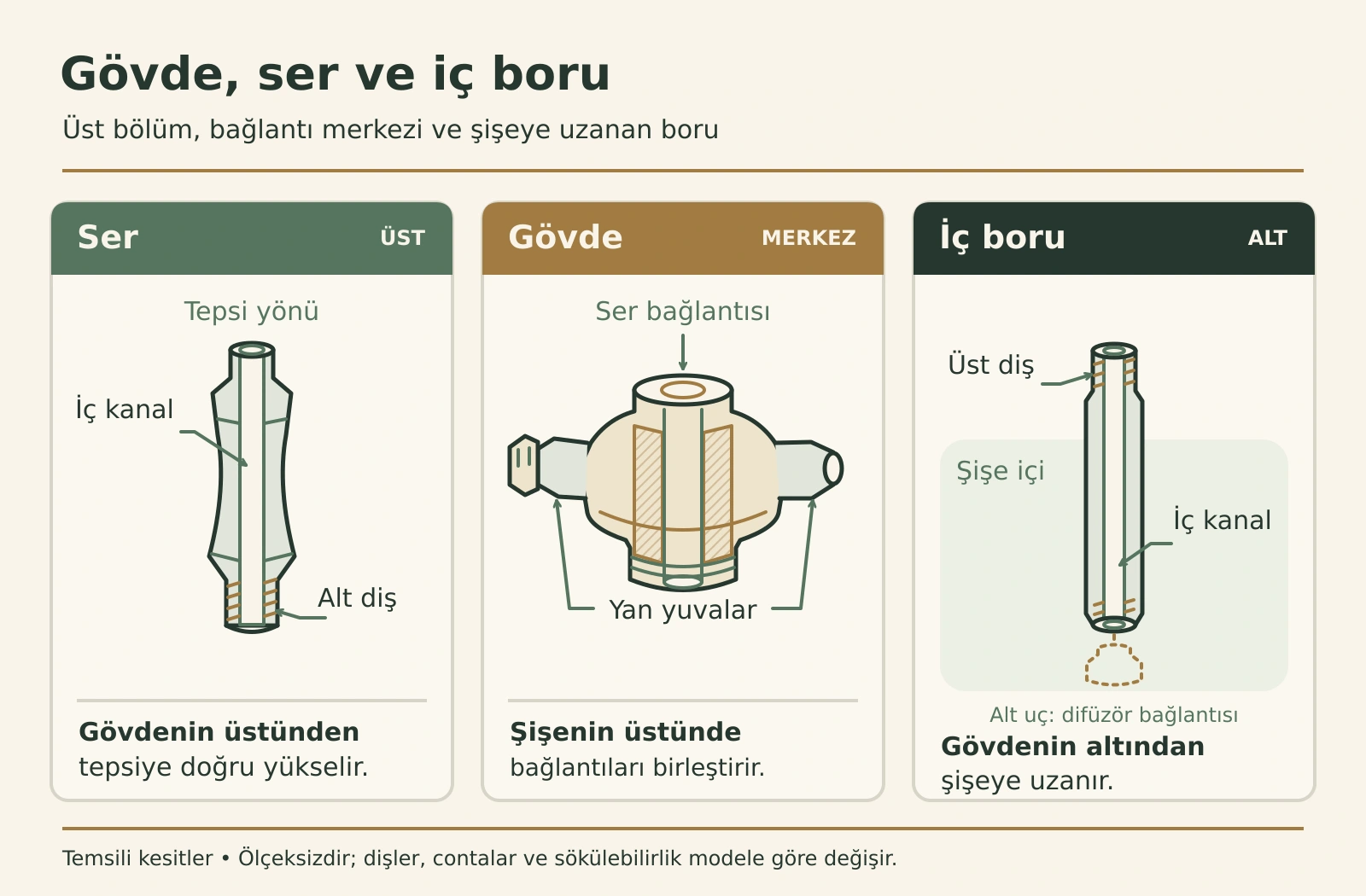
In this guide, the body refers to the main connection section above the base. This section connects with the base and inner tube below, the stem above, and the hose outlet and purge system at the side. From the outside, it may look like a short or wide metal part. Because connection channels are not positioned the same way in every model, the external appearance does not establish a single standard.
In this description, the body and stem are named separately. The body is the lower main section where the connections come together; the stem is the long section above it that rises toward the tray. In foreign technical drawings, these two components may be labeled separately as “base” and “column.” Some manufacturers may use different names for their products as a whole. When reading a part name in a guide, look not only at the word but also at the section it identifies in the drawing.
How do you distinguish the body’s connections?
First distinguish the lower surface that sits on the base from the upper surface where the stem connects. Then examine the positions of the hose outlet and purge channel. These nearby connections do not serve the same purpose. For example, the adapter at the hose outlet does not replace the purge cap. A technical drawing shows which channel each socket belongs to.
When describing a problem with the body, specify the location of the connection. Saying “the lower surface that sits on the base” or “the upper thread where the stem joins” provides clearer information than “body connection.” Since the joining method varies by model, not every visible line on the outer surface means the part can be disassembled at that point.
What is a stem, and how does it differ from the body?
In this guide, the stem means the long section rising from the body toward the tray. It may account for a substantial portion of the set’s visible height. However, its external shape alone does not reveal the length of its central channel or the dimensions of its lower connection. In some designs, the decorative outer covering and the inner tube are separate components.
Distinguishing the body from the stem prevents confusion between the long upper section and the main connection piece. A drawing may show the stem separately, while another model may present it together with the body. The fact that the two sections appear to be a single piece or are listed together does not make their functions identical. Consult the relevant model’s manual for disassembly information.
The stem's outer surface and central tube
A patterned, colored or coated exterior does not mean every part in the series is made of the same material. The word steel appearing in a description also does not mean the whole set, including the base and hose, is steel. Material information should be evaluated only for the part it refers to.
A scratch in a coating and damage to connection threads are different issues. The first can affect appearance, while the second can affect the joint. Specify whether the problem is on the stem's exterior, lower connection, or upper fitting. A close-up of the relevant connection alongside an overall photo of the part provides clearer information.
YT Cris Off Steel Hookah The set's product description identifies ring-shaped transitions on the long upper section and a rounded section around the base connection. These exterior details do not reveal the diameter of the channel inside the stem or where the part disassembles. The visible long section and the connection hub should be treated separately in the technical description.
What is a hookah tray used for?
The tray is the broad surface usually located below the bowl at the top of the stem. It provides a place to catch ash and small debris. Its wider appearance compared with the bowl makes the two easier to distinguish. The tray is not the chamber where tobacco goes; calling different upper parts by the same name can cause confusion when choosing replacement parts.
How the tray is secured to the set varies by model. In some designs, it is held beneath the upper connection; others use a dedicated seat or fastener. Therefore, considering only the tray's outer diameter is not enough. The size of the center opening, seating surface, and structure of the securing part must also be suitable.
If you are considering replacing a tray, inspect both the upper and lower surfaces of the existing part. A surface that looks flat from the outside may have a raised section, socket, or connection underneath. If the product photo only shows the pattern, you need additional information about the connection. Also, a loose tray does not always mean the tray itself is the problem; the upper connection holding it in place should be checked too.
Although the tray provides a surface for ash, it should not be regarded as a safeguard that eliminates every risk in an arrangement containing hot parts. Replace and inspect parts only when the set is completely cool; do not force damaged parts or parts that do not fit.
What is purging, and what does it do?
Purging refers to the arrangement of valves and channels through which smoke can leave the chamber. The purge valve is one component of this arrangement; the visible outlet hole or cap may not represent the entire system. Some models have a visible cap and moving part, while others integrate the mechanism into the body design. Purge appearance and direction therefore vary among sets. Purge channels may direct smoke beside the body, around the stem, or near the tray; the visible outlet and the valve do not have to be in the same place.
Do not confuse the purge cap with the entire valve. The visible cap may only be the outer section; there may be a seat and moving parts inside. Replacing only the cap may not resolve a problem. Identify which part is missing, damaged, or displaced using the model's diagram.
Why do purge parts vary by model?
The shape of the valve seat and the dimensions of the moving part relate to how the mechanism works. A small part looking similar therefore does not mean it is suitable. Use the part specified by the manufacturer instead of fitting a random ball or another component. Record the order and location of the parts during disassembly.
A design's ability to change the purge direction should not be described as a general feature found in all hookahs. Even different models from the same brand may use different arrangements. If the model's manual shows the placement of purge parts, follow that diagram; do not rely on a video of another set simply because it looks similar.
What is a hose port?
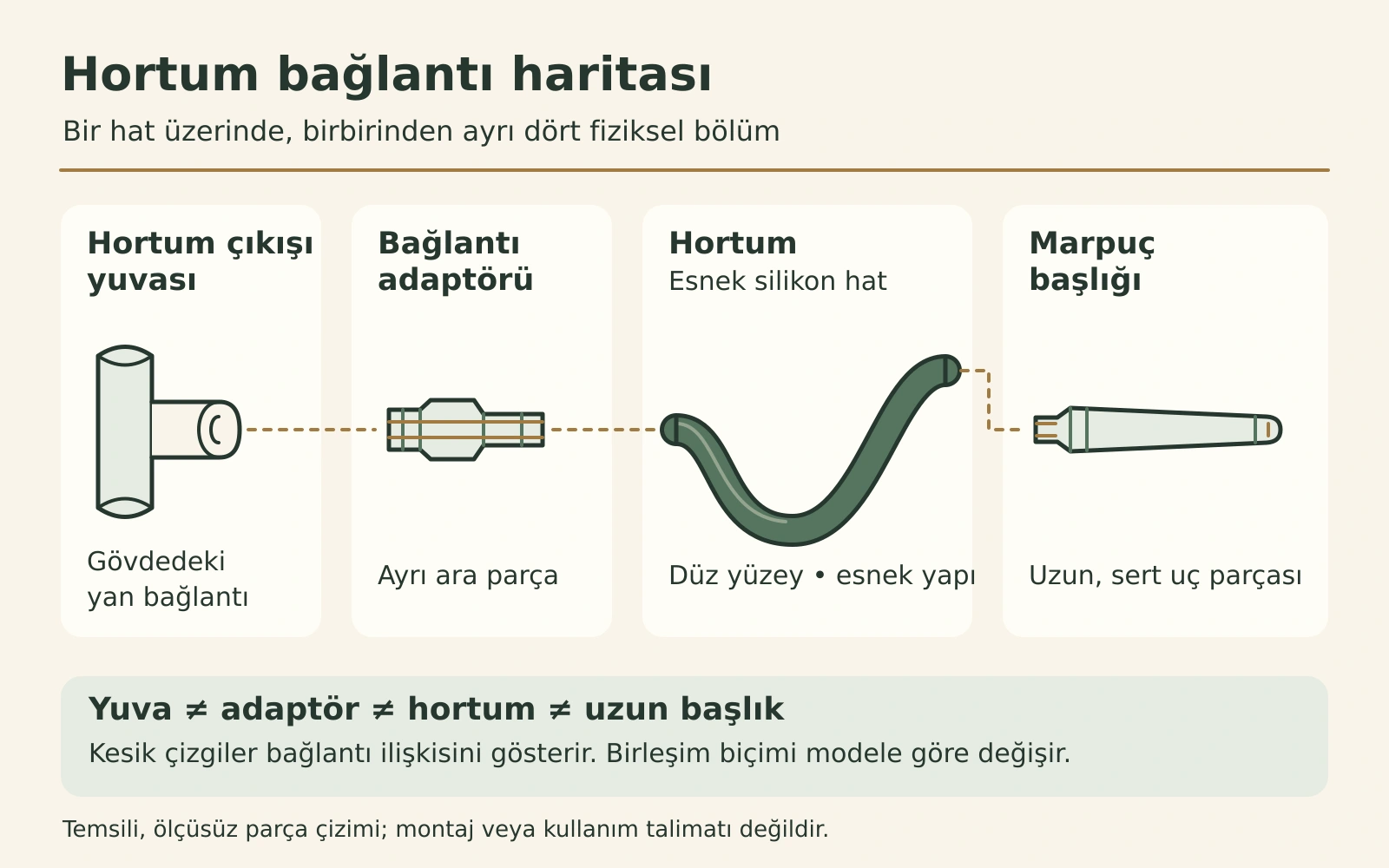
The hose port is where the flexible hose connects to the set. This guide treats the port itself and the hose as separate parts. Depending on the model's design, the port may be a fixed socket on the body or a removable connector. An additional adapter and grommet may be used to attach the hose.
It helps to distinguish three terms here: the outlet on the body, the connector that fits into it, and the hose attached to that connector. All three may look like one assembly in a photo. But if only the adapter is missing, describing it with the same term as the hose or body makes the technical explanation unclear.
The hose port and purge should not be confused either. They may be located near one another on the body, but their functions differ. The hose port connects the hose line; the purge relates to the mechanism that opens outward from the chamber. Describing something as being on the right or left can be misleading when the photo’s orientation changes. The part’s name and a photo of its connection provide a clearer description.
What is the hose, and which parts does it connect?
The hose is the flexible line between the hose outlet and the hose handle. The end on the set side connects to the outlet or a suitable adapter, while the other end connects to the hose handle. The entire flexible section and the rigid handle at its end are separate components. This distinction clarifies which connection is meant when describing a part's location.
The connections at the two ends of the hose do not have to be identical. The adapter used on the set side may differ from the connection at the mouthpiece. The hose's total length alone therefore does not provide enough information about end compatibility. Consider the construction of both joints together with the model's technical description.
Are the hose and connection adapter the same part?
The hose is the flexible line; the adapter is the intermediate component that makes the connection. Some parts lists may show them together, while others list them separately. Appearing in the same photo does not mean they form a single integrated part. Check the manual for removability and what the connection includes.
Hose care information should be interpreted according to the material and model. A method specified for one hose should not be applied directly to another hose with a different internal construction. Follow the manufacturer’s information about washability and whether the end pieces are removable. A flexible-looking exterior alone does not explain the internal construction or appropriate care method.
What is a hose handle, and how is it different from a hose?
The hose mouthpiece is the end piece on the user’s side of the hose. It is separate from the flexible hose, and the section where it joins the hose has its own connection dimensions. Parts drawings may show the hose and mouthpiece separately. Although the two connected sections may look like a single line from the outside, they have separate names in technical descriptions.
The total length of a hose handle does not indicate the size of the connection section that enters the hose. A long and a short handle may have joining surfaces of the same size, while two handles with similar appearances may have different connections. Overall length and the section where the hose fits should therefore not be used as interchangeable measurements.
The short personal tip that attaches to the end of the handle is a separate accessory from the long hose handle. In designs that include it, the short personal tip fits onto the end of the long handle. In this guide, “hose handle” refers to the long end piece connected to the hose.
When reading material information, pay attention to what the outer surface, the inner channel and the hose connection are made of. If only the color of the coating is given, no firm conclusion can be drawn about the structure of the whole part. The manufacturer’s technical description and care information should refer to the same part.
If the handle does not fit the hose fully, forcing the connection is not a proper way to match them. Determine whether the problem comes from the hose end’s dimensions, the connector, or the handle belonging to a different model. When seeking technical support, photographing the entire handle and its hose insertion end separately makes it clearer which part you are describing.
What is a bowl, and where is it located on the set?
The bowl is the chamber at the top of the hookah. In everyday use, it is sometimes called the “head.” It sits on the stem's upper connection, where a model-compatible grommet may be used. The bowl's upper chamber and lower connection opening serve different functions; do not confuse these two sections when assessing compatibility.
A bowl’s exterior may not provide enough information about its lower connection. Two models that look similar from above may have lower openings of different depths or shapes. When evaluating a product, consider a photo showing the underside, the connection dimensions, and the manufacturer’s compatibility information together. Deciding solely on color, pattern, or overall size is insufficient.
Are the bowl and bowl adapter the same part?
The bowl is the upper chamber; the bowl adapter is the connector that attaches this chamber to the top of the stem. It is therefore normal for the two names to appear separately in a technical drawing. The adapter may remain on the upper connection while the bowl is shown as a separate component. The grommet used in the connection is also separate from the bowl itself and the metal adapter.
In some designs, the bowl adapter also helps secure the tray. This should not be assumed to apply to all models. Showing where a part connects while learning its name makes the distinction between bowl, adapter, and grommet clearer. A broad expression such as “top fitting” may not identify which of these three components is meant on its own.
The difference between a bowl and a heat management device
The heat management device used on top of the bowl is a separate part. Product descriptions may call it an HMD, heat management device, or charcoal holder. Since these names can refer to different products depending on the seller, check the image and description to identify the part. Do not assume the bowl and the device on top are a single product.
Compatibility is assessed at two separate points: the fit of the bowl's bottom onto the stem's top connector, and the fit of its top section with the relevant accessory. Meeting the first condition does not automatically meet the second. This distinction is particularly important when reading a part drawing or technical description. The bowl's lower and upper connections are separate surfaces that interact with different parts.
What Are Grommets and O-Rings?
A seal helps prevent leaks where two surfaces meet. An O-ring is a ring-shaped type of seal. Seals used at different points on a set do not have to share the same size or shape. The grommet under the bowl and a pipe connection's ring may serve different locations and fit different sockets.
Matching a grommet solely by color is not appropriate. Even if the color is the same, the inner diameter, outer diameter, cross section, and shape may differ. A grommet that does not fit its seat may make assembly difficult, while one that is too small may not provide the desired fit. Determine the part's dimensions and intended connection instead of relying on “it looks similar.”
How do you identify the old grommet?
First, record where the grommet came from. Once the part is sitting alone on a table, it may be difficult to tell whether it belongs to the bowl connection, base, or downstem. A photo taken before disassembly and the model information provide more context than a photo of the removed grommet alone.
A used grommet that has changed shape may not appear to have the same dimensions as a new part. Instead of using the old part as your only reference, check the manufacturer's spare parts list. There may also be differences between model versions. Model-specific parts lists may identify ball, cylinder, and O-ring arrangements separately. A ring or valve part from one model should not be transferred to another without verifying its dimensions.
Replacing a grommet is not about randomly thickening a connection. Stacking parts or wedging another material in between does not substitute for the correct replacement part. If you do not know which grommet is needed, obtain part information for the set's model and assess whether the connection is damaged.
What does a connection adapter do?
A connection adapter is an intermediate piece that joins two parts. It can be used where the hose connects to the stem, at the top head or at another joint. The product name should clearly state which point the adapter belongs to. The phrase “hookah adapter” alone is not detailed enough to identify the right part.
Both sides of an adapter must be considered together. If one side fits the body and the other the hose, both connections must match. A fit on only one side does not establish that the part can be used. Grommet requirements, connection depth, and the fastening method are also part of this assessment.
An adapter and a grommet are not the same thing
A grommet helps create an airtight seal, while an adapter connects parts. An adapter may come with a grommet, but that does not make them the same part. The package description should specifically state whether the adapter comes with its grommet. A small grommet sold separately can easily be overlooked in a product photo even though it is necessary for assembly.
Photos showing both ends of the old part are useful when requesting a replacement adapter. For a threaded connection, show the threads; for a push-fit connection, show the seating surface. An adapter being described as "universal" should not mean it fits all brands and models unconditionally; examine its specified dimensions and intended uses.
Connection and covering parts outside the main list
Ten main sections provide an organized starting point for understanding a hookah, but they do not replace a technical inventory listing every screw, grommet, and cap. The manufacturer’s drawing may be more detailed. When assessing part counts, distinguish main components, their subparts, and accessories included in the package.
Base connection and locking part
The joint between the base and body may feature a model-specific thread, lock, or intermediate connector. Technical diagrams may label the base connection system separately. This part does not mean the glass chamber and body are the same component. Nor should a similar-looking lock from another brand be assumed to have the same dimensions.
Stem sleeve
On models that have one, the sleeve forms the exterior appearance of the long upper section. It may be visible together with the tube running through it, but it serves a separate function. The sleeve's color or shape alone does not indicate the diameter of the internal channel. A drawing showing the sleeve separately also does not mean users can remove it under all circumstances; consult the care instructions.
Valve ball and internal mechanism
There may be a ball, seat, or other moving components beneath the purge cap. Some models with multiple connections have purge systems with more components. These small parts may be grouped under a single “purge” heading in the main list but shown separately in the technical drawing. When reporting a missing part, specify whether it is the outer cap or the moving component inside.
Hookah parts that must not be confused with one another
Being located in a similar area does not mean two parts do the same job. The table below shows which distinctions to keep in mind when reading a technical description. For connection sizes and removability, the model’s own drawing should still be the reference.
| Parts being compared | Key difference | How are they distinguished in the technical description? |
|---|---|---|
| Body and stem | The body is the connection hub; the stem is the long section rising above it. | The body's base and side connections and the stem's lower and upper connections are shown separately. |
| Stem and downstem | The stem is the upper section; the downstem is the lower section extending into the base. | Total set height, stem height, and downstem length are not interchangeable measurements. |
| Purge and diffuser | The purge opens outward from the chamber; the diffuser is at the submerged end of the downstem. | The valve and passage layout and the perforated piece at the end of the tube are identified separately. |
| Hose outlet and adapter | The port is the connection point on the body; the adapter may be a separate intermediate part. | The socket, removable connection, and hose itself are checked together. |
| Hose and hose mouthpiece | The hose is the flexible line; the hose handle is the long rigid piece at the end. | The connections at both ends of the hose and the handle’s mating surface are evaluated separately. |
| Bowl and bowl adapter | The bowl is the chamber; the adapter is the upper connector. | The chamber, metal connection, and grommet between them are identified as different components. |
How do the parts come together in a working setup?
In a classic hookah arrangement, smoke from the upper chamber travels through the stem’s internal channel and downstem into the water chamber, then passes from the space above the water toward the hose and hose handle. This explanation is intended to clarify the relative positions of the parts. Electronic products and different designs may not operate in the same way.
Thinking about this path makes it easier to learn the part names. The bowl is the chamber at the top; the internal tube extends into the water chamber; and the hose connects to a passage leading to the section of the base above the water. Parts such as the tray and the stem's outer covering serve different functions from the other components along this path.
You do not need to disassemble the entire set to understand where a connection belongs. First consult the model's manual or parts diagram. Identify externally visible joints instead of removing parts at random. This makes it easier to distinguish decorative pieces from connectors and removable sections from fixed ones.
Push-fit, threaded, and locking connections
Connection type is essential to hookah part compatibility. The bases of two sets with the same overall height may not be interchangeable if their connections differ. Specifying the connection type alongside the brand or series in the product name makes comparisons more concrete.
| Connection | Section to inspect | Information that is insufficient on its own |
|---|---|---|
| Push-fit | Seating surface, depth, and suitable grommet | Overall height of the base |
| Threaded | Size, pitch, and seating surface of internal and external threads | Only the diameter visible from outside |
| Locking | Locking geometry, matching parts, and grommet | Both products saying "locking" |
| Model-specific adapter | Both ends and the fastening arrangement | The product being from the same brand |
For push-fit connections, the fit of the grommet and mating surfaces matters. In threaded designs, the two parts’ threads must match. In locking systems, the lock’s own geometry is decisive. These groups provide a general classification; different dimensions and designs may exist within each group.
A connection that closes only with force does not indicate compatibility. An incorrectly seated part, incompatible screw, or wrong grommet may create similar resistance. If unusual resistance occurs when fitting a new part, stop and check the part match. Applying force, particularly where parts connect to glass, is not an appropriate way to adapt them.
How do you read replacement part dimensions?
What a number measures in a replacement part description should be clear. Words such as “length,” “diameter,” or “thickness” may be incomplete on their own. Specifying which surface, which two points, or which connection section is being measured makes it possible to compare two different products accurately.
Inner and outer diameters differ. A measurement taken outside the hose does not convey the same information as the measurement of the part that fits inside it. Likewise, the base's exterior width and its top opening measurement are not interchangeable. If a product description gives only one diameter, ask which section it refers to.
Total length and working section length may differ. The threaded section of a downstem, the part of an adapter inserted into a connection, or the section of a mouthpiece inside the hose may have been excluded from the measurement. If the measurement methods for two products differ, the figures can be misleading.
More than one measurement may be needed for a grommet. Details such as inner diameter, outer diameter, and cross section help identify the part. However, deformation of a used grommet can affect measurements. The model's part code or manufacturer-supplied measurements may be a more reliable reference than an estimate based on the old part.
A single measurement is not enough for thread compatibility. Two connections that appear to have similar diameters may have different thread pitches or fits. A threaded part therefore should not be considered definitely compatible based only on a photo or its outside measurement against a ruler. Matching by manufacturer code is preferable.
Care is also needed when judging scale from a photo. Camera angle, perspective, and the part's distance from the camera can affect apparent measurements. A photo with a ruler beside the part may help, but it does not establish all the specifications of a precise connection. Providing a measurement in writing with its unit and specifying where it was taken makes communication easier.
Correct matching through four replacement part examples
What information should you prepare when the base breaks?
First identify the set's brand and model. An order record, product code, or old product page is useful at this stage. Then prepare a clear photo showing where the body joins the base. The base's color or pattern may matter for your preference, but connection compatibility must be verified separately.
If your request stops at "I want a base in the same color," essential connection information is missing. A more informative request includes the model name, connection type, and a photo of the body side of the connection. Instead of reassembling broken glass to test it, work from the existing model's parts record.
Which part should be checked if the bowl does not seat fully?
The bowl's lower opening, top connector, and grommet should be assessed together. Do not assume from the outset that the bowl alone is causing the problem. A grommet from another model, a misplaced part, or an incompatible connector can also affect the fit. Photos should therefore show the bottom of the bowl and the stem's top connector separately.
This example shows that the entire connection must be considered when replacing accessories. Identifying the names and dimensions of your parts helps explain which section of the connection has the problem. Adding a connection photo to “It didn't fit” also makes technical support easier.
How do you describe a missing part at the hose connection?
Specify whether the missing section is on the set side or the hose handle side. The hose itself may be present, with only the adapter that enters the body missing. In this case, replacing the entire hose may not be necessary, but whether a suitable adapter is available separately depends on the model.
It is useful to show both ends of the hose and the connection on the body in your request. The adapter, grommet, and hose are not interchangeable parts. When the package description lists these components individually, selecting the product you need is easier. A distant photo of the set alone may not show connection details.
What should you do if a purge cap or small valve part is lost?
A missing cap and a missing moving component inside are different situations. First identify the lost section. Do not assume a part from another model by the same brand will fit. The manufacturer's model and version information is especially important for these small components.
Request information about the appropriate replacement part instead of replacing it with a random ball, screw, or cap. Including the model name and a photo of the existing valve seat in your request provides a sufficient starting point. If more measurements are needed, the surface to measure should be clearly described.
Which part does the material name apply to?
A set may combine steel, brass, glass, silicone, or different coating materials. Check the description to see which component the material in the product title refers to. This information does not mean every part is made from the same substance. Read carefully, especially when the outer coating and fitting materials are specified separately.
The YT Ballı Gold Cut-Glass Steel Hookah Set is an example of this distinction. The product listing identifies the body material as steel; “Gold” names its gold-toned appearance. The color in the model name does not mean the part is made of gold. The same listing also does not prove that every component is steel or the same grade of steel.
If definitive information about the material grade or coating type is needed, rely on the product's technical description. For example, a part listed only as “steel” should not be assigned grade 304 or 316 without separate documentation. Shine or color tone in a photograph is not a test that distinguishes these grades.
The fact that a replacement part fits geometrically does not show that it is suitable under every condition of use and maintenance. The manufacturer’s recommended material and part number should be considered together. In particular, grommets, coatings, and connection surfaces should not be modified arbitrarily. A product’s care instructions may also apply only to the materials specified for that product.
Which distinctions matter when caring for the parts?
The first distinction to make during maintenance is which parts are removable. Connections not intended to be disassembled should not be forced. The second distinction is material: the glass chamber, metal body, hose, grommet, and coated surfaces do not share the same construction. Follow the manufacturer's part-specific instructions instead of applying a single cleaning method to everything.
Keep small removed parts separate and organized. Recording which socket each grommet, adapter, and purge component came from makes matching them up again easier. A photograph showing the order of parts may help distinguish two rings that look identical later.
Care instructions for a steel stem should not automatically be applied to the same set's glass, plastic sleeve, or silicone hose. A coating also changes the assessment. If the manual calls for cleaning a part without disassembly, do not attempt to disassemble it merely because a similar model comes apart. Read the product's material information and care instructions together.
If you see damage, cracks, a torn grommet, or damaged connecting threads, cleaning alone is not enough. The part's usability must be assessed. For cracked glass, loose joints, or strained screws, obtain suitable replacement part information rather than recommending a general repair method. Do not disassemble or inspect the set until it has cooled completely.
How should the terms hookah set and complete set be interpreted?
“The scope of “set,” “kit,” and “complete set” may vary by seller and product. One package may include a body, base, tray, hose, and bowl, while another may contain only the main set components. You should therefore not assume that every item in the photo will be shipped. The written package contents are more informative than the product name.
Small connectors should also be considered when checking the packing list. Do not assume a grommet, adapter, or hose handle is included unless listed separately. The same product may come in different packages; review what the selected variation includes. Color selection and accessory package selection may also be separate choices.
The parts numbered in a technical drawing may also differ from the items listed in the package contents. For example, an assembled body may be listed as a single item while the drawing shows its internal tube, connectors, and rings separately. This difference alone does not indicate missing parts. It is necessary to understand the purposes of the parts list and the assembled component list.
Tobacco and charcoal are consumables distinct from the set's hardware. Considering them in the same parts list as the bowl, body, or base makes the product's contents unclear. A technical list should identify permanent components and any other products added to the package separately.
The difference between a photo and a technical parts drawing
An overall photo of a set makes it easier to identify the externally visible parts. The top tray, long stem, lower chamber, and hose extending to the side can be distinguished in most classic designs. However, the internal channel, connecting threads, and cross-sections of the grommets are not visible in the same photo. Information about the visible shape must be distinguished from information about the internal mechanism.
A technical parts drawing serves a different purpose by numbering components or showing them separated. A gap between two parts in a drawing does not mean a gap will remain there after assembly. The exploded view explains the sequence and the relationships between parts. Actual length or diameter cannot be determined from a drawing without a scale.
When reading a drawing, match the numbers to the description list. A number repeated in several places may indicate that the same type of part appears at multiple points, but the description still governs the parts’ dimensions. Do not assume a component shown in the image is removable simply because it is drawn separately. The maintenance manual determines the limits of disassembly.
Information to prepare for a spare part request
A request that makes it easier to find the right part includes brief but specific information. The set’s brand and model, the name of the needed part, its connection point, and a product code if available are enough to start. If additional measurements are needed, specify the surface measured and the unit as well.
- Model information: The set's full name and version, if known.
- Part name: A clear description such as bowl, inner tube, base, hose handle, grommet, or adapter.
- Overall photo: An image showing the part's location on the set.
- Close-up photo: A clear view of the connection opening, thread or grommet seat.
- Size information: A value specifying where the measurement starts and ends.
- Package expectations: Is only the part needed, or are the necessary grommets and adapters wanted too?
A sample request could read: “This is the model of my set; I need the adapter that connects to the base. I photographed the stem side and both ends of the existing part. I would also like to know whether the grommet is included.” This provides more information than simply saying, “I'm looking for a hookah part.”
Frequently asked questions about hookah parts
How many parts does a hookah have?
This guide names ten main sections separately: base, diffuser, downstem, body, stem, tray, purge valve, hose port, hose, and hose handle. The bowl, grommets, and adapters are discussed separately. Because of integrated components, the actual number of removable parts varies by model.
What is the part on top of a hookah called?
The upper chamber that holds the tobacco is called the bowl. The wide surface below it is the tray. The separate attachment used on top of the bowl may have different names depending on its construction. Since “top piece” can refer to more than one component, using the part's name alongside a photo is more descriptive.
Are the inner tube and body the same part?
The body refers to the main connection section above the base; the inner tube refers to the section extending from there into the base. Some models have separate removable parts, while others integrate them. A product's total height or stem length does not indicate the length of the inner tube. When requesting a spare part, clearly specify which section is needed.
What is the difference between a hose handle and a hose?
The hose is the flexible line, while the hose handle is the end piece on the user’s side. They are sometimes sold together and sometimes separately. Therefore, do not assume a product listed as a “hose” includes a handle. Checking the components in the package description helps identify the part you need more accurately.
Does every bowl fit every hookah set?
Not every bowl fits every set. The bowl’s lower connection, the stem’s top fitting, and the appropriate grommet must be considered together. Compatibility with the device used above it is a separate issue. A bowl fitting the stem’s top fitting does not mean it matches every upper accessory. The manufacturer’s dimensions and compatibility information should be the basis.
Can two bases of the same height be used interchangeably?
Total height alone is not enough. The opening shape, seating depth, grommet, and connection type must also match. For details to the base and water chamber section is a useful reference.
Can any rubber ring be used instead of a grommet?
A random ring should not be accepted as the correct replacement part. Its size, cross section, material, and seating groove must be suitable. The old part's color or appearance alone does not provide enough information. Choose a grommet for the set's model or a part the manufacturer explicitly identifies as compatible.
Is it enough for only one end of the adapter to fit?
No. Both sides of the adapter must match the parts they connect to. The grommet and seating depth are also part of the connection. This distinction in the connection adapter section is explained.
Does every model have a diffuser?
Not every model has a separate diffuser. Some may have a removable part, while others have a structure integrated into the lower end. The presence of a diffuser alone does not indicate superior quality or health benefits. Check the model's description for information on removability, connections, and replacement parts.
Are the purge valve and diffuser the same thing?
They have different functions. The purge valve relates to the mechanism opening outward from the chamber, while the diffuser relates to the internal tube's outlet arrangement underwater. The presence of a diffuser does not explain the purge mechanism's design. Assess the two sections separately in the model's drawing according to their respective functions.
Does the product photo show the box contents?
A photo does not replace the written package list. An accessory in the photo may be excluded. The terms set and complete set section, you can find the difference between the package list and the technical components list.
How can I ask for help if I don't know the part's name?
You can start with an overall photo, a close-up of the connection, and model information. Parts request information list, shows which details will be informative through a sample text.
The scope and sources of this guide
This article was prepared to identify hookah parts and make connection information easier to understand. The cover image is an illustration of part types, not a technical drawing of a particular model. The explanations cover general component names and how to read technical documents. This is not a hands-on test verifying the dimensions, durability, or performance of a specific set. For model-specific part identification, refer to the relevant manufacturer's current manual.
YT Shisha’s own product listings were used as model examples in this guide. The YT Cris Off listing illustrates an exterior description, while the YT Ballı Gold Cut-Glass listing illustrates the distinction between a color name and steel material information. No conclusions were drawn about connection measurements, steel grades, or disassembly features not specified in these listings.
For general technical terminology and connection types manufacturer’s parts diagram, technical component guide, small part description and end piece description were examined. These documents were not used to claim that YT Shisha models have the same dimensions or mechanisms.
Source of the Brief Health-Related Explanation is the CDC's hookah information. The Turkish terms were matched according to the components’ functions and positions; no claim was made that a single Turkish naming standard applies to every manufacturer.