



Can hookah parts be washed in the dishwasher?

Summarize this article with AI
Discover the key points with your preferred tool.
The title, article link and text context are sent to your chosen tool.
Before putting hookah parts in a dishwasher, each part must be explicitly approved by its manufacturer. The words glass, metal, or silicone alone do not authorize dishwasher washing. Finishes, decoration, gaskets, and fixed connections may tolerate different conditions. If instructions are absent, confirm the limits of hand care; a low-temperature program or short cycle does not automatically establish unknown material compatibility.
Why a set should not be assessed as one single part
A set may have a metal stem, glass base, different connection rings, and another material in the mouthpiece. Dishwasher suitability is a separate question for each. “Durable” in the general product description does not mean dishwasher-approved. Likewise, “stainless steel” does not show that all finishes and joints on it suit the same conditions.
Prepare the checklist by parts rather than by model name. Create separate lines for the base, stem, tray, hose, and small connections. Mark those explicitly permitted in the manual. If a statement concerns only one part, leave the other lines blank. Obtain missing information from the manufacturer instead of trying to resolve uncertainty by selecting a gentle program.

A dishwasher program involves more than temperature
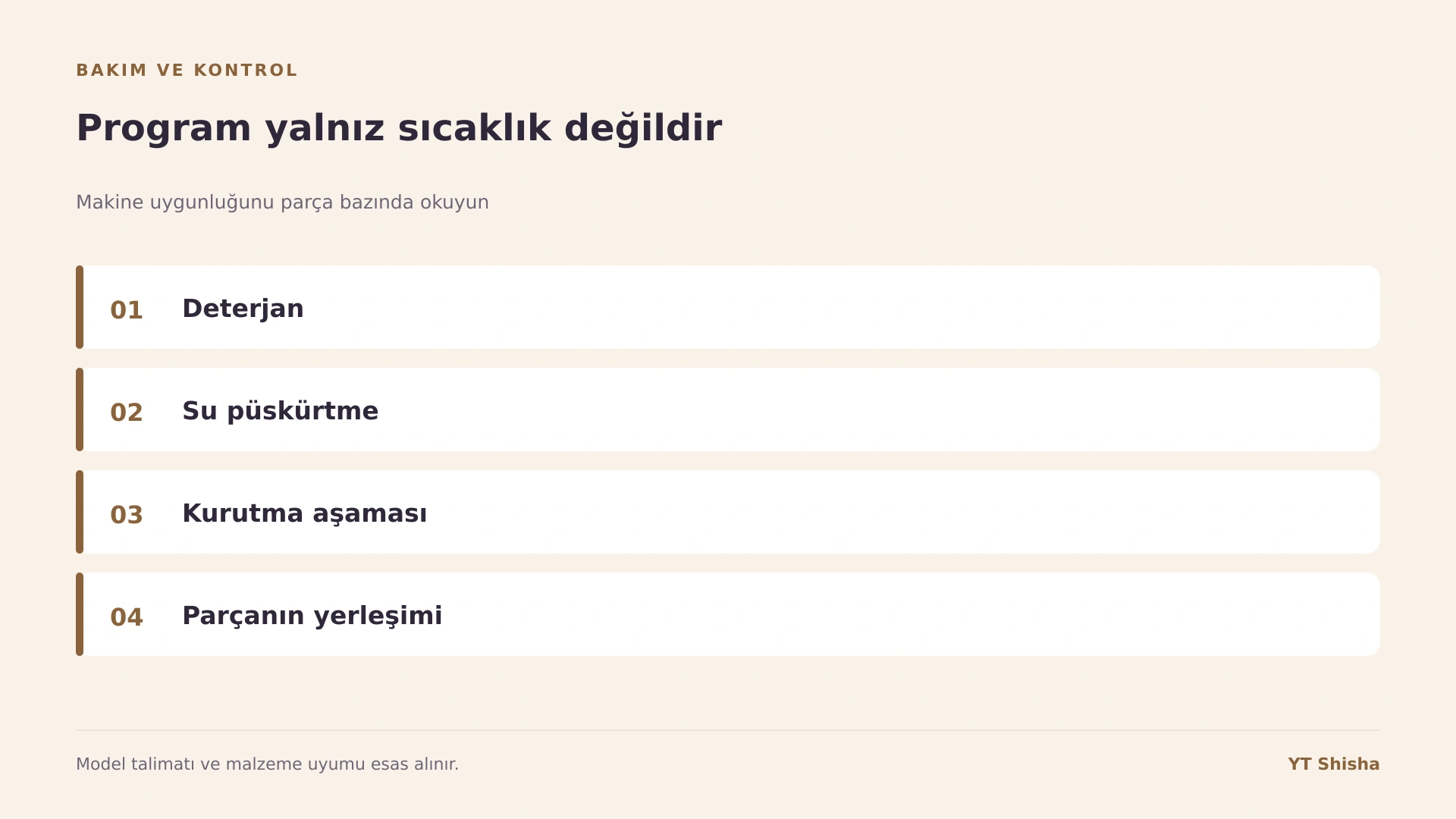
A dishwasher process includes detergent, water jets, and drying as well as temperature. Assessing a part by one temperature value is therefore insufficient. The manufacturer must clearly approve the detergent and program used. Someone else washing a same-colored part without problems does not provide verified information for your own model.
A short program does not eliminate every condition either. The part must sit securely inside the machine, avoid hitting other objects, and have unaffected connections. Without placement guidance, do not force it into a cutlery basket or between plate slots. Fitting inside a rack does not mean that position is suitable for its care.
Seek separate permission for patterns and finishes
The exterior of decorated glass may have a treatment different from the glass itself. Gilding, prints, and painted areas require separate assessment. Contact between the exterior pattern and water is not the same as exposure to dishwasher detergent and a wash cycle. Previous trouble-free hand washing does not establish dishwasher approval.
Finish information matters for metal sections too. Do not try another cleaner or program on a surface the manufacturer requires you to hand-clean. For example, Steamulation specifies hand cleaning and excludes dishwashers in its initial cleaning document for the relevant models. This document does not establish a rule for all brands; it is a limited example showing why model instructions are more decisive than general assumptions about materials.
What to do if it has already been washed in a dishwasher
Inspect the part’s current condition before treating it again. Look for decoration loss, cloudiness, color changes, loosening, or gasket deterioration. Do not expose a hot part to sudden temperature changes immediately after removing it from the machine. Wait for safe cooling and the assessment conditions specified by the manufacturer. Trying to polish the surface back to its old appearance should not be the first step.
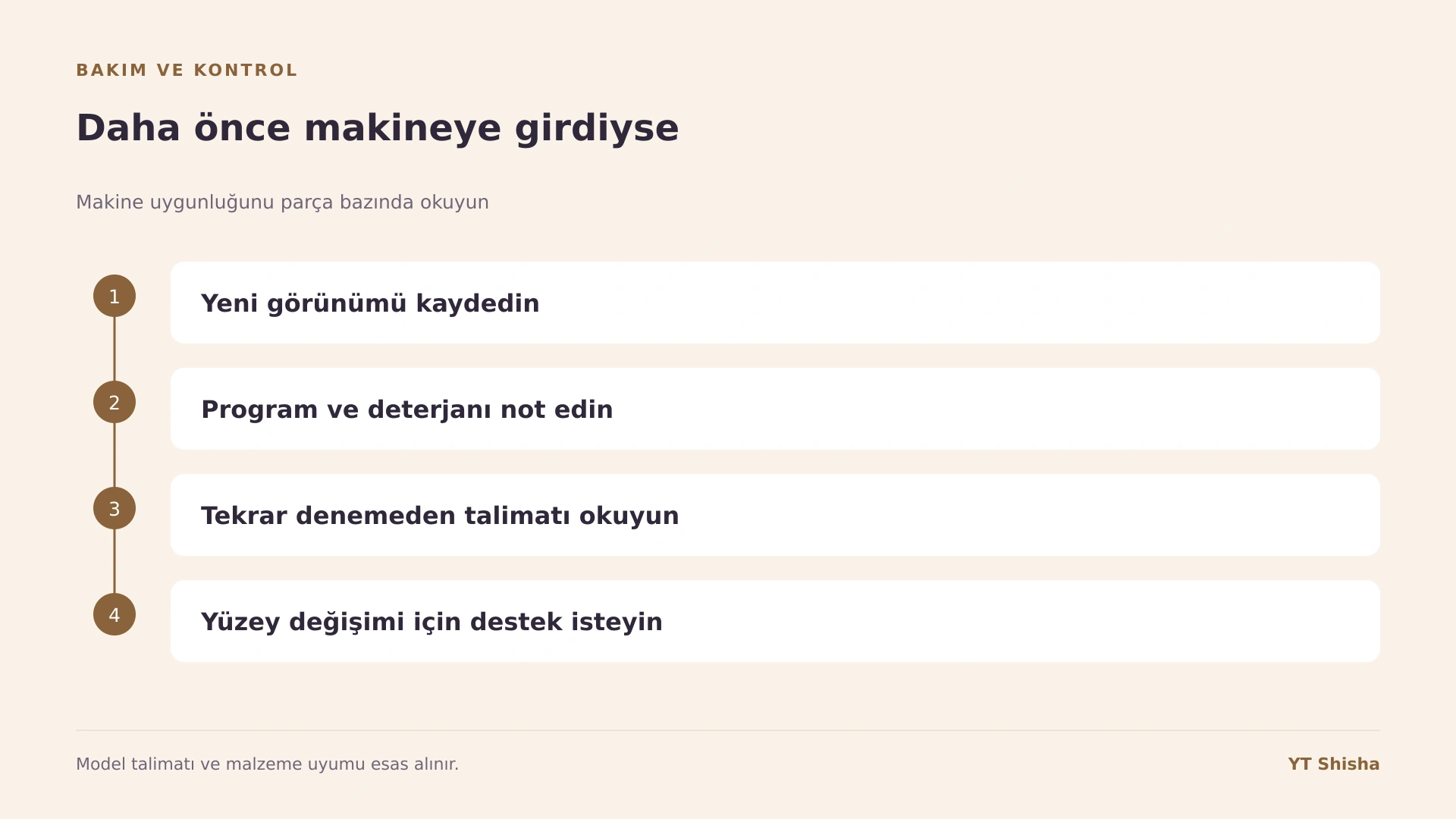
Record the program and detergent used. Even if no problem is noticed, this history may help assess changes that appear later. Find the model’s care instructions instead of trying another program. Do not conclude that the machine is suitable for all parts over the long term because there is no visible change; one treatment does not become approved durability information.
Verify the part's care information with the right source
Two parts that look alike are not necessarily suitable for the same care method. One may have paint on its outer surface while the other is uncoated. An added ring at a connection, hidden adhesive, or an inner layer that cannot be removed may also affect which method is appropriate. Do not decide based only on a photo, color, or the general name of the product range. Identify the specific model of the part and its production series, if available.
Look for the cleaning section in the user manual. Check whether it clearly states which sections can be separated, whether water contact is permitted, which cleaners may be used and how to dry the part. If a sentence refers only to the body, do not extend that permission to the hose, glass or decorated section. If the explanation is incomplete, set the part aside and request written information instead of guessing.
Include the model name, a photograph of the entire part and a close-up of the problem with your request for information. Also explain any previous treatment. Instead of simply asking how to clean it, ask specific questions such as whether this surface can be submerged, whether the connection should be disassembled and which products should be avoided. Keep the reply with the part's care notes.
Inspect visually without damaging the surface
No aggressive treatment is needed during inspection. Put the part on a stable surface, provide adequate light, and look from different angles. Do not scrape the surface to reveal a hidden detail. Testing with a fingernail, needle, or metal tip may create a new mark and make it harder afterward to distinguish which marks were originally present.
Photograph the entire part first, then the affected area. Using only an extreme close-up may make the mark’s location unclear. If a size reference is needed, hold a ruler nearby without touching the part. Do not feel the part by hand if breakage or sharp edges are suspected. Set up a calm work area where checking one section does not put stress on others.
Write observations separately from interpretations. Instead of declaring “definitely rust,” use a description such as “orange spot”; instead of “definitely mold,” use “dark area on the inner wall.” Add whether the change was noticed before or after cleaning. This does not minimize the problem. It conveys observed findings more clearly than a hasty diagnosis for an accurate assessment.
Follow the label when choosing a cleaner
Not every household cleaner is suitable for every part. A product that works on bathroom surfaces should not automatically be used on metal, decorated glass, or inside a hose. First read the part manufacturer’s instructions, then the cleaner’s intended applications. The two must be compatible. Reducing the quantity or shortening the exposure time is not a reliable solution for an application not described on the label.
Do not combine cleaners. If you think one product has not worked, do not pour a second product into the same container. In particular, bleach must not be mixed with other cleaners. Do not work in a container whose previous product is unknown. Do not transfer cleaning products to beverage bottles; keeping the original label visible helps prevent misuse and confusion.
Do not start if you cannot provide the ventilation and protective measures required by the label. Stop instead of trying stronger products on an unidentified stain. Reduced odor, lighter color, or a shiny surface alone does not prove the process is appropriate. Assess material compatibility, the ability to remove residue, and the part’s integrity before appearance.
Do not judge dryness by the outer surface alone
Moisture can remain in the internal cavities of a part that looks dry on the outside. The bases of connections, narrow channels and surfaces touching each other should be checked separately. Separating sections that the manufacturer allows you to detach makes this inspection easier. Do not force open a connection that is not meant to be opened just to make it dry faster. If it is unclear what to do with sections that cannot be disassembled, ask the manufacturer for guidance.
After rinsing, do not try to dry the part by shaking it, striking it against a hard surface or pulling its edge. Collect draining water in a suitable container and support the part so it cannot tip over. Leave it in a clean area with air circulation. Direct heat, a hair dryer or a radiator should only be considered if expressly permitted by the product's own instructions; they cannot be presented as general drying methods.
It is not appropriate to give a drying time that applies to everyone. The part's shape, internal volume and surrounding conditions vary. Instead of rushing, inspect visible areas again for droplets or pooled water. Do not put a part in a closed box if you are unsure about its interior. Keep the designated drying area clean too; leaving the part on a dirty cloth may mean having to start the completed process again.
Read the scope of a care instruction correctly
For example, suppose a manual says the exterior of the glass can be wiped with a damp cloth. This does not say the base can be washed in a dishwasher, metal parts tolerate detergent, or the hose can undergo a hot cycle. Preserve the instruction’s limits on parts and procedures. Prepare separate questions for gaps in the document. If the same document requires hand cleaning of the stem, do not treat a gentle program as an alternative. Without clear information, experimenting with a dishwasher is not a way to complete a missing manual. First clarify the permitted care, then determine which tools and setting suit it. Avoid assessing the result by shine alone.

Even if mild and fragrance-free, hand dishwashing liquid is not a dishwasher product and must not be used in a dishwasher. Even if the manufacturer permits hand use, this does not mean the part is dishwasher-safe; only the manufacturer can provide dishwasher approval. Laundry or dishwasher detergent is also unsuitable. Follow the label, do not mix with other cleaners, and after hand washing, rinse thoroughly and dry completely.
Frequently asked questions
Is putting in only the glass base safer?
Being glass alone is insufficient information. Decoration, previous repairs, cracks, and the glass’s own properties matter. Do not assume dishwasher suitability unless explicitly stated. Especially with decorative surfaces, consider preservation of the pattern and the part’s current integrity as well as stain removal.
Does a detergent-free cycle remove all risks?
No. Removing detergent does not eliminate uncertainties concerning temperature, water jets, drying, and part placement. Even the machine’s rinse-only function is not automatically suitable for the product. Its own manual must explain which procedures are permitted for each part.
Does dishwasher washing guarantee disinfection?
This cannot be claimed for every household program and every part. Fitting into the machine or completing a cycle does not prove that a part has undergone an approved disinfection process. Cleaning, disinfection, and material compatibility are separate issues. Do not give health assurances for a procedure outside the manufacturer’s care instructions.