




How to distinguish rust, tarnish, and peeling plating on a hookah

Summarize this article with AI
Discover the key points with your preferred tool.
The title, article link and text context are sent to your chosen tool.
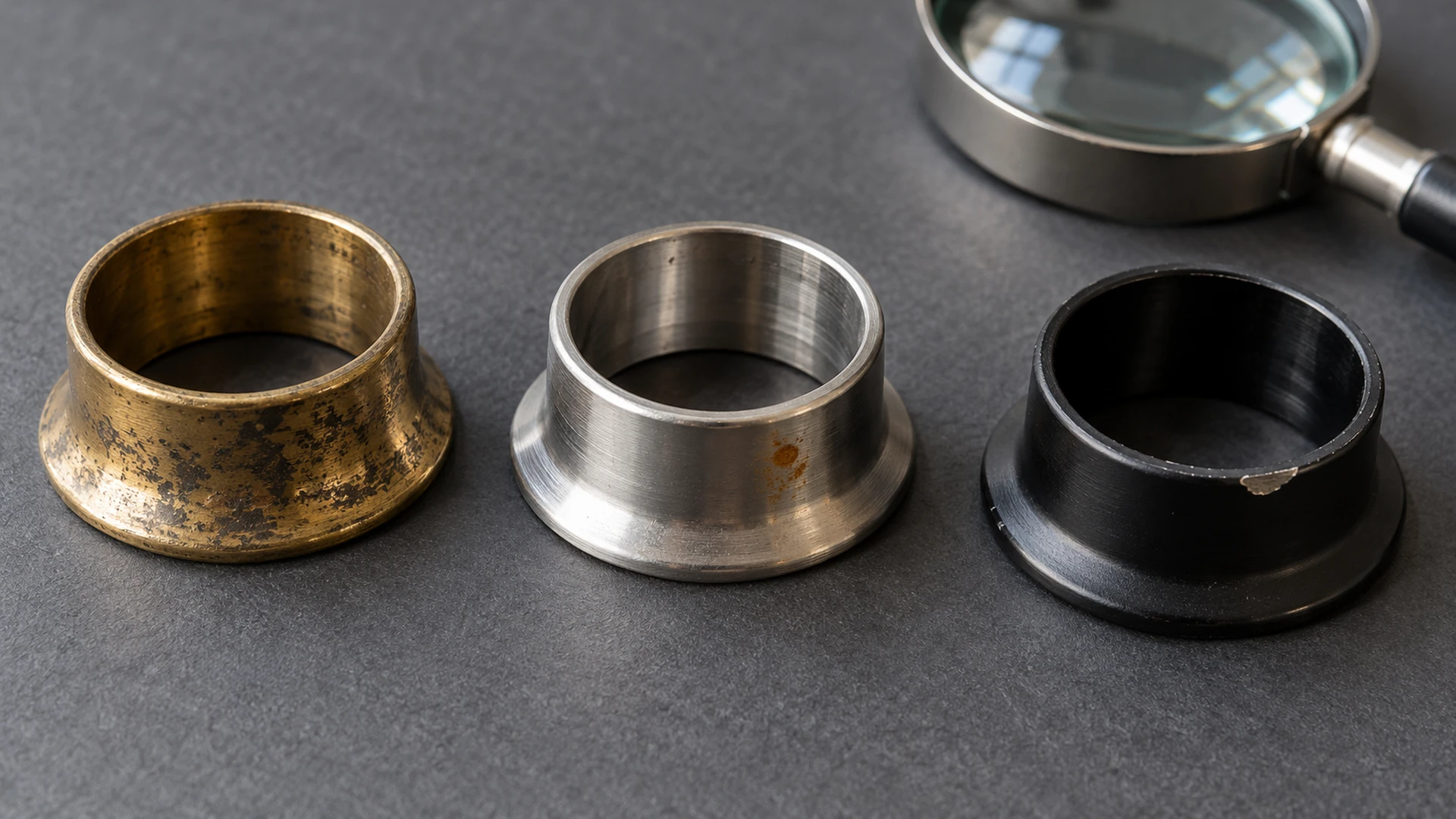
A color change on a hookah cannot be definitively identified as rust, natural tarnish, or plating damage from a photo alone. First identify the part’s material, the location of the change, and whether there is surface loss. If you see blistering, peeling, pitting, or particles coming off, do not proceed to polishing. Record the findings and request an assessment from the manufacturer; lightening the color does not verify the part’s integrity.
Distinguish color from material information
A gold-colored surface may not be brass throughout. A silver-colored part is not necessarily stainless steel either. Paint, decorative plating, and different alloys can create similar appearances. The first question is therefore what the part is, rather than which product removes the stain. Do not automatically apply the material in the set’s general description to every small connection.
The stem, tray, screws, and downstem may be made of different materials. A mark on the base neck may also be residue transferred from metal to glass. Clearly describe where the mark is. For example, do not treat exterior stem discoloration and particles coming off inside as the same maintenance issue. If you suspect damage internally, request an inspection without experimenting with chemicals at home.

Even tone changes and surface loss are not the same
A surface’s color may change over time. However, this does not mean every dark area should be considered normal. Check whether the color is evenly distributed, how distinct its boundaries are, and whether there is a new texture change. Do not scrape the surface to reveal the color underneath during inspection. Such an experiment may add new damage to the existing condition.
Do not consider polishing a solution, especially if there is blistering or lifting at plating edges. Gluing down a lifted area, painting over it, or evening out the entire surface are not maintenance steps to take before assessment. The part’s original surface information and damage location matter. Contacting the manufacturer with photographic records offers a clearer starting point than trying a random polish.
Orange and green marks alone are not a diagnosis
Although describing color helps explain the problem, it does not establish a definite cause. An orange area may be residue transferred from another metal part. A greenish mark may also have different meanings depending on the material and past treatments. Do not choose rust remover or acid directly from the color. First verify which part has the mark and what material that part is made of.
If you see roughness, pits, or loose powder beside the mark, record these separately. Document them with photos instead of testing by touch. You may not be able to reliably assess the source of particles at home, especially in a narrow internal channel. In such cases, separate the part and apply no further treatment until inspection is complete. Cleaning instructions for another surface do not resolve this uncertainty.
Why ask about previous maintenance treatments?
Surface changes are sometimes noticed immediately after cleaning. The product used, contact duration, and whether the part was previously plated are important. Concealing or vaguely describing the previous treatment makes assessment harder. Keep the product packaging and label. If multiple cleaners were used, write down their order too; do not try to recreate the situation by mixing them again.
Take a photo of the current condition before applying any new treatment. Every attempt may change the appearance of the original finding. Applying different products one after another makes it harder to determine which caused which change. Take care not to lose the treatment history while trying to remove the stain. An untouched photo may sometimes provide more useful technical support information than a subsequently polished surface.
Verify the part's care information with the right source
Two parts that look alike are not necessarily suitable for the same care method. One may have paint on its outer surface while the other is uncoated. An added ring at a connection, hidden adhesive, or an inner layer that cannot be removed may also affect which method is appropriate. Do not decide based only on a photo, color, or the general name of the product range. Identify the specific model of the part and its production series, if available.
Look for the cleaning section in the user manual. Check whether it clearly states which sections can be separated, whether water contact is permitted, which cleaners may be used and how to dry the part. If a sentence refers only to the body, do not extend that permission to the hose, glass or decorated section. If the explanation is incomplete, set the part aside and request written information instead of guessing.
Include the model name, a photograph of the entire part and a close-up of the problem with your request for information. Also explain any previous treatment. Instead of simply asking how to clean it, ask specific questions such as whether this surface can be submerged, whether the connection should be disassembled and which products should be avoided. Keep the reply with the part's care notes.
Inspect visually without damaging the surface
No aggressive treatment is needed during inspection. Put the part on a stable surface, provide adequate light, and look from different angles. Do not scrape the surface to reveal a hidden detail. Testing with a fingernail, needle, or metal tip may create a new mark and make it harder afterward to distinguish which marks were originally present.
Photograph the entire part first, then the affected area. Using only an extreme close-up may make the mark’s location unclear. If a size reference is needed, hold a ruler nearby without touching the part. Do not feel the part by hand if breakage or sharp edges are suspected. Set up a calm work area where checking one section does not put stress on others.
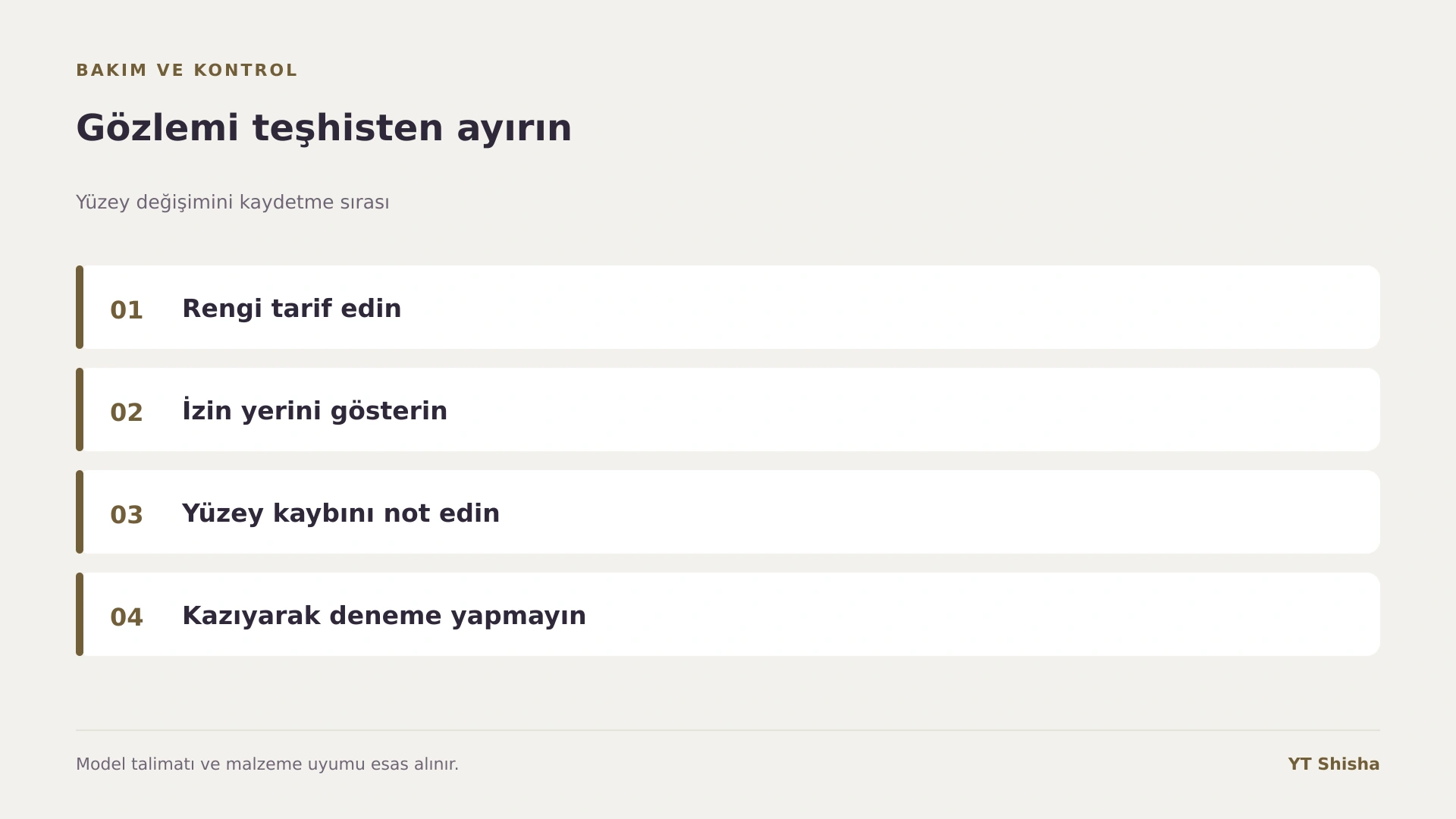
Write observations separately from interpretations. Instead of declaring “definitely rust,” use a description such as “orange spot”; instead of “definitely mold,” use “dark area on the inner wall.” Add whether the change was noticed before or after cleaning. This does not minimize the problem. It conveys observed findings more clearly than a hasty diagnosis for an accurate assessment.
Follow the label when choosing a cleaner
Not every household cleaner is suitable for every part. A product that works on bathroom surfaces should not automatically be used on metal, decorated glass, or inside a hose. First read the part manufacturer’s instructions, then the cleaner’s intended applications. The two must be compatible. Reducing the quantity or shortening the exposure time is not a reliable solution for an application not described on the label.
Do not combine cleaners. If you think one product has not worked, do not pour a second product into the same container. In particular, bleach must not be mixed with other cleaners. Do not work in a container whose previous product is unknown. Do not transfer cleaning products to beverage bottles; keeping the original label visible helps prevent misuse and confusion.
Do not start if you cannot provide the ventilation and protective measures required by the label. Stop instead of trying stronger products on an unidentified stain. Reduced odor, lighter color, or a shiny surface alone does not prove the process is appropriate. Assess material compatibility, the ability to remove residue, and the part’s integrity before appearance.
A care record makes the next decision easier
Keeping a record does not require a long form. A few sentences with the model name, the part inspected, the date and the changes observed are enough. Take before-and-after photographs from the same angle. Images taken under different lighting can exaggerate or understate color changes. Use a plain image showing surface detail instead of filters that make the photograph more attractive.
If you treated the part, record the exact name of the product used, which section it touched and how it was applied according to the manufacturer's instructions. If you waited for support without doing anything, record that too. This helps anyone inspecting it later distinguish a new problem from an old mark. If several people perform maintenance, keeping the record in a shared location where everyone can find it is useful.
At the next inspection, do not look only at the final photograph. Consider whether the affected area has expanded, whether similar marks have appeared elsewhere and whether the part encountered moisture in storage. These notes do not replace a technical diagnosis; they make the information request more specific. When needed, you can provide the manufacturer with an organized record clearly showing what was done instead of trying to recall the entire history.
A short example describing a finding
Imagine seeing a small orange area at the edge of a metal connection. Instead of recording “it rusted,” state the part name, mark location, and observed color. Check visually whether the area is raised; do not scrape it. If the part was left in the same container as another metal during its last cleaning, include that information. Send the manufacturer both an overall photo and a close-up so the affected connection can be identified. Wait for material and surface guidance instead of proceeding directly to rust remover because of the color. If the response recommends a specific treatment, also clarify whether it applies only to the exterior or to the entire connection.

Frequently asked questions
Is every stain on stainless steel rust?
No. Color alone cannot determine this. Assess the part’s material information, environment, and previous cleaning. The possibility of a mark transferred from another metal may also be impossible to distinguish definitively from the outside. Instead of abrading the entire surface before the stain’s source is known, request support with the material information.
Does polishing brass solve the surface problem?
Parlatma yalnız görünümle ilgili bir işlem değildir; yüzeye müdahale eder. Kaplamalı veya işlemeli bir bölüm için uygun olmayabilir. Daha açık renk elde edilmesi, parçanın sağlam olduğu sonucunu vermez. Bu yazı parlatma tarifi sunmaz; önce malzeme, yüzey ve bulgu ayrımının yapılmasını önerir.
Should I repair peeling plating at home?
Paint or adhesive cannot be recommended without knowing the surface and the part’s contact conditions. Covering damage may also make its progression harder to observe. Tell the manufacturer which section is peeling and request written guidance on whether maintenance, inspection, or replacement is needed.