

Hookah Grommets: Which Size, When to Replace, How to Fit

Summarize this article with AI
Discover the key points with your preferred tool.
The title, article link and text context are sent to your chosen tool.
A hookah grommet is a small flexible ring that prevents air leaks where two push-fit or threaded parts join; the right size is determined by considering the inner diameter and cross-section thickness measured with calipers together with the model's parts list. A grommet should be replaced when it shows cracking, hardening, flattening or moving around in its groove. A new grommet must also be seated in its own groove flat, clean and untwisted.
This guide describes a general measuring and care method; it doesn't give the exact grommet size for any particular model. The number, location and material of grommets can differ from set to set; your manual or the seller's parts information takes priority. Do all checks on equipment that is cold, empty and without charcoal. Don't take apart a connection that the manual doesn't allow users to open.
What does a grommet do on a hookah, and where is it?
On many models, parts join where metal, glass, ceramic or plastic surfaces meet. These surfaces don't seal perfectly on their own; the flexible ring between them fills small gaps. A compressed grommet keeps the air path from opening to the outside and helps direct the draw only to the hose end.
Where grommets are found varies by model; some sets have none at certain points. The list below gathers common examples and doesn't replace your own model's layout.
- Base neck and stem connection Some models use a ring or sleeve where the stem sits in the base.
- Bowl and heat management device connection There may be a grommet where the bowl fits onto the stem. Because this area is close to the heat, the material the grommet is made of matters even more.
- Hose adapter Some designs have one or two O-rings on the adapter at the hose port.
- Purge or valve cap Small valve assemblies may have a thin ring around the cap. For problems in this area, see the purge ball air leak guide is a useful reference.
Grommet types and materials
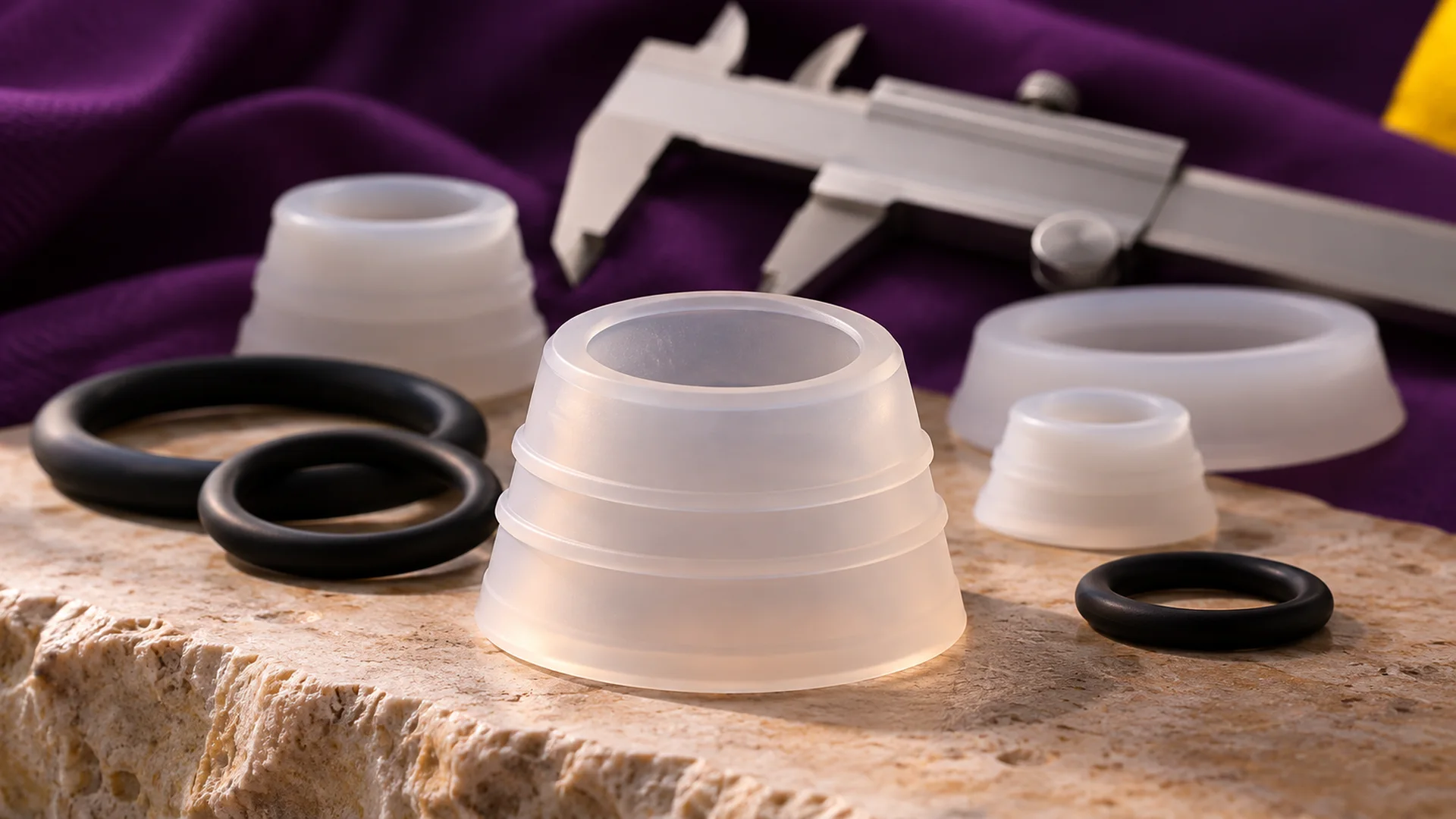
Most small rings are O-rings: round in cross-section and ring-shaped overall. Some parts use a flat gasket or a molded grommet bonded to the part instead. The part's own design determines which one suits which area.
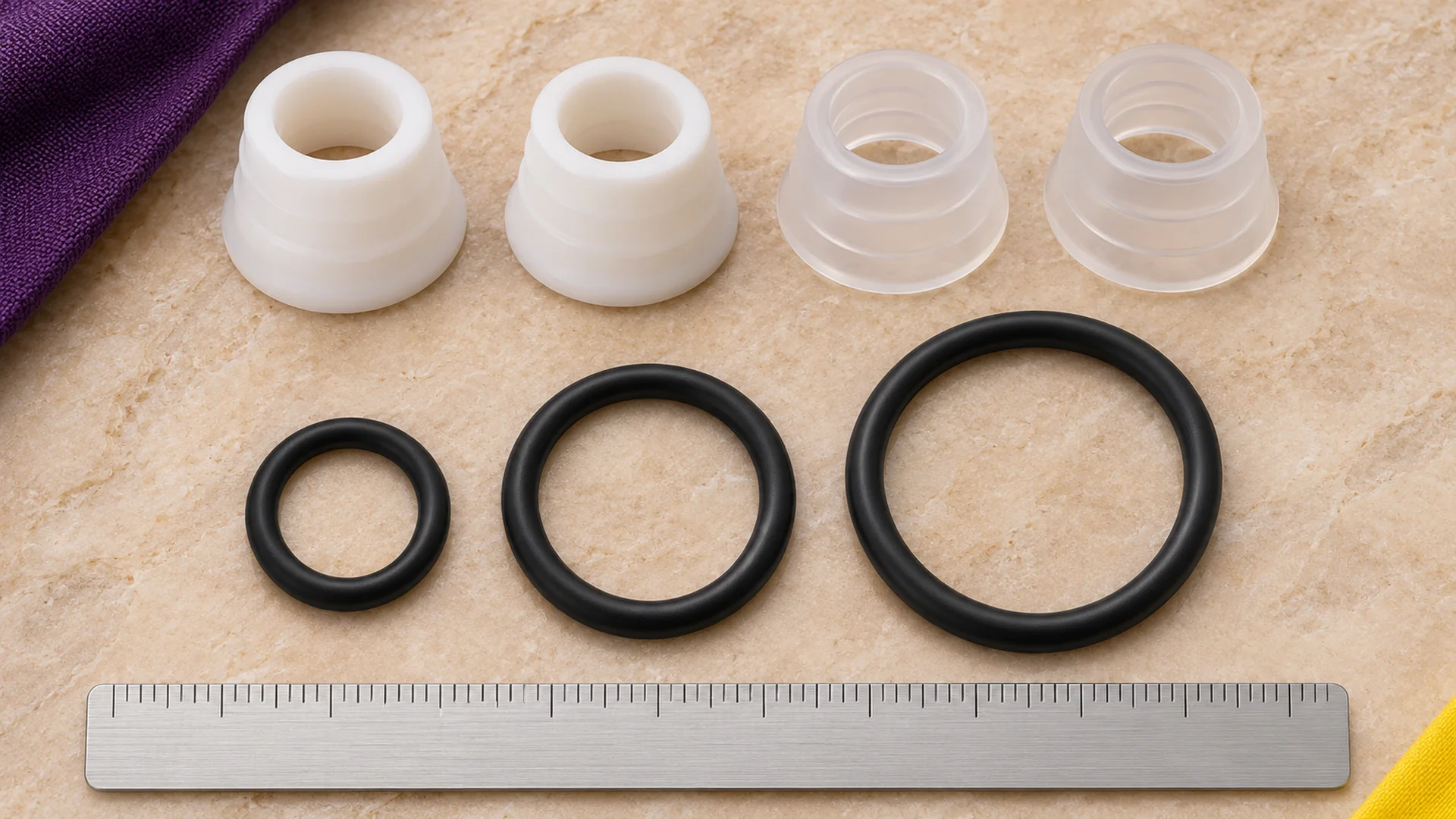
Silicone, nitrile (NBR), EPDM and fluoroelastomer (FKM) are commonly mentioned materials. General sources show they withstand environments such as heat, oil and water differently. The table below summarizes this general approach; it is not a model or brand comparison for hookah grommets.
| Material | General property | What to watch for |
|---|---|---|
| Silicone | Known for a wide temperature range and flexibility | Lower mechanical strength than nitrile and FKM; can be weak in contact with oil |
| Nitrile (NBR) | General-purpose rubber resistant to oil and fuel | Can have problems with ozone and some solvents |
| EPDM | Common for water, steam and outdoor use | Can swell noticeably with petroleum-based oils |
| FKM (Viton type) | Resistant to high temperatures and many chemicals | Usually more expensive; not necessary for every hookah part |
You can't tell the material of the grommet in your hand for certain from its color or texture. If the parts list states the material, go by that. If it doesn't, instead of guessing the material, ask the seller for the right replacement part for your model. You can browse ready-made options Gaskets and Spare Parts page.
How do you determine grommet size?
An O-ring is defined by three values: inner diameter (ID), cross-section (CS, the thickness of the ring's cord) and outer diameter (OD). The outer diameter isn't measured but calculated: outer diameter = inner diameter + 2 × cross-section. For example, a ring with a 10 mm inner diameter and a 2 mm cross-section has an outer diameter of 14 mm; this example is only given to show the calculation.
For measuring, digital or vernier calipers are much more reliable than a ruler. Measure the ring without squeezing or stretching it; a stretched ring's cross-section can read thinner than it really is. Because a worn ring may not be perfectly round, it helps to measure the cross-section at several points and take the average.
- Take the part apart while it's cold and empty, and place the grommet on a clean, dry surface.
- Lay the ring flat and read the inner diameter with the calipers' inside jaws without stretching it.
- Measure the cross-section at three different points with the calipers' outside jaws without crushing the ring, and take the average.
- Calculate the outer diameter with the formula; if needed, also measure it from the outside as a check.
- Also check the width and depth of the groove; the grommet should fit into that groove without spilling over.
- Compare your measurements with the information in the product description and the parts diagram.
The value you measure on an old, worn grommet may not be exactly the same as the new part's value. Sources state that the replacement should be chosen by the nearest standard size, not by the measured value. A ring that doesn't match the size may not compress enough or may twist in its groove. For glass base and stem measurements, the replacement glass size compatibility guide, and for Russian-style bases, the Russian Replacement Bases page can help.
Signs of wear, when to replace and a troubleshooting table
There's no universal schedule for a grommet's lifespan; how often you use it, how you clean it and how close it is to heat all affect it. So instead of saying “replace it every so many months,” it's better to check it by eye and by touch every time you take it apart. Check the part only when it's cold and empty; touch parts around the bowl and the heat management device only after they've fully cooled.
- Flattening If the ring looks like an oval with flattened sides instead of a circle, it may have lost its elasticity. Technical sources call this compression set.
- Crack or tear If there's a fine crack, a cut or a torn edge on the surface, the grommet may no longer seal reliably.
- Hardening or softening Heat and chemical exposure can harden or soften the ring.
- Swelling or stretching A ring that no longer fits its groove as before, or that curls and spills over, may have come into contact with an incompatible substance.
- Moving around If it sits loosely in its groove, there may be a size or wear problem.
The main causes of compression set include overtightening, high temperatures and incompatible fluids. That's why pressing the grommet firmly into place can create a new problem. The table below shows how likely it is that the problem comes from the grommet; on its own it is not a definite diagnosis.
| Observed problem | Possible grommet cause | First check |
|---|---|---|
| Air noise from a connection or a weak draw | Flattened, cracked or dislodged grommet | Whether the grommet is in place, and any damage |
| Extra resistance when fitting the part | Twisted or overflowing grommet | Whether the ring sits flat in the groove |
| The part never tightens or stays loose | Wrong size or thickness | Inner diameter and cross-section measurement |
| Leak or wetness | Worn-out grommet or incorrect seating | Cleanliness of the surface and grommet condition |
| Draw that changes suddenly after cleaning | Grommet that shifted during refitting | The part's layout and diagram before disassembly |
The table only lists possibilities; the problem can often be at a connection other than the grommet. To check the connections one by one, the air leak check order guide offers a broader framework. Before replacing the grommet, also check the part's surface for scratches, burrs or residue.

How do you seat it in the right groove?
A grommet is usually designed for its own channel or groove; fitting it in another area can upset how the connection fits. Before fitting, wipe the groove with a soft, dry, lint-free cloth. If there's limescale, residue or small debris in the channel, the grommet won't seat properly.
- Check the ring by eye and by touch; don't use it if it has a cut or crack.
- Place the grommet in its groove with one smooth motion; don't stretch it too much.
- Check that the ring isn't twisted and doesn't rise up out of the channel anywhere.
- Bring the mating part in along its axis, without tilting or forcing it.
- On a threaded connection, start the threads by hand; if it won't go on, don't force it, and see the cross-threading check for more.
- After assembly, still look the connection over for leaks while it's empty and cold.
Overtightening can flatten the grommet, which soon leads to a new leak. If the manual describes a tightening pattern, follow it. Pressing the grommet into its groove with a sharp tool can cut the ring.
Warnings about oil, chemicals and storage
Don't lubricate the grommet unless the manufacturer allows it. The wrong lubricant can make the ring swell or soften, which usually makes the problem worse rather than fixing it. According to technical sources, petroleum-based oils and solvent-based products like WD-40 can cause noticeable swelling, especially in EPDM. Sources disagree on using silicone grease on silicone grommets, so the manufacturer's instructions are the deciding factor.
Washing the grommet with bleach, strong solvents, acetone or abrasive cleaners can damage the material. For cleaning, stick to warm water and a gentle cleaner; to see which chemicals should not be mixed, check the hookah cleaning chemicals guide for details. Dry the grommet completely after washing it.
For storage, keep the grommet in a clean, dry place away from direct sunlight and heat sources, without stretching or bending it. Store spare grommets in a small closed box, labeled with the model they belong to. For sets stored for a long time, refer to the long-term storage guide for details.
Quick decision guide: replace, refit or ask
- Refit If the grommet is intact, clean and untwisted, it can be carefully reseated in its groove and tried again.
- Replace If you see flattening, cracks, cuts, hardening or permanent swelling.
- Recheck the size If the new grommet won't fit into the groove or moves around.
- Look elsewhere If the grommet looks intact and the leak continues, check the other connections.
- Ask for support Share the model, a photo of the part and the measurements.
Frequently asked questions
Can I choose a grommet size without measuring with calipers?
It may be possible, but guessing leads to the wrong part. If the model's parts list or the seller's information is available, check those first. If not, take the inner diameter and cross-section measurements and send them to the seller.
When should a hookah grommet be replaced?
There's no fixed interval. Replace it when you see flattening, cracks, hardening, swelling or leaks. How often you use it and how close it is to heat change the interval.
Does lubricating the grommet improve the draw?
Don't lubricate it unless the manufacturer's instructions say to. The wrong lubricant can make the ring swell. Cleaning the connection surface and seating the grommet in the right groove is usually a safer first step.
Can I use a grommet that looks the same from another hookah?
Looks don't guarantee a fit. Rings that look the same can have a different inner diameter, cross-section or material. Confirm the size first and check model compatibility with the manufacturer or seller.
What should I do if a newly fitted grommet still leaks?
Check that the grommet isn't twisted and sits flat in its groove. Make sure there are no scratches or residue on the surface. If the problem continues, check the other connections one by one.
Sources and scope
This guide provides general information; your model's manual and the seller's parts information take priority. For the measuring method, the Delta Rubber O-ring measuring guide; for lubricant compatibility, the O-Ring Supply Co. lubrication guide; and for definitions of wear and compression set, the Barnwell O-ring failure guide were reviewed. These sources describe industrial O-rings and don't apply directly to hookah models; the tables are general summaries prepared for this article.