

Hookah Diffuser and Airflow: Choosing for a Quiet, Balanced Draw

Summarize this article with AI
Discover the key points with your preferred tool.
The title, article link and text context are sent to your chosen tool.
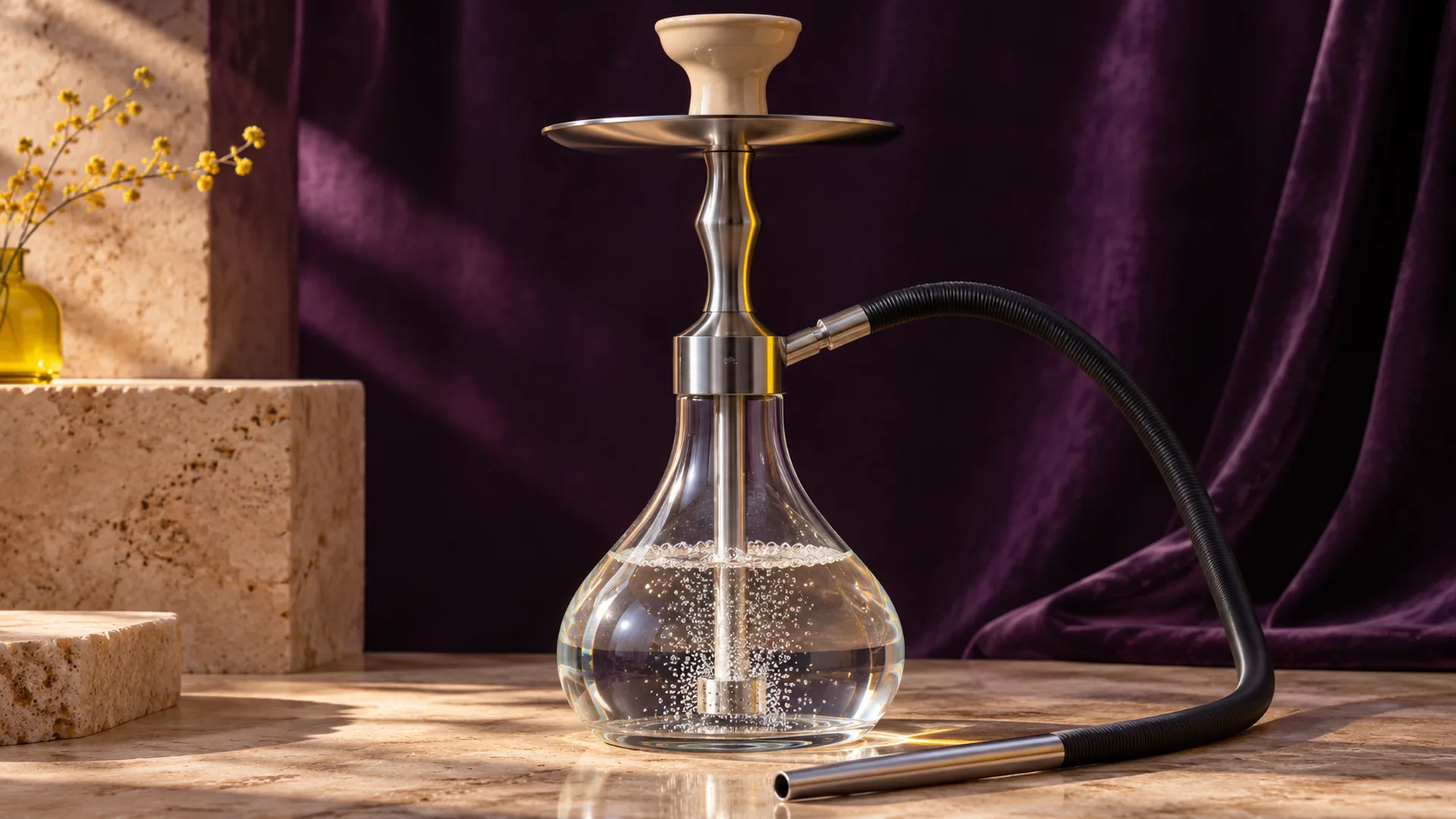
A hookah diffuser is the part at the submerged end of the downstem that splits the air into many small bubbles instead of one large one. It reduces the bubbling noise and can make the draw feel smoother. For a quiet, balanced draw, don't look at the diffuser on its own; consider it together with the downstem diameter, water level, base volume and how well the connections seal.
This guide explains how a diffuser works, the parts that make up a hookah's airflow path, diffuser types, the effect of water level and what to look for when choosing a stem. It makes no claim that a diffuser increases smoke volume or flavor; sources disagree on this. For a specific model's measurements, see the technical information on the product page.
What is a hookah diffuser and how does it work?
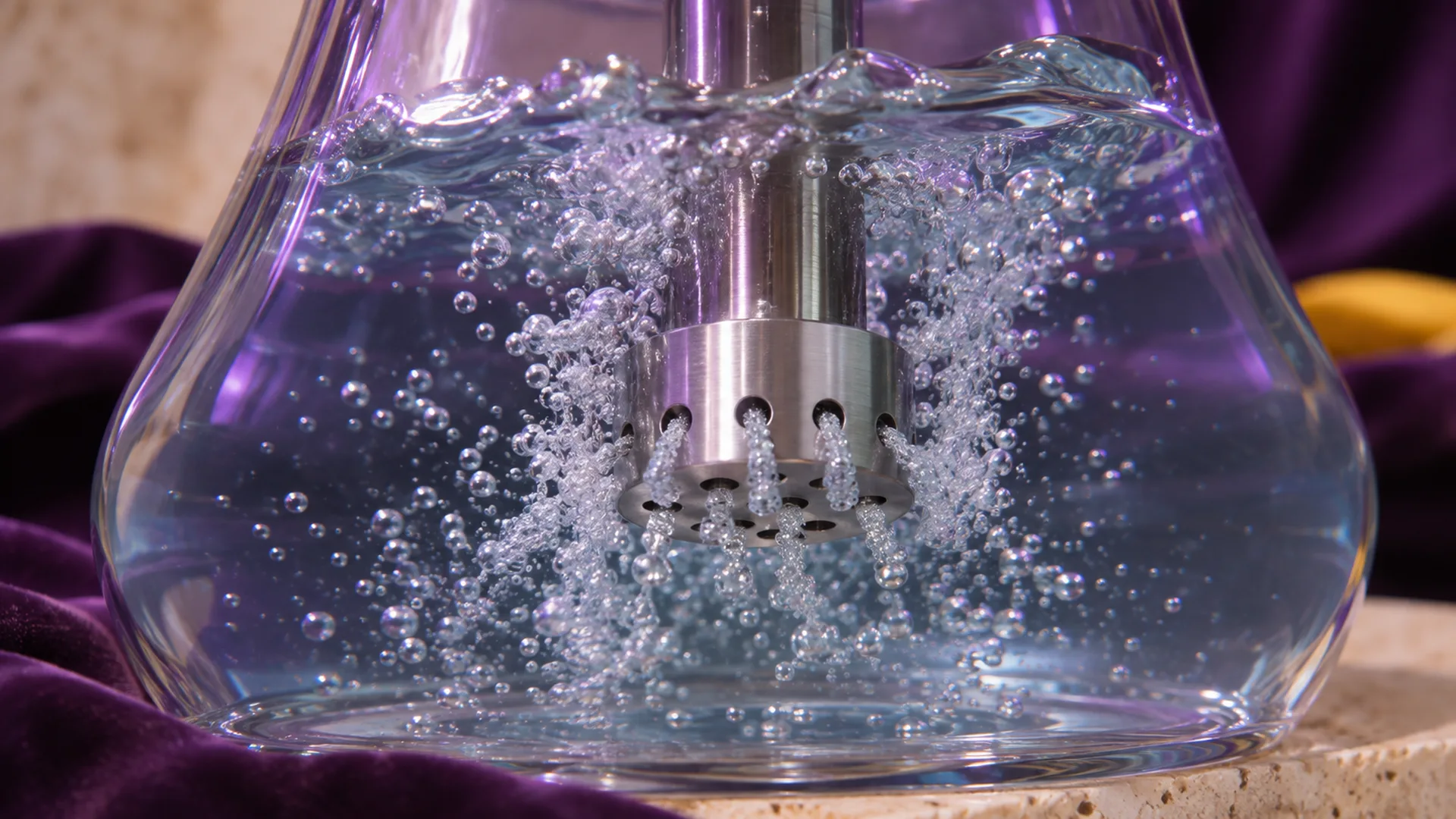
In a hookah, air enters through the bowl, passes through the stem and downstem and goes down into the water in the base. It rises from the water as bubbles, fills the space at the top of the base and reaches you through the hose. With a downstem that has no diffuser, air leaves the single open end of the tube as large bubbles, which creates a noticeable bubbling sound and a vibration you can feel in the draw.
A diffuser is a part with many small holes that is fitted to the end of the downstem or built into the stem. By forcing the air through these holes, it splits a single stream into many small bubbles. As a result, the noise drops and the draw feels smoother.
- Noise Sources agree that a diffuser reduces bubbling. However, as one vendor also notes, it does not make the hookah completely silent.
- Feel of the draw The pulsing feel created by large bubbles is reduced. Some users like that feel; a diffuser is not a must-have part for everyone.
- Smoke and flavor Sources disagree on this. Some say small bubbles cool the smoke better, while others say a diffuser only affects noise and the feel of the draw. What really determines smoke volume is the bowl, heat management and tobacco.
The parts that make up the airflow path
Whether the draw is light or heavy depends on the narrowest, most restrictive point in the airflow path. The diffuser is only one link in that path. You can think of the airflow path from start to finish like this:
- Bowl holes The bottom holes or center hole of the bowl are the first place air passes through. A hole that is clogged or covered by packing affects the whole draw.
- Stem inner channel The diameter of the channel running from the bowl to the downstem and the cleanliness of its inner surface matter.
- Inner tube The inner diameter of the downstem and how deep it sits in the water determine the resistance.
- Diffuser The number of holes, their diameter and whether they are clean can add extra resistance.
- Base headspace The volume of air above the water level is where the smoke collects.
- Hose port and hose A narrow port or a kinked hose makes the draw harder.
For example, even on a set with a wide downstem and a clean diffuser, the draw will feel heavy if the bowl holes are covered by packing. Conversely, if the bowl and downstem are clear but there is an air leak at the hose connection, the draw gets lighter but the smoke gets weaker. That's why you should check the other links in the chain before replacing the diffuser.
This order also shows you where to start when you run into a problem. For the general logic of airflow, see our hookah airflow article is a useful reference.
Diffuser types and how they attach
Diffusers are categorized by material and how they attach. Once mostly plastic, these parts are now also made of silicone and metal. The main difference is how they connect to the stem.
| Type | How it attaches | Advantage | Caution |
|---|---|---|---|
| Built into the stem | Attached to the downstem by the manufacturer | No extra part needed | Cleaning access varies by model |
| Removable, threaded | Screws onto the end of the downstem | Can be removed for cleaning | Thread design is model-specific |
| Adjustable | Comes with the stem; the adjustment method varies by model | The feel of the draw can be customized | The adjustment method is in the model's manual |
| Push-on (added later) | Slides onto the end of the downstem | Can be added to a stem without a diffuser | Downstem tip diameter and base opening must match |
On Russian-style hookah sets, the diffuser often comes as part of the stem. In the Russian hookah sets category on our site, some model descriptions specifically mention a removable, threaded or adjustable diffuser. If you want to add a diffuser to a classic stem later, you can look at YT Shisha's plastic diffuser that fits onto the end of the downstem; before fitting it, check the outer diameter of the downstem tip and whether the diffuser will pass through the base opening.
A push-on diffuser can make the downstem slightly longer. This small difference changes both the water level and the distance from the downstem to the bottom of the base. Measure the length before fitting it.
Water level and submersion depth
A diffuser's effect can't be considered separately from the water level. General sources say the downstem should be submerged only a few centimeters and that deeper water makes the draw harder. With a diffuser, measure from the diffuser's holes, not from the end of the tube. If the holes sit too deep, the draw becomes unnecessarily heavy.
- Assemble the set cold and empty Fit the stem onto the base and check where the downstem, and the diffuser if there is one, sits inside the base.
- Add water little by little Add enough water to cover the diffuser holes; don't fill it all at once.
- Take a test draw without charcoal With the bowl empty, draw gently from the hose. If the draw is very heavy, remove a little water; if it's very light and noisy, add a little.
- Keep enough headspace As the water level rises, the volume of air left at the top of the base shrinks and the chance of water splashing into the hose increases.
- Note the level Remember the level you're comfortable with using a reference point on the base, and fill to the same point each time you set up.
If water comes up the hose even though the base isn't overfilled, the problem may not be the level alone. Work through the guide to water coming through the hose checks in order.
Choosing a stem for a quiet, balanced draw
When choosing a new set, think of the diffuser as a feature of the stem rather than an accessory. The questions below show where to look when reading a product page.
- Is there a diffuser? Does the description mention a diffuser? Is it removable, fixed or adjustable?
- Cleaning access Can the diffuser and downstem be separated for cleaning? Keeping the holes clean takes more effort on fixed parts.
- Downstem and base fit Is there enough room between the downstem length and the base's inner height to adjust the water level?
- Vase capacity A wide base leaves more headspace at the same water level. On small bases, setting the water level takes more precision.
- Connection seal On a set with an air leak, a diffuser won't have the expected effect. The condition of grommet and threaded connections also affects the draw.
Steel Hookah Sets — when choosing among these, if the description doesn't mention a diffuser, judge whether you could add one later by looking at the downstem tip diameter and the base opening. For other factors that affect smoke density, the big-cloud hookah sets page explains the diffuser's role together with the bowl and heat management. You can see all options on the hookah sets category.
There is also a difference in approach between classic and modern stems. On Kahveci sets, check the product description to see whether there is a diffuser; if the stem allows it, a diffuser can also be added later. On modern stems, the diffuser is often treated as part of the design. Whichever you choose, having a diffuser you can reach for cleaning is the most practical way to keep the draw balanced over the long term.

Noise, heavy draw and water in the hose: checks by symptom
When you notice a change in the draw, identify the symptom before replacing any parts. The table below summarizes the order of checks for the most common symptoms.
| Symptom | Possible cause | First check |
|---|---|---|
| Bubbling is very loud | Diffuser missing, loose or fallen off | Check that the diffuser is in place and tight |
| Draw is heavier than before | Diffuser holes clogged, water level too high | Clean the holes and reduce the water slightly |
| Draw changed after cleaning | A part was fitted wrong or left out | Check by following the disassembly order in reverse |
| Draw is very light, smoke is weak | Air leak or low water level | Check the connections and the purge valve |
| Water comes up the hose | Too little headspace, water sloshing | Assess the water level and base size |
If the draw got heavier after cleaning, our post-cleaning draw guidecan help, and if you can't locate a leak, our air leak check order guide walks you through it step by step.
Cleaning the diffuser
The diffuser's small holes clog easily with tobacco molasses, limescale and residue. Contrary to what you might expect, a clogged diffuser makes the draw heavier. That's why the diffuser should also be part of your weekly maintenance.
- Make sure the set has cooled down and empty the water.
- Detach a removable diffuser from the downstem; on threaded models, turn it without forcing the threads.
- Soak the diffuser in warm water, then clean inside the holes with a small brush.
- Hold the holes up to the light to check that they are clear.
- Dry it completely, refit it and check the water level again the first time you use it.
On stems with a fixed diffuser, clean the downstem with plenty of water and a suitable brush inside the tube. In areas with hard water, you may need to check the holes for white buildup more often.
Frequently asked questions
Does a diffuser make a hookah completely silent?
No. A diffuser reduces bubbling by splitting large bubbles into small ones, but it doesn't eliminate the noise entirely. The water level and how well the connections seal also affect the noise.
Does a diffuser increase the amount of smoke?
Sources disagree on this. What really determines smoke volume is the bowl, heat management and tobacco. It's more realistic to think of a diffuser in terms of noise and the feel of the draw.
Can a diffuser be fitted to any hookah?
No. A diffuser added later has to fit the downstem tip and pass through the base opening. Don't decide without measuring the outer diameter of the downstem tip and the inner diameter of the base opening.
Why did the draw get heavier after I fitted a diffuser?
The diffuser may have made the downstem longer and pushed the holes deeper into the water. Try removing a little water. If the problem continues, check that the holes are clean and clear.
Is it wrong to use a hookah without a diffuser?
No. Some users prefer the sound of large bubbles and the distinct feel in the draw. A diffuser isn't a requirement; it's a part chosen based on your preference for noise and draw.
Sources and scope
This guide explains the general working logic of a hookah diffuser and airflow path; it does not guarantee the measurements, noise level or draw resistance of any specific model. Information on water level is taken from general sources and varies from set to set. Do all disassembly, cleaning and adjustment on a cold set with no charcoal. Hookah is a tobacco product and is not sold or served to anyone under 18.
Sources reviewed: Hookah.com diffuser article, Smokedex diffuser glossary entry and Wikipedia, Hookah— the first two are vendor or sales-linked content and may highlight their own products.