

Hookah Set Care: After Every Use, Weekly and Monthly Schedule

Summarize this article with AI
Discover the key points with your preferred tool.
The title, article link and text context are sent to your chosen tool.
Hookah set care is planned in three layers: after every use, empty the water, rinse and dry; weekly, clean the downstem, base, bowl and diffuser with a brush; monthly, check the grommets, purge valve ball, connections and surface. Shorten or lengthen the intervals according to how often you use it.
This guide is designed to help you tie care to a schedule instead of leaving it to memory. It lists step by step what to do to which part at each layer, what to watch for depending on the material, and what to do before and after a long break. It does not replace the manual for a specific model; if your manual recommends a different method, follow it.
Why follow a schedule for hookah set care?
Residue builds up slowly in a hookah set. The water in the base, the inner surface of the downstem, the bowl and the diffuser holes get a little dirtier with every use; the problem is usually noticed when the draw gets heavier or the smell changes. By then, cleaning takes longer. Short, regular steps limit this buildup before it starts.
The schedule should be adjusted to how heavily the set is used. A common approach in seller sources is this: for a set used every day, deep cleaning once a week; for a set used once or twice a week, every few uses; and for a set used occasionally, before a long break. These intervals are starting points, not strict rules.
- Heavy use Every day or more than once a day. Do not skip the weekly steps, and consider moving the monthly check to every two weeks.
- Regular use A few times a week. The schedule can be followed as is.
- Occasional use A few times a month. Do the after-use steps in full every time; you can combine the weekly cleaning into a single session after each use.
What to do after every use
These steps take a few minutes and form the basis of the schedule. Skipping a daily step makes the weekly cleaning harder.
- Remove the charcoal safely Move the burning charcoal into a non-flammable container with tongs. Do not touch the bowl, heat management device or tray with your hands until they have cooled completely.
- Empty the water right away Water left standing in the base leaves smell and residue. Once the set has cooled, separate the stem from the base and pour out the water.
- Rinse the base and downstem Rinsing with lukewarm water loosens most residue. Do not expose the glass to sudden temperature changes.
- Handle the hose according to its type A washable silicone hose can be rinsed with water; traditional non-washable hoses should not get wet, so just blow air through them and set them aside. For details, see our guide on whether a hookah hose can be washed for more.
- Dry Lay the parts on a soft cloth where air can reach them. Leaving the downstem upright to drain makes this easier. For methods, see our guide to drying hookah parts for more.
Once the set has cooled, also empty the ash from the tray and heat management device. When ash and charcoal residue mix with moisture, they can leave stains on metal surfaces. Removing the burnt tobacco left in the bowl on the same day also makes the bowl easier to clean during weekly care.
Putting damp parts back together and storing them traps moisture at the connection points. Reassemble the set only after all parts are dry.
Weekly care
The goal of weekly care is to remove residue that rinsing does not, using a brush and a suitable cleaner. Take the set apart completely and handle each part separately.
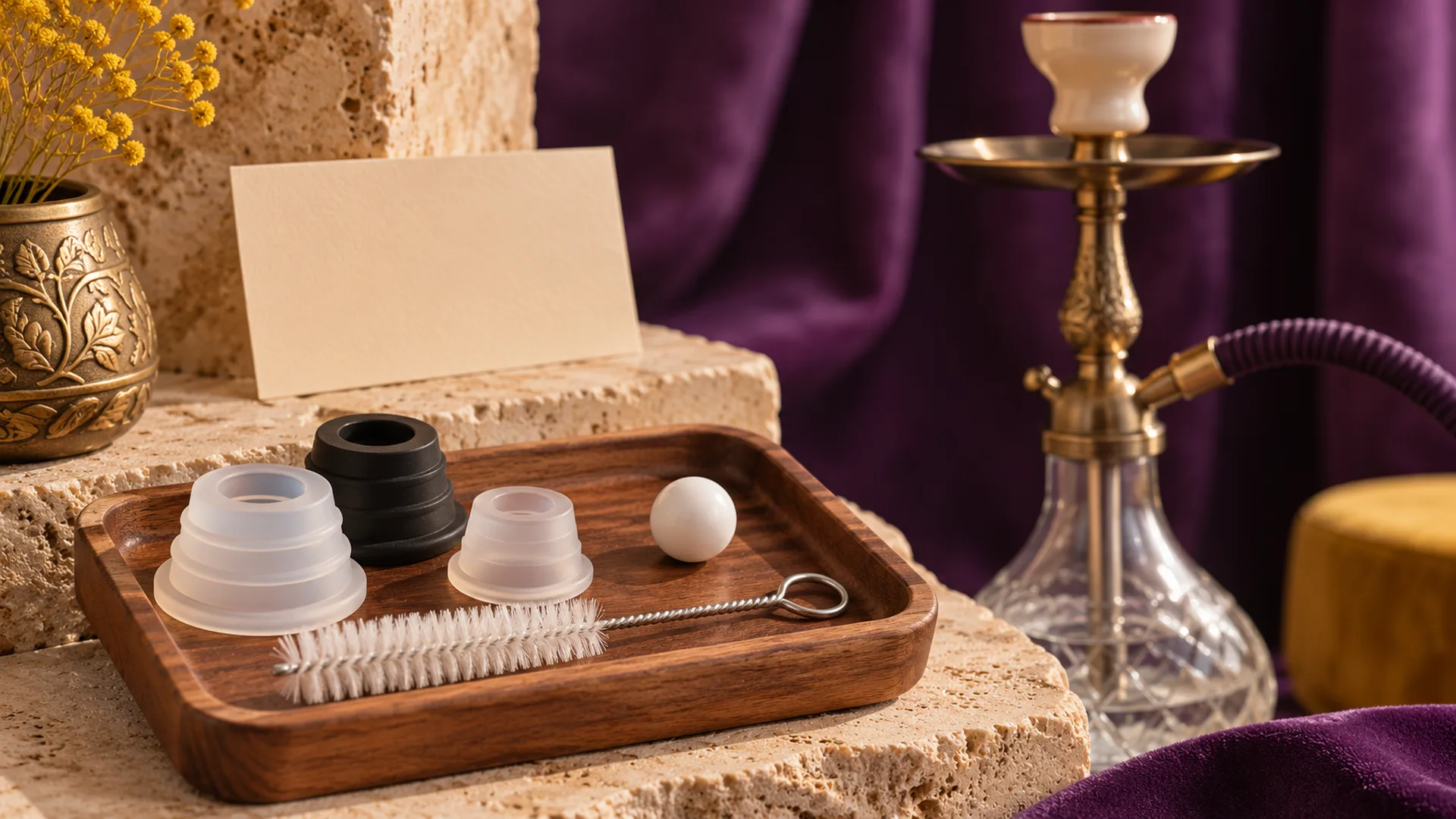
- Downstem and stem channel Clean the inside of the downstem with a long brush. Choose a tool long enough for the stem’s inner channel; the YT Shisha stem cleaning rod is a long cleaning tool designed for this job.
- Bottle Clean the inner surface with a flexible brush. If a white layer has formed, it is usually limescale; to remove it, see our guide to cleaning limescale from a hookah base for more.
- Bowl Clean it with a method suited to the bowl’s material. Glazed surfaces need a soft sponge; hard tools can scratch the glaze.
- Diffuser Because the holes are small, residue clogs them easily. If it can be removed, take it out, soak it in lukewarm water and open the holes with a small brush.
- Eviction Remove the ball without losing it, and clean the sticky residue in its seat with a small brush or cotton swab.
Be careful when choosing a cleaner. Seller sources describe lemon juice or vinegar with lukewarm water as a common option. Bleach only comes up in special cases such as mold, and it must never be mixed with vinegar or any other acid, because the mixture creates toxic gas. The the hookah cleaning chemicals guide explains separately which products should not be used together. After weekly cleaning, rinse the parts with plenty of water until no cleaner smell remains.
Monthly checklist
The monthly check is not a cleaning but an inspection. Take the set apart, examine the parts one by one in good light and note what you see.
- Grommets Is there cracking, hardening, flattening or slipping in its seat? A grommet that has lost its flexibility leads to air leaks and loose connections.
- Purge ball Is the ball in place, does it sit properly in its seat, is it sticking?
- Connections Does the bowl sit straight? Does the stem connect to the base without wobbling? Do threaded connections turn without forcing?
- Bottle Is there a crack or scratch in the glass, or a chip on the rim? Do not use a cracked base.
- Bowl Is there cracking or loss of glaze? Do not keep using a damaged bowl.
- Hose Is there a lasting smell or discoloration in a silicone hose, or moisture or smell inside a traditional hose?
- Outer surface Is there tarnish on brass, stains on steel or peeling on a coating? Record the condition with a photo.
If you find a worn part during the check, do not leave it for the next step in the schedule. For small spares such as grommets and purge valve parts, check the grommets and spare parts category and confirm from the size information on the product page that the size fits your set. If you need to replace a hose that holds a lasting smell, choose one from hookah hoses that fits your set’s port type.

Care schedule table
You can print the table below and keep it next to your set, or save it as a note on your phone. The intervals are suggested for regular use; shorten them for heavy use. Setting a recurring reminder on your phone for the weekly and monthly steps keeps the schedule from being forgotten. If you note the changes you see during the monthly check along with the date, over time you will also see how long it takes for a part to wear out.
| Frequency | Part | Task | Note |
|---|---|---|---|
| Every use | Bottle | Empty the water, rinse, dry | Do not leave water standing in the base |
| Every use | Inner tube | Rinse with lukewarm water, dry upright | After the set has cooled |
| Every use | Hose | Rinse or air out depending on type | Do not get a non-washable hose wet |
| Weekly | Downstem and stem channel | Clean with a brush | Use a long brush or cleaning rod |
| Weekly | Bottle | Clean with a brush, check for limescale | Avoid sudden hot-cold changes |
| Weekly | Bowl and diffuser | Clean to suit the material, open the holes | Do not scratch glazed surfaces |
| Weekly | Eviction | Clean the ball and its seat | Do not lose the ball |
| Monthly | Grommets | Check for cracking and hardening | Replace with the same size if needed |
| Monthly | Connections and glass | Check fit and cracks | Do not use cracked glass |
| Monthly | Outer surface | Surface care by material | Read the coating note |
What to watch for by material
In hookah set care, the same step is not applied the same way to every material. Find out from the product page whether the stem is brass, stainless steel or aluminum, and care for the outer surface accordingly.
| Material | Do | Avoid |
|---|---|---|
| Brass stem | Wipe with a soft cloth, dry thoroughly, handle with clean hands to reduce fingerprints | Frequent polishing, scouring powder, hard brushes |
| Stainless steel body | Clean with water and mild detergent, rinse and dry | Steel wool, bleach, sponges used on carbon steel |
| Coated surface | Follow the method in the product note | Polishes that wear down the coating |
| Glass base | Clean with lukewarm water, use a flexible brush | Sudden temperature changes, leaving the base exposed to knocks |
| Silicone hose | Rinse and hang to dry | Folding and storing it while still damp inside |
| Traditional hose | Blow air through it, keep it in a dry place | Washing with water |
Remember that polishing and cleaning brass are separate tasks. The Canadian Conservation Institute notes that polishing removes some surface metal along with the tarnish and causes loss of detail when repeated. For stainless steel, the Australian stainless steel association’s cleaning note stresses that steel wool can leave rust stains on the surface and that brushed surfaces should be wiped along the grain.
Before and after a long break
If you will not use the set for several weeks or longer, do the weekly cleaning in full and dry the parts completely. Store the set taken apart, so that glass and metal do not touch; keep the grommets somewhere they will not get squashed. For detailed storage steps, see our guide to storing a hookah set long term is a useful reference.
When choosing a storage spot, avoid damp areas and places in direct sunlight. Keep the hose unfolded, hanging or lying flat if possible; put the bowl in a box where it will not take knocks.
Before the first use after a long break, go through the monthly checklist. During storage, the grommets may have hardened or the ball may have stuck in its seat. Rinse and dry the parts, then assemble the set and check the connections while it is cold. If you are considering a new set, browse hookah sets and also weigh removable parts and cleaning access when choosing.
Frequently asked questions
Do I need to change the water in the base after every use?
Yes. Leaving used water standing in the base leaves smell and residue. Emptying the water and rinsing the base after every use also makes weekly cleaning easier.
Can hookah parts go in the dishwasher?
It depends on the part’s material, its coating and the manufacturer’s instructions. Coated, ornate or glued parts can be damaged in a dishwasher. Unless the product note explicitly allows it, wash by hand.
When should I replace the grommet?
Go by condition rather than a set time. Cracking, hardening, flattening or a connection that no longer fits tightly show that the grommet needs replacing. Choose the new one in the same size.
Can vinegar or lemon juice be used on every part?
Not on every surface. It is a common option for glass and stainless steel inner parts, but for coated or ornate surfaces, check the product note. Rinse with plenty of water after use, and never mix it with bleach.
Is weekly care necessary for a set I only use occasionally?
Tie the schedule to the number of uses. For a set used occasionally, do the rinsing and drying in full after every use; do the brush cleaning every few uses and before a long break.
Sources and scope
This guide explains hookah set care through a general schedule; it does not replace the care instructions for a specific model. The intervals are starting suggestions compiled from seller accounts and general material care sources. Put fire and burn safety first when handling charcoal and hot parts; do all cleaning steps on a cold set. Hookah is a tobacco product and is not sold or served to anyone under 18.
Sources reviewed: Hookah Vault hookah cleaning guide (vendor content), Canadian Conservation Institute, note on caring for brass and copper and Australian Stainless Steel Development Association, cleaning indoor stainless steel.