

Russian Hookah Sets Materials and Care Guide

Summarize this article with AI
Discover the key points with your preferred tool.
The title, article link and text context are sent to your chosen tool.
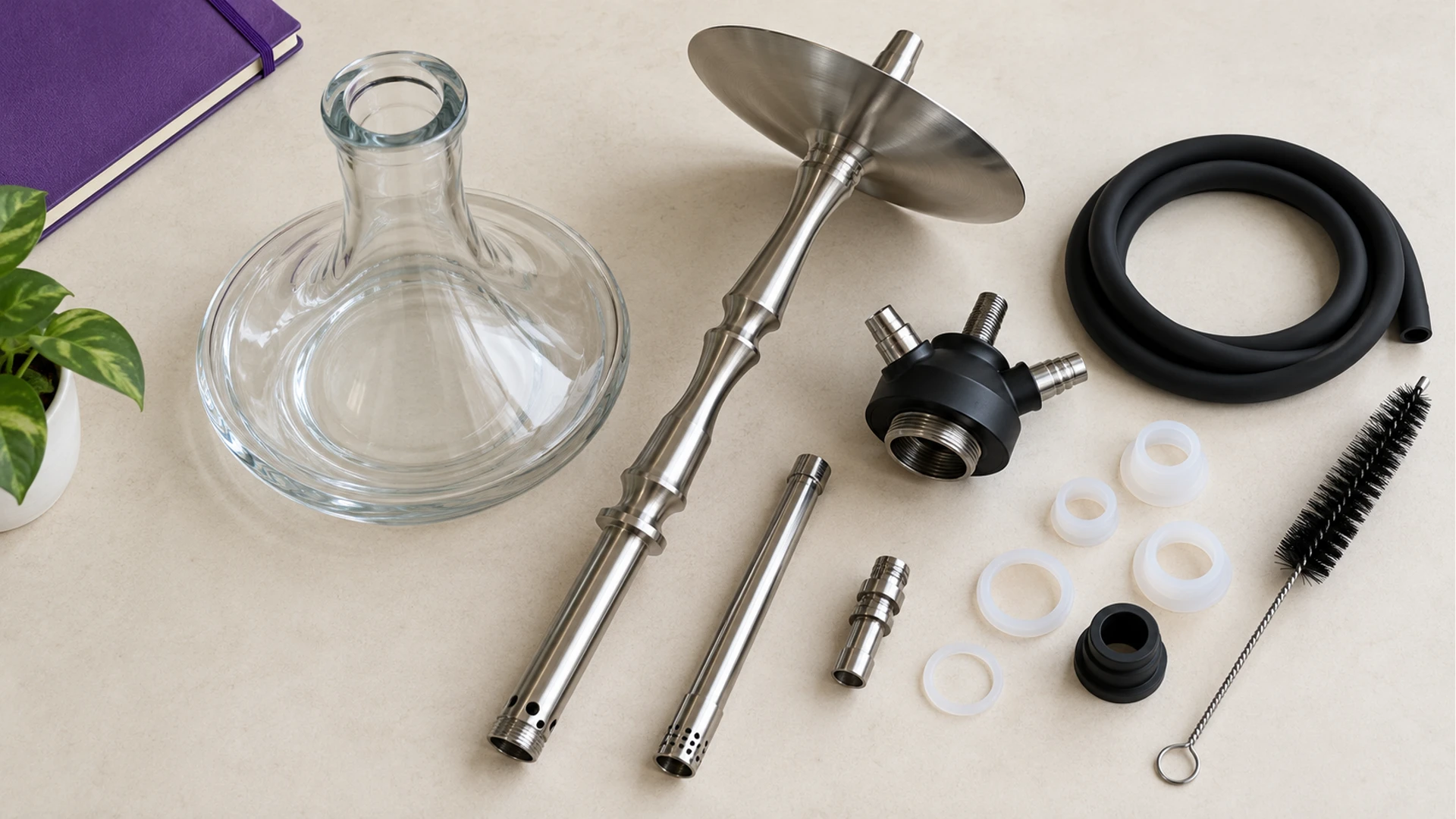
When caring for Russian hookah sets, what matters is each part's material, connection system and manufacturer's instructions, rather than the set's name or appearance. A stainless steel inner tube, painted outer body, polymer connector hub, glass base and silicone seal may not be suitable for the same cleaning process. Identifying the parts, checking compatibility through measurements and drying disassembled components completely are the foundations of preventing damage from unsuitable chemicals, excessive force and damp storage.
This guide examines equipment described as Russian hookah sets in terms of materials, connection compatibility, maintenance and damage checks and explains how to identify the parts of your own set rather than ranking brands. The instructions for the particular model always take precedence over these general checks; do not try to open a section that the manufacturer does not intend users to disassemble.
What the term Russian hookah set means
Russian hookah set is not the name of a single technical standard. It is a general label covering models from different manufacturers that use different materials, connections and body designs. Two sets listed under the same heading may have entirely different seal dimensions, base connections or purge components. A country or design category does not establish that their parts are interchangeable.
When examining equipment, first record its brand, model and production series, if available. Then match the parts diagram in the manual to the components you have. Note any base or adapter that has been replaced. A compatibility issue discovered during maintenance may come from a differently sized component added in the past, rather than from the main body itself.
- Model information helps you find the correct disassembly sequence and maintenance limits.
- Material information determines which cloth, brush and cleaning method suit the surface.
- Connection information distinguishes sealed, threaded, push-fit and magnetic components.
- Modification records allow parts added later to be assessed separately.
Distinguish the visible finish from the material underneath
A part's shiny, black or colored appearance does not establish what it is made of. The decorative finish on the outside of the body may differ from the material of the inner tube. Similarly, a connector hub that looks metallic may combine metal and polymer components. It is not appropriate to choose one cleaning method for the entire set based on a photograph alone.
If the manual does not identify the materials, contact the manufacturer with the model name rather than making a definite judgment from appearance. Scraping a surface, scratching it with a sharp object or testing it with an unknown chemical can damage the part. Color left on a cloth does not establish the metal type either; surface dirt, the finish and residue from earlier cleaning products must be considered separately.
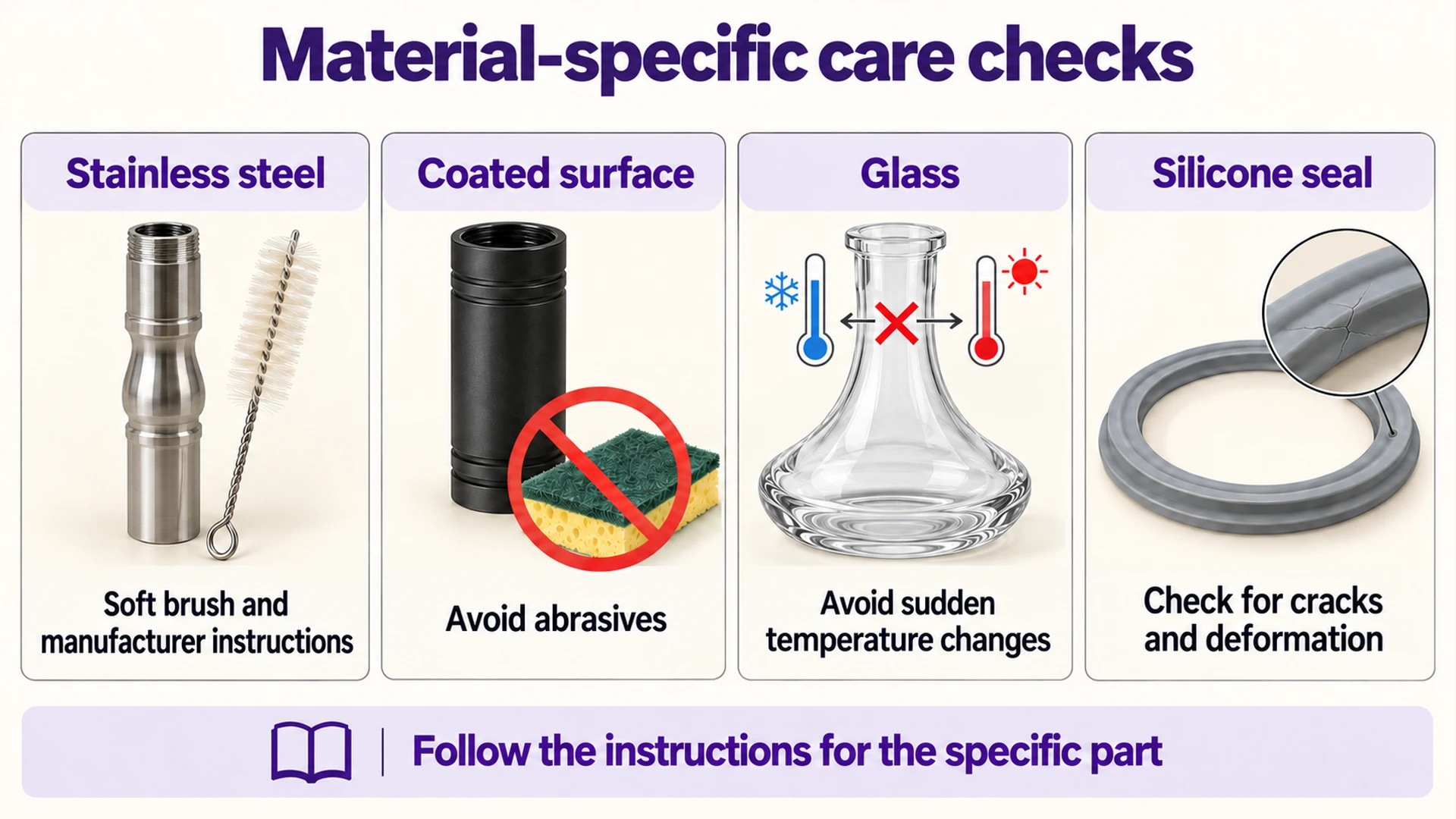
| Part or surface | What to check first | Approach to avoid |
|---|---|---|
| Stainless steel tube | The inner channel, deposits and the brush permitted by the manufacturer | Scraping deposits with a sharp metal object |
| Painted or anodized outer surface | Discoloration, scratches and care instructions for the finish | Applying the brushing method used inside the tube to the outer surface |
| Glass base | Cracks around the neck, bottom and connection | Sudden temperature changes and impact during placement |
| Silicone seal | Tears, permanent compression and dimensions | Using more force to squeeze an incompatible connection together |
| Polymer connector hub | The manufacturer's limits for chemicals and disassembly | Prolonged soaking without identifying the material |
Why stainless steel and coated surfaces need different care
An appropriate tube brush may be needed to reach a steel inner channel, but this does not mean that every surface of the set can be cleaned with the same brush. Stiff bristles and abrasive sponges can leave marks, particularly on decorative finishes. Brush size matters too. Forcing an oversized brush into a narrow channel can put stress on the surrounding connection rather than letting the bristles do their job.
Differences between manufacturers' instructions provide a practical example. Alpha Hookah's care page specifically prohibits brushing certain anodized aluminum parts. HOOB's own product instructions mention a suitable brush for steel tubes while advising against abrasive tools on metal surfaces. Permission to use a method on one part should not be treated as permission to use it on every surface of the same set.
Do not immediately identify a mark noticed after cleaning as rust. Water marks, surface deposits and coating damage are different issues. Photograph the initial condition, then check whether its appearance changes after gentle care permitted by the manufacturer. If there is peeling or pitting, seek technical support rather than continuing with a harsher method.
Check connection and seal compatibility through measurements
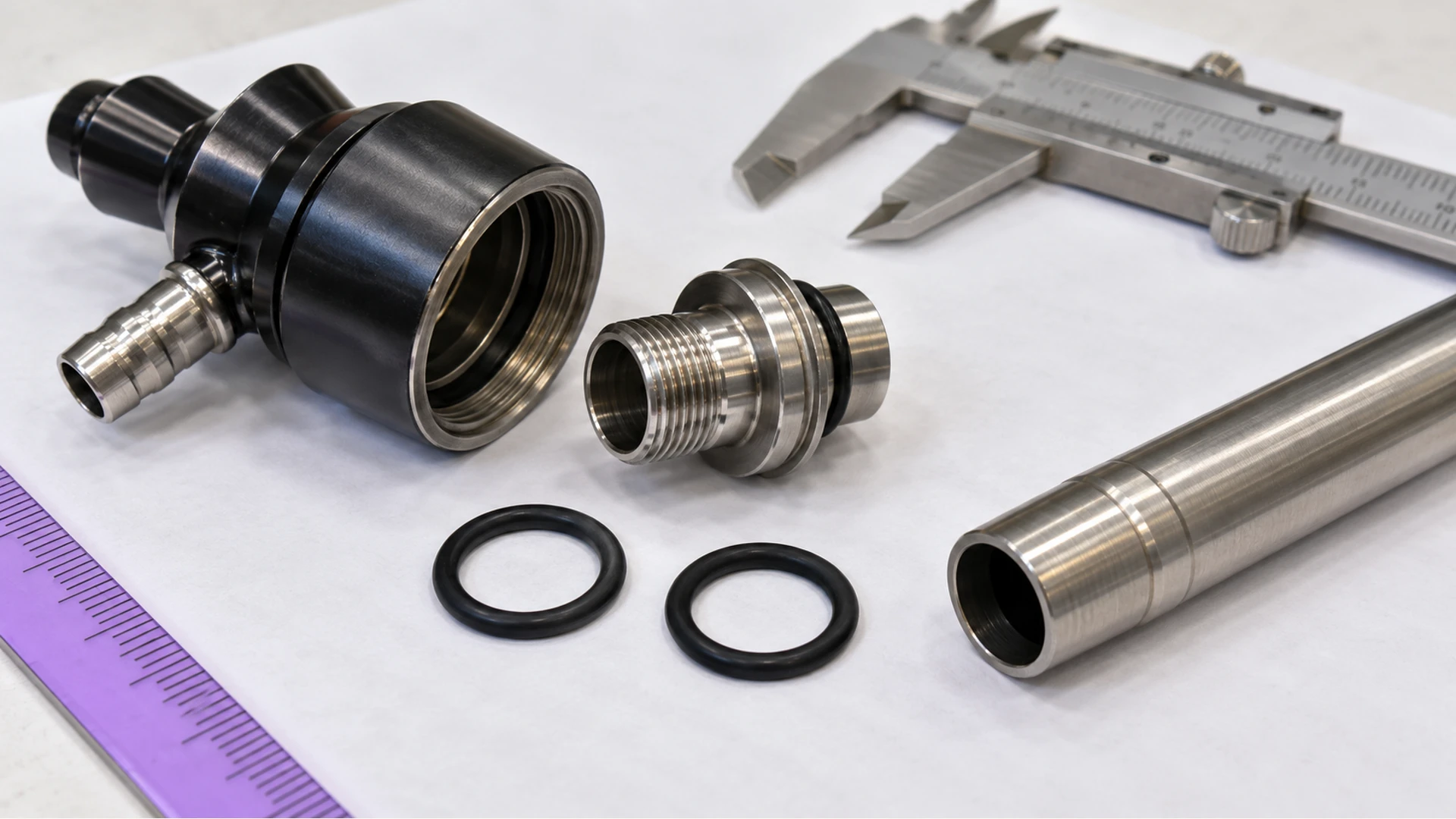
Two adapters that look similar are not guaranteed to fit each other. Diameter is only one consideration; seating depth, seal position, thread geometry and clearance around the part also matter. Forcing an incompatible part into place can crush the seal or damage the connection. A part fitting initially is not sufficient evidence of correct compatibility either.
Place the part on a clean, dry surface before measuring. Compare your measurements with the manufacturer's technical dimensions when available, and do not treat measurements taken at different points as interchangeable. For example, a base's outer neck diameter and inner seating diameter are different measurements. Record which surface you measured. Do not clamp calipers tightly onto glass or manipulate a broken or cracked part to take a measurement.
When a seal needs a separate inspection
Cracks, tears or permanent deformation in a seal mean that the connection should be reassessed. If a seal is swollen, sticky or sitting unevenly in its groove, do not try to solve the problem simply by compressing it further. Do not assume that another seal of the same color has the same material and dimensions; use the component specifications for the model.
Keep track of small parts during disassembly
Photographing the equipment's existing arrangement before maintenance creates a useful record, particularly where several small components are involved. Separate removable parts over a wide tray. Place seals, balls and adapters in separate compartments. This reduces uncertainty about which part came from which seat.
Do not try to open a magnetic connection with the same motion as a threaded one. If the method described in the manual is unclear, stop before applying force. Gripping a stuck connection with pliers can damage its surface; adding an unknown oil or solvent may also be incompatible with the material. A section that will not come apart is not necessarily faulty; some joints may not be designed for user disassembly.
Do not leave small parts loose in a sink. Separating them in a suitable container and closing the drain first reduces the risk of losing them. After maintenance, count and match the parts against the diagram in the manual. If a component's position is unclear, check the manufacturer's explanation instead of placing it in a random seat.
Assess the glass base and hose separately
The neck, body and bottom of a glass base should be inspected from different angles. Fine cracks around a connection can be particularly difficult to see from above. Assess the base on a stable surface under adequate lighting. Do not squeeze cracked glass or expose it to temperature changes to test it; stop using the damaged part.
For the hose, first establish whether it is washable. An outer surface that looks like silicone does not prove that the entire inner construction is suitable for water. There may be different internal layers, connections or parts that cannot be disassembled. Filling a hose that is not approved for washing with water can leave moisture in areas you cannot see. The guide to hose washability, which explains this distinction in detail, is a useful additional reference for checking materials.
Drying must not be skipped even for parts that are approved for washing. A dry outer surface does not establish that the inner channel is dry. Check for trapped water before putting a part in a closed bag. Do not use heat sources that are not specified in the manual to speed up drying.
Organize maintenance around five checks
A useful maintenance record does not have to be long. Brief notes on the parts separated, the method used and any damage observed are enough. Where several similar sets of equipment are present, keep records by model to avoid mixing up parts. Use a system that makes material differences clear rather than a single list that applies the same chemical or disassembly method to every set.
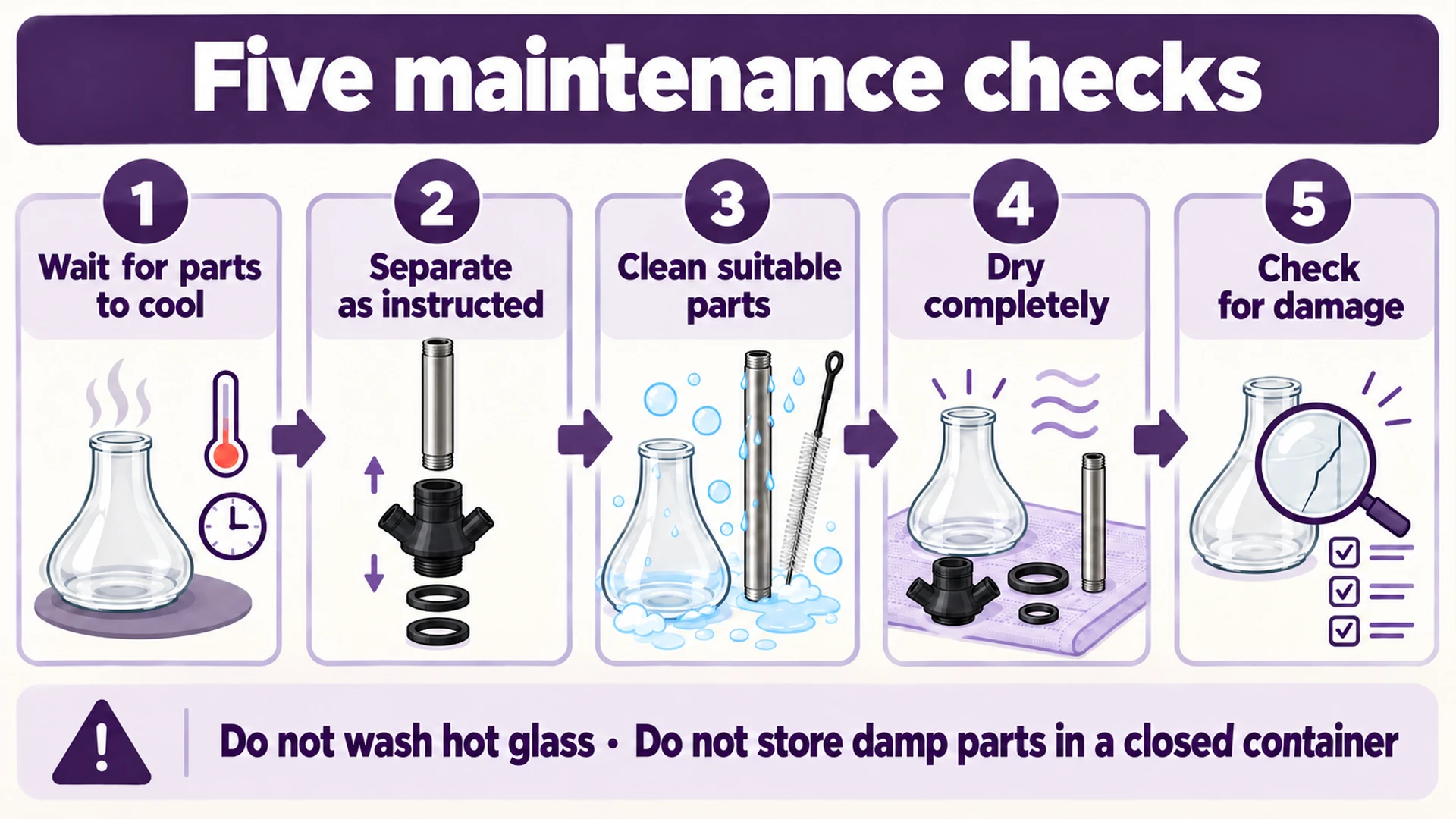
- Let it cool. Do not expose hot parts to cold water. Make sure the work surface is stable and clear.
- Disassemble according to the instructions. Open only the sections that users are permitted to disassemble. Record the small parts and the seats they belong to.
- Clean according to the material. Use the tools and method permitted by the manual. Do not treat increasing the force or duration as an automatic solution.
- Dry completely. Leave the parts separate so air can circulate. Pay particular attention to channels and enclosed seats where water may remain.
- Check for damage. If you find cracks in glass, tears in seals, peeling surfaces or damaged connections, resolve the issue before using the part again.
Is ordinary detergent suitable for every part
There is no single detergent recommendation that applies to every part. Manufacturer approval, the product label and material compatibility must be considered together. A cleaner being common in households does not establish that it is suitable for a coating, seal or polymer component. Do not try a chemical that the model's instructions do not permit on the assumption that a smaller amount will cause no problem.
Remember that manufacturers' instructions can differ. HOOB prohibits acidic and alkaline cleaners, metal brushes and dishwashers for its products. The anodized-surface section of Alpha Hookah's care page sets out separate conditions for those surfaces. These examples underline the need to prioritize instructions for the brand and individual part over general advice instead of recommending a particular cleaning mixture.
Do not mix chemicals. Do not invent soaking times or disinfection claims that are absent from the instructions. A surface having no noticeable odor does not prove that a product is suitable in every situation. Follow both the equipment manufacturer's instructions and the approved cleaner's label for rinsing and drying. For further details, the guide to cleaning chemicals is a useful reference.
Match the symptom to the correct part
When an issue appears, first record where the symptom occurs rather than applying more intensive cleaning to the entire set. Looseness may involve dimensions or a seal, while a scratch may relate to the tool used. These observations are not a definitive fault diagnosis, but they can make a technical support request clearer. Making several changes at once makes it harder to distinguish which action helped or caused damage.
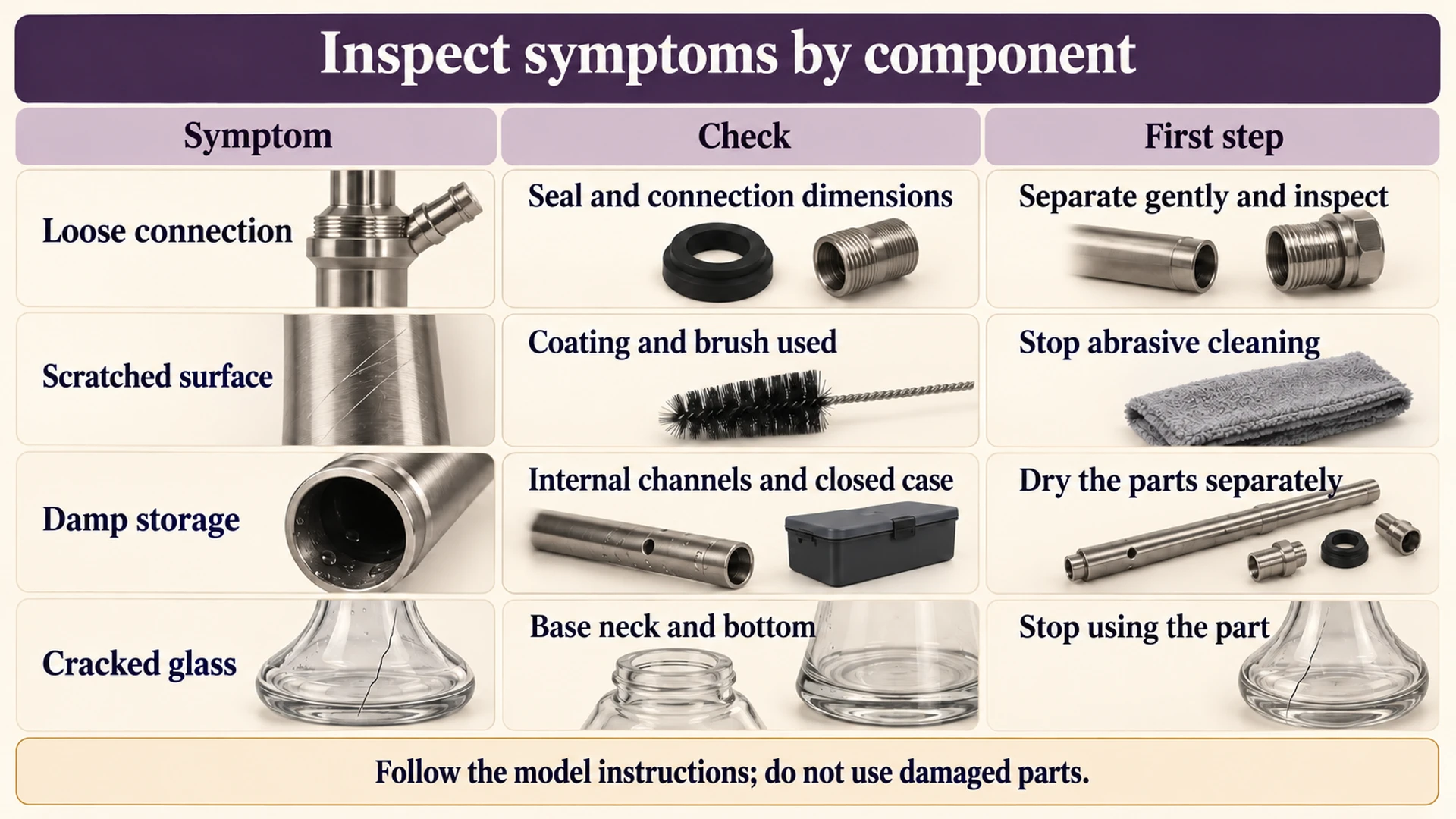
When seeking support, provide the model name, a close-up photograph of the part, when the issue was noticed and the earlier maintenance method. Saying, for example, 'there is a tear at the edge of the connection seal' is more specific than a general statement such as 'the set is broken.' Do not force a damaged part again to take a photograph; recording its existing condition is enough.
Protect parts during storage and transport
Make sure the equipment is dry before storage. Do not place glass in the same compartment in direct contact with metal components. Separate parts that may be disassembled so they do not rub against one another, and keep small components in a labeled container. Using a bag or box does not remove moisture from its contents automatically.
When taking equipment out after a long period of storage, look beyond its outer appearance. Inspect the inner channels, seal seats and glass connection as well. There may be an unnoticed impact mark or permanent seal deformation from storage. For a more detailed checklist, the guide to long-term storage and guide to drying parts can be read together.
Frequently asked questions
Are all parts of Russian hookah sets interchangeable
No. Belonging to the same general category does not mean sharing the same connection dimensions. The model, connection type, seating surface and seal specifications must be checked together. Visual similarity is not proof of technical compatibility.
Can every part of a stainless steel set be washed in the same way
The set may contain coatings, polymers, seals or different connector components in addition to steel. Assess each part's material and the manufacturer's instructions for that part separately. Do not force open a component that is not designed to be disassembled.
Is changing the water alone enough for maintenance
Emptying the liquid from the base does not establish that moisture or deposits in other parts have been checked. Components that the manufacturer permits you to clean should be inspected separately, with drying and damage checks completed at the end of maintenance.
What should you do if damage is found during cleaning
Stop using cracked glass or a damaged component whose condition is uncertain. Do not try to resolve the issue with more force, a stiffer brush or different chemicals. Contact the manufacturer with the model information and photographs for guidance on the appropriate action.
Manufacturer sources and scope
This is a model-independent guide to maintenance and material inspection. The visuals are conceptual illustrations created for this guide; they are not a parts list or a dimensioned assembly drawing for a particular product. Check the current manual for your own model before working on the equipment.
- Alpha Hookah official care instructions — particularly the maintenance limits for anodized surfaces.
- HOOB Flex official use and care instructions — cleaning and drying conditions specified for the model.