

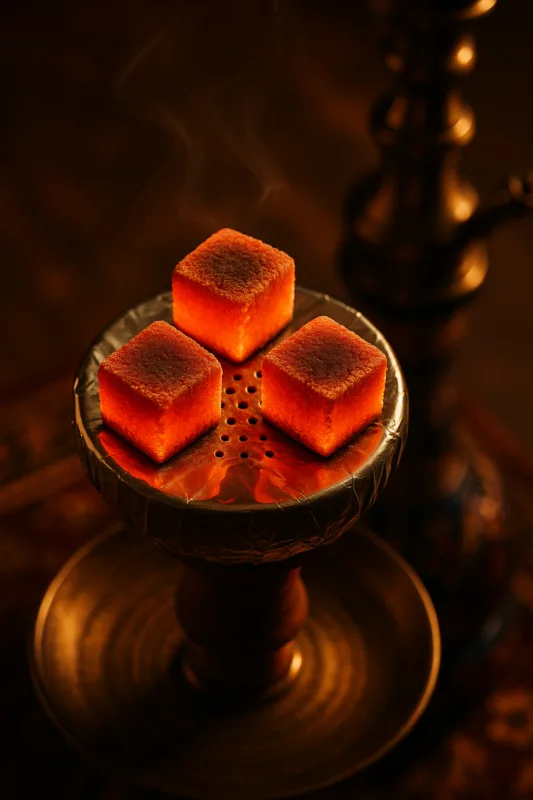
Hookah Charcoal Adjustment and Ember Placement – A Guide to Perfect Heat Control
One of the most critical factors determining the quality of the hookah experience is, hookah charcoal proper adjustment and placement of the coals. The issues many hookah enthusiasts encounter—such as a harsh taste, bitter smoke, or insufficient vapor—are actually caused by mistakes in coal management. The correct technique for placing hookah coals ensures that the tobacco burns at the optimal temperature and allows you to enjoy a long, pleasant session.
Having accurate knowledge about the number of hookah coals, their placement, and heat distribution is what sets amateur users apart from professionals. Improper charcoal placement can lead not only to a loss of flavor but also to damage to the tobacco and health problems. For this reason, having comprehensive knowledge of hookah charcoal techniques is extremely important.
In modern hookah culture, a variety of techniques are used, ranging from the traditional foil method to Kaloud and other heat management systems. Each method has its own specific rules for placing the coals. Hookah heat control is closely related not only to the number of coals but also to their position on the bowl, the distance between them, and the frequency of rotation.
In this comprehensive guide, we’ll cover everything you need to know about adjusting hookah charcoal in detail. From beginner-level basics to advanced techniques, we’ll share all the information necessary for perfect heat control. By offering specific recommendations for different types of bowls, charcoal varieties, and usage conditions, we’ll ensure you have a perfect hookah experience every time.
1. Types and Characteristics of Hookah Charcoal
Types of Natural Coal
Before adjusting the charcoal in your hookah, it is critical to choose the right type of charcoal. Natural charcoals are the safest and highest-quality options thanks to their chemical-free composition.
Coconut Charcoal:
- Longest burn time (60–90 minutes)
- Low ash production
- Constant-temperature efficiency
- Number of hookah coals: 2–3 are sufficient
Bamboo Charcoal:
- Medium burn time (45–60 minutes)
- Very clean combustion
- Lightweight design
- Quick-heating feature
Fast-Burning Coals
Quick-burning coals, which are preferred for practical use, require a different approach when it comes to placing them in a hookah.
Advantages:
- Rapid ignition (1–2 minutes)
- Easy to use
- Ideal for emergencies
Disadvantages:
- Chemical Additive Content
- Short burn time
- Risk of a change in taste
2. Basic Coal Placement Techniques
The Foil Method
The foil method, a traditional technique for setting hookah charcoal, is the most widely used system. In this method, the hookah charcoal is adjusted by the arrangement of holes in the foil and the position of the charcoal.
Steps for Proper Placement:
- Place 2–3 pieces of charcoal on the foil
- Place the coals along the edges of the bowl
- Leave the center blank
- Maintain equal distances
Determining the Number of Hookah Coals:
- Small coals: 2 pieces
- Medium-sized pipes: 2–3 pieces of coal
- Large coals: 3–4
Kaloud System
Kaloud systems, developed for temperature control in modern hookahs, offer more precise charcoal management.
Kaloud Benefits:
- Precise temperature control
- Coal Safety
- Long-term constant temperature
- Easy coal replacement
3. Coal Grading by Bowl Type
Clay Pipes
Traditional clay hookahs require special care when placing the hookah charcoal. Clay absorbs and releases heat slowly.
Tips for Clay Pipes:
- Start with 3 pieces of coal
- Wait for the first 10 minutes
- Gradually reduce your coal consumption
- Keep the center warm
Ceramic and Glass Faucets
Coils made from modern materials exhibit different thermal conductivity properties.
Ceramic Spouts:
- Quick heating
- 2 Getting Started with Coal
- The need for frequent monitoring
Glass Pipes:
- Highly precise temperature control
- Low number of coal units
- Requirement for continuous monitoring
4. Coal Rotation and Time Management
Rotation Techniques
In terms of hookah charcoal technique, rotation is vital for even heat distribution. Regular turning and repositioning of the charcoal are necessary.
Rotation Program:
- Turn every 15 minutes
- 30 one position change per minute
- Coal replenishment once an hour
- Continuous temperature control
Time Intervals
Intervention is required at specific intervals to control the temperature of the hookah.
Timeline:
- 0-10 minute: High heat (3 coals)
- 10-30 minutes: Medium heat (2–3 coals)
- 30-60 minute: Low heat (2 coals)
- 60+ minute: Coal replenishment
5. Heat Control and Temperature Management
Optimal Temperature Ranges
When adjusting the charcoal in a hookah, the target temperature ranges are of critical importance.
Temperature Targets:
- Starting temperature: 220–250°C
- Ideal range: 180–220°C
- Minimum: 160°C
- Maximum: 280°C
Temperature Control Methods
Temperature measurement and control systems can be used for professional hookah charcoal techniques.
Control Tools:
- Infrared thermometer
- Digital thermometer
- Visual inspection techniques
- Experience-Based Evaluation
6. Common Errors and Their Solutions
Common Mistakes with Coal
Common mistakes made when loading charcoal into a hookah and suggested solutions:
Excessive Coal Use:
- Problem: A harsh taste and the smell of burning tobacco
- Solution: Reduce the number of pieces of coal
- Precaution: Increase gradually
Incorrect Positioning:
- Problem: Uneven heat distribution
- Solution: Replace the coal
- Precaution: Follow the rule of equal distance
Emergency Solutions
Quick-fix methods when there are issues with the number of hookah coals or their placement:
Overheating:
- Reduce the number of pieces of coal
- Move the coals to the sides
- Cover the holes in the foil
- Wait for it to cool
Insufficient Heat:
- Add coal
- Move the positions closer to the center
- New coal is coming
- Adjust the Kaloud cap
7. Advanced Coal Technologies
Professional Placement Methods
Advanced techniques for expert-level hookah temperature control:
Multi-Coal System:
- Coals at different stages of combustion
- Continuous thermal stability
- Minimum intervention requirement
Zonal Heating:
- Different temperatures in different areas of the shower
- Adjustment by tobacco type
- Maximum efficiency
Settings for Special Cases
A hookah charcoal technique tailored to different conditions:
Cold Weather Conditions:
- Use of extra coal
- More frequent rotation
- Using the Windcover
High Humidity:
- Long preheating
- Increase in the number of coal pieces
- The need for frequent monitoring
8. Safety Precautions and Maintenance
Coal Safety
Safety should be the top priority when adjusting the charcoal in a hookah.
Safety Rules:
- Keep away from flammable materials
- The use of tongs is required
- Do not place on cold surfaces
- Keep away from children
Equipment Maintenance
Equipment maintenance after using coal:
Cleaning Steps:
- Wait for it to cool completely
- Clean up the ash residue
- Check the nozzle
- Clean the foil/Kaloud
Regular Maintenance:
- Weekly Deep Cleaning
- Monthly equipment inspection
- Coal Quality Assessment
- Procurement of spare parts
Frequently Asked Questions
Q: How do you determine the number of hookah coals? A: The number of charcoal pieces varies between 2 and 4, depending on the size of the bowl, the type of tobacco, and personal preference. Two pieces are ideal for small bowls, and 3–4 pieces for large bowls.
Q: How often should charcoal be replaced in a hookah? A: After the initial setup, it should be checked every 15–20 minutes, and the position should be adjusted every 30 minutes.
Q: Is the technique for using hookah charcoal different for foil and Kaloud? A: Yes, edge placement is preferred in the foil system, while center placement is preferred in the Kaloud system. Each system has its own specific rules.
Q: How do you control the temperature of a hookah? A: The number of coal pieces is controlled by their position and rotation. The use of a thermometer also ensures precise control.
Q: How do you adjust the hookah charcoal if it's too hot? A: Reduce the number of coals, move them to the sides, or remove some of them. Wait a few minutes for them to cool.
Properly adjusting the hookah charcoal and positioning the embers are the cornerstones of a perfect hookah experience. The techniques and recommendations covered in this guide provide valuable information for both beginners and experienced users. The proper technique for placing hookah coals not only enhances flavor quality but also ensures safe and long-lasting use.
The knowledge you’ve gained about determining the number of hookah coals, their placement, and rotation will help you achieve consistent results in every session. Remember that hookah charcoal technique is a skill that develops with experience. By practicing with different types of charcoal, bowl varieties, and under various conditions, you can develop your own style.
When it comes to hookah heat control, it’s important to be patient and adopt a mindset of continuous learning. Every hookah session should be viewed as an opportunity to improve your charcoal management skills. Never neglect safety precautions, and be sure to use high-quality materials.
By following the recommendations in this guide, you can adjust your hookah charcoal to a professional level and achieve perfect results every time. We wish you enjoyable and safe hookah sessions!


Write a reply