

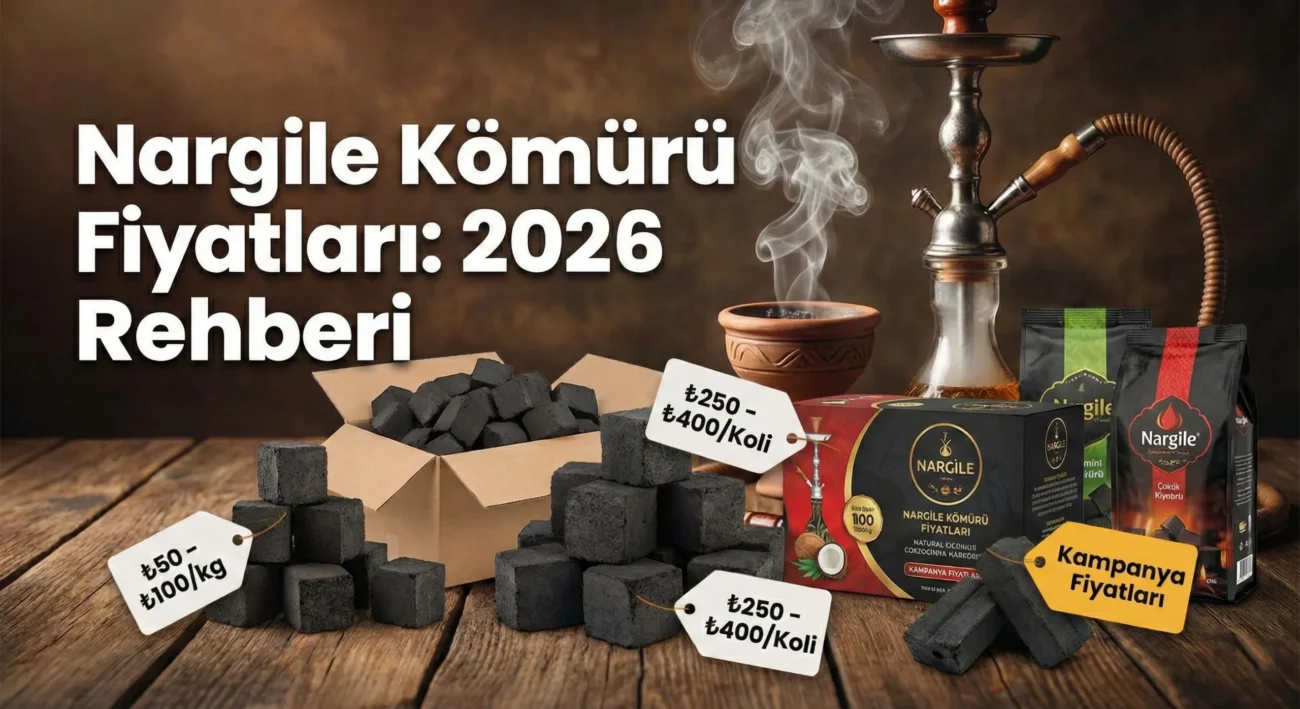
Hookah Charcoal Prices (January 2026): How Much Is 1 kg in TL, and What Factors Affect the Price?
The pleasure of smoking a hookah sometimes starts with the charcoal, not the tobacco. You use the same tobacco in the same bowl, but one day the smoke flows smoothly, and another day it tastes burnt. Most of the time, the charcoal is to blame, but the first thing we usually look at when buying it is hookah charcoal prices Okay.
So why do hookah charcoal prices fluctuate so much? In January 2026, on the Turkish market, 1 kg was frequently listed at 159-250 TL The price range is visible, but it can sometimes be higher depending on the product type, brand, seller, and shipping. The same coal can be priced very differently depending on the seller.
In this article, you’ll find clear information on current price ranges, how to interpret the price per kilogram, price differences by type, the key factors that determine price, where to shop more safely, and tips for making budget-friendly choices.
January 2026 hookah charcoal prices, current price ranges, and examples
The most appropriate unit when discussing coal prices 1 kg. That’s because small packages—such as 250 g or 500 g—may “seem cheap” but can actually end up being expensive per kilogram. For someone who drinks regularly, the real cost isn’t the price listed on the package, but the price per kilogram.
The overall market picture is as follows: While prices around 159 TL can be found during promotions or at certain retailers, most products on the market fall within the 180–250 TL range. For higher-end imported options, prices can even approach 300 TL. That’s why it’s essential to ask questions like “Is it the same product? Is the weight the same? Is shipping included?” when shopping.
The most common way to lower the unit price is to buy in bulk. When you buy in packs of 3 or 5, or by the bag, the price per kilogram generally goes down. Of course, for someone who says, “I drink it once or twice a month,” this means excess stock and the risk of the product going stale or getting damp.
1 How much does a kilogram of hookah charcoal cost in TL? (general market range)
The practical market range for 1 kg in January 2026 159-250 TL You might think that. Breaking this down into three simple categories makes decision-making easier:
- The lowest-priced segment (approximately 159–180 TL): It's usually found in promotional offers. The ash content and odor performance may vary depending on the brand and batch.
- Mid-range (approximately 180–230 TL): The most popular setting for home users. The heat is more stable, and the breakage rate is lower.
- Premium (approximately 230–250 TL and up): You’d expect longer burn time, less odor, and a more even cut. Imported, popular brands and high demand drive up the price.
This classification does not mean “expensive is good.” But coal’s burn time, ash content and smell As performance improves, the price often goes up as well.
What are the prices for popular brands? (Black Coco’s, Pure 27er, One Nation, Kefo Gold)
Prices can vary by brand even within the same day, so consider the figures below as “examples.” Also, terms like “26er” and “27er” are used by many brands to indicate the cube size (or package standard). The exact equivalents may not be the same across all brands, but they generally give you an idea of “cube size and usage habits.”
| Brand and model | 1 Sample price per kg | A brief note |
|---|---|---|
| Black Coco’s (26-inch/27-inch) | 233 TL (promotional example) | On some marketplaces, you may see wider price ranges; this varies by seller. |
| Pure 27er | 159 You can see promotional prices as low as TL | Inventory and seller reliability are important; products with the same name may have different package contents. |
| One Nation (26er) | 200 TL (promotional example) | It is priced in the mid-to-high range, and seasonal discounts may be available. |
| Kefo Gold | Varies by seller; generally positioned as premium quality | The net price varies greatly depending on the store, so it's a good idea to check the return policy. |
A quick reminder: If you’re buying a 250-gram or 500-gram package, be sure to convert the price to per kilogram. A 500-gram package priced at 199 TL may seem “reasonable” at first glance, but the price per kilogram comes out to 398 TL.
6 Key Factors That Determine Hookah Charcoal Prices
It can be frustrating when the same coal is sold at two different prices in two different places. But these differences are often based on a few clear reasons. If you’re aware of the following 6 factors, you’ll be able to answer the question “Is this price normal?” more quickly.
Type of charcoal: coconut, wood, or marabu?
The most common option in Turkey Coconut shell charcoal. The reason is simple: it burns longer, provides more consistent heat, and generally produces less odor. The quality of wood charcoal can be more variable—one batch might be good, while another might be smokier.
Brands like Marabu are also available on the market. Products like these can be positioned at a higher price point due to their “premium” image. They may not be suitable for every user, as they can burn the tobacco quickly when the heat is too intense.
Quality indicators: ash content, odor, uniform cut, burn time
It’s difficult to measure coal quality in a laboratory setting, but there are practical indicators. The following generally indicate low quality: high ash content, a pungent odor, crumbling, irregular cuts, and excessive breakage.
Good coal, on the other hand, provides a more stable heat and lasts longer. This leads to the following: Cheap coal runs out quickly, You’ll end up adding coal more often. In the end, even though you might think, “I got a good deal,” the total cost could go up, and you’ll enjoy it less.
Package size and weight: small package, 1 kg, or a sack?
To accurately assess the price of tobacco, first determine the weight. In small packages (especially 250 g), the price per kilogram is almost always higher. A 1-kilogram box offers better value for regular users.
Buying in bulk lowers the unit price. But if you don’t use it often, the coal will sit in your home for a long time. If it absorbs moisture, it will be hard to light and may produce more odor. So “buying in bulk to save money” isn’t always an advantage.
Imports and logistics: foreign exchange, shipping, and customs implications
For imported products, exchange rates, freight costs, and customs duties directly affect the price tag. Since some types of coal come from different countries, this can lead to price fluctuations even for the same brand from time to time.
Then there’s storage and shipping. Coal is a heavy product, and shipping costs can account for a significant portion of the total price. That’s why you shouldn’t just fill your cart thinking “the product is cheap” and end up with a surprise when it comes to shipping.
Differences by seller and promotion: online, in-store, wholesale
Promotions are more common in online stores because competition is fierce. In physical stores, however, the advantage is “immediate delivery” and, sometimes, the ability to pick up the product and inspect it in person. When buying in bulk, the price per kilogram may be lower, but choosing a reliable seller becomes even more important.
If you notice a significant price difference for the same product, check the following first: seller rating, reviews, product images, and whether the return and damaged-item policies are clearly stated.
Inventory, production lot, and scrap rate
Even if coal is of the “same brand and same series,” there can still be differences between production batches. Some batches are more brittle, while others are harder. This can also affect sellers’ pricing policies.
A product with a high breakage rate runs out faster in practice. This increases the price per kilogram not just on paper, but in actual use.
Where can you buy hookah charcoal, and how can you find safe and reasonably priced options?
The goal here isn't to "snag the cheapest one." The goal is price-performance ratio to strike the right balance. In other words, the charcoal shouldn't spoil the flavor or force you to keep replacing it.
There’s a simple method for safe shopping: compare the same product at at least 2–3 different places, calculate the price per kilogram, check the total including shipping, and verify the seller’s reliability. This quick check prevents most mistakes right from the start.
Quick comparisons for online shopping: filtering, calculating price per kg, reading reviews
On marketplaces like Trendyol and Hepsiburada, different sellers offer the same product. The first step is filtering: product type (cubes, coconut), weight (1 kg), and delivery time.
Then there’s this three-step check:
- Calculate the price per kilogram: 500 The price per g may seem attractive, but the price per kg reveals the truth.
- Add shipping to the total price: “There are many products that appear “cheap” in the cart but become more expensive on the checkout page.
- Search for complaints about breakage and odor in the comments: “The comment, “Half the coal arrived broken,” is just as important a signal as the price.
Also, if the seller’s description claims the item is “authentic,” check to see if the product images and packaging details match. A suspiciously low price can sometimes increase the risk of the item being counterfeit or old stock.
Example websites and price tracking: myshisha, nargileuzmani, myahookah (subject to change)
Seasonal promotions can also be found on hookah-focused websites. For example, during certain sales, discounted prices such as 233 TL for Black Coco’s and promotional prices such as 200 TL for One Nation may be available. The same product may also be listed at a wider range of prices on online marketplaces.
Prices on sites like myshisha, nargileuzmani, and myahookah can fluctuate throughout the day. That’s why some simple strategies work well for keeping track:
Add to Favorites: You'll be quick to snap it up when there's a sale.
Add to Cart: Some promotions appear in the shopping cart.
Keep an eye out for sales periods: Prices may drop during certain periods, such as at the end of the month or during special-occasion promotions.
Here’s the most practical approach: Compare the “total price per 1 kg” on two different websites on the same day, then read the seller’s return policy. You don’t want to have to deal with it if the coal arrives broken.
A Budget-Friendly Buying Guide: Which Coal Is Right for You?
There’s no need to choose coal just because “it’s the most expensive.” A better approach is to choose the right coal based on how often you use it. Because coal is like the gas pedal of a hookah. If you press it wrong, everything goes wrong.
The following three profiles will help you make a decision faster.
For Beginners: Choosing Charcoal That Doesn't Produce Smoke and Is Easy to Manage
If you're just starting out, aim for "easy control." That's why cube-shaped, uniformly cut charcoal is easier to work with. The heat is more even, and you won't have to struggle with the charcoal.
Avoid this mistake: buying strongly scented tobacco just because it’s cheap. If it ruins the taste on your first try, you’ll blame the tobacco. Look for these simple criteria when buying: minimal ash, even cut, and a texture that doesn’t crumble.
For regular drinkers: total cost, bulk purchases, storage
If you drink a few times a week, the real issue isn't the "package price," total cost. 10 There’s a significant difference at the end of the month between coal that burns out quickly and coal that lasts as long as six pieces of coal.
Buying in bulk might make sense, but proper storage is essential. Keep the charcoal in a sealed container in a dry place. Charcoal that absorbs moisture takes longer to ignite and may produce more smoke. When shopping, also check the breakage rate and return policy, because for a regular user, broken charcoal is a direct loss of money.
For cafes and crowded environments: stability, supply, and return policy
In a café or a crowded setting, coffee means “keeping up with the pace of the day.” It needs to deliver the same performance every day. That’s why it’s more convenient to work with a supplier who offers a steady supply rather than relying on a single box.
The most common mistake here is this: focusing only on the unit price and ignoring the breakage rate and delivery time. Coal that arrives late or is damaged reduces service quality during peak hours.
Conclusion
In January 2026 Hookah charcoal prices 1 Prices generally range from 159 to 250 TL per kilogram, though they can go higher depending on promotions and the product segment. The best choice is made by considering the type of coal and quality indicators, calculating the price per kilogram, and purchasing from a reliable seller.
The next time you shop, don’t just look at the price tag—check the “total including shipping” and “breakage rate in reviews” sections too. Which brand do you use, and how much do you pay for it? Leave a comment, and let’s work together to expand the list.


Write a reply