

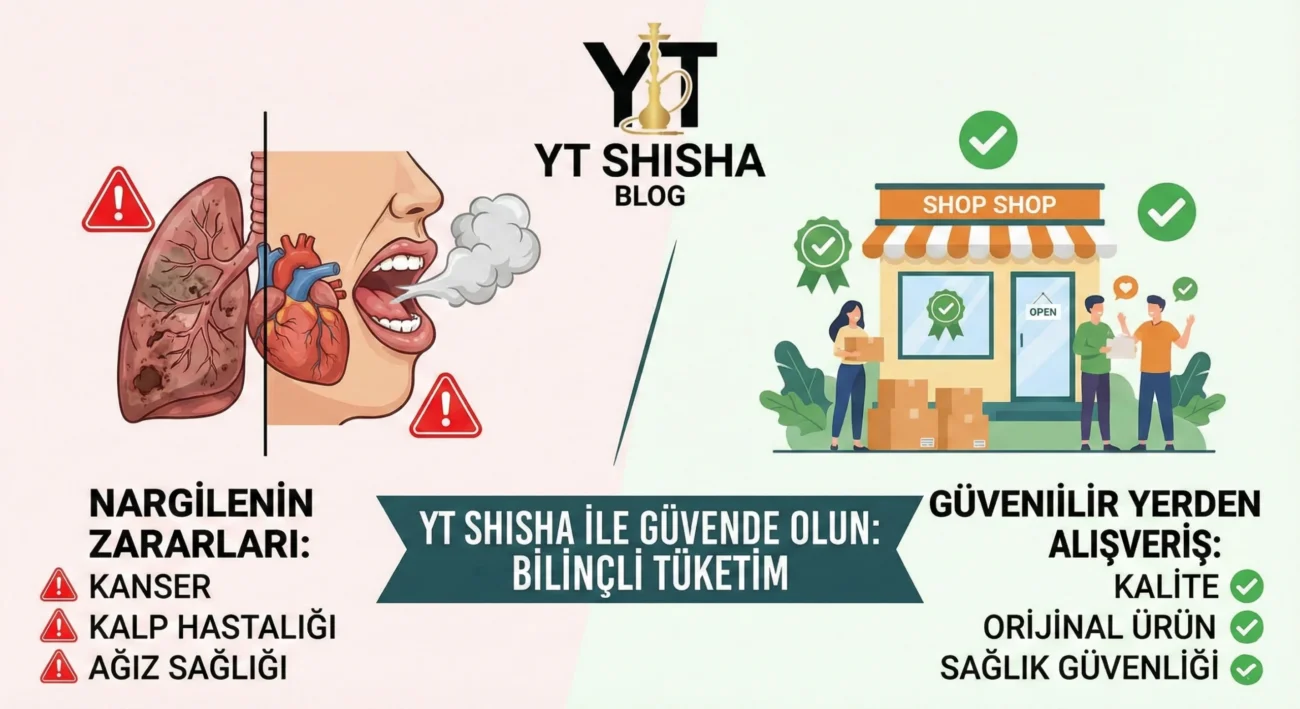
The Dangers of Hookah: What Is That “Innocent Smoke” You Think You’re Inhaling Doing to Your Body?
Whether you’re sitting with friends at a café, watching a game at home, or trying it out thinking, “It’s just once—it won’t hurt,” smoking a hookah can seem perfectly normal. It smells nice, the smoke is smooth, and when people say, “It has water—it filters it,” it puts your mind at ease.
But the truth of the matter is this: The Harms of Hookah It’s not just a matter of it “irritating the throat.” The smoke contains nicotine and many toxic substances, and the coal adds to this burden. Moreover, because hookah is smoked for long periods, exposure sometimes increases without the user even realizing it.
In this article, we’ll discuss the following in a clear and simple way: What’s in hookah smoke, does the water actually filter it, how does one session compare to smoking a cigarette, what health issues can it trigger, what are the risks regarding secondhand smoke and hygiene, and how can users reduce risks and choose authentic products.
Why is hookah harmful, and what’s in the smoke?
It’s a big mistake to think of the hookah as “flavored vapor.” What you’re inhaling isn’t vapor, combustion product: smoke. The tobacco heats up, the coal burns, and a chemical mixture is produced.
The substances most commonly discussed in hookah smoke are the following:
- Nicotine: The substance that triggers the cycle of addiction. “Aroma” can mask this.
- Carbon Monoxide (CO): A gas—produced primarily by coal—that can interfere with the transport of oxygen in the blood.
- Tar: A sticky mixture that settles in the lungs with smoke and contains many harmful compounds.
- Heavy metals: Substances that can accumulate in the body (e.g., lead), which may vary depending on the source of the device, coal, and tobacco.
- Irritating particles: Tiny particles that “abrade” the respiratory tract.
“This is where the idea that “it has a water tank, so it cleans the air” comes into play. Yes, water vapor cools the air. But cool vapor doesn’t mean harmless vapor.
The table below quickly clarifies the part that causes the most confusion:
| A common belief | What actually happened | Why is it important? |
|---|---|---|
| “"It filters water and causes minimal harm." | Water vapor cools; it does not eliminate toxins | A gentle sip can lead to a deeper draw |
| “"It has a nice aroma, and the tobacco is mild." | Nicotine and toxic substances are still present | Dependence and exposure continue |
| “"I drink once in a while—it's no big deal." | Since the session lasts a long time, the total amount of smoke may increase | “The feeling that “I didn’t drink much” can be misleading |
“Why is the myth that “it filters water and is harmless” wrong?
Water generally does the following: It lowers the temperature of the smoke, so it doesn’t burn the throat as much. This can create a psychological sense of “cleansing.”
The problem is this: When the smoke is milder, people often smoke for longer, take deeper puffs, and extend the session. So what you think is filtered can actually lead to greater exposure in practice. It’s kind of like saying, “I ate the hot pepper with yogurt, so it’s not spicy”—the heat may lessen, but the pepper is still a pepper.
How many cigarettes is a hookah session equivalent to?
It’s hard to give a single figure on this, because the session duration, the number of puffs, the frequency of puffs, the amount of tobacco, and the room’s ventilation all make a difference. Still, the general picture is clear: 45-60 a minute-long hookah session, in terms of the amount of smoke emitted about one pack of cigarettes (20–40 cigarettes) may approach those levels.
The key point here is the “amount of smoke.” A cigarette is finished quickly, but a hookah seems to go on forever. That’s why the idea that “I don’t smoke much” is often misleading. Since it’s spread out over a conversation lasting an hour or two, we stop counting.
The Dangers of Hookah: How Does It Affect the Body?
Hookah smoke enters the respiratory system, mixes with the bloodstream, strains the heart, and damages many tissues over the long term. The effects vary from person to person, but some symptoms are very common: more frequent coughing, getting tired more quickly, bad breath, headaches, and heart palpitations.
Let’s proceed with the following headings: “What happens, how can it be understood, and who is at greater risk?”
Lung and respiratory problems (cough, shortness of breath, risk of COPD)
Hookah smoke irritates the respiratory tract. This irritation starts in the short term as a burning sensation in the throat and, over time, turns into more “everyday” complaints.
What can you experience?
- Morning cough and increased phlegm
- On the stairs getting out of breath quickly
- The feeling of “not being able to catch my breath” while exercising
- Frequently common cold, bronchitis infections such as
Long-term regular exposure to smoke can lead to chronic bronchitis and COPD can increase the risk. COPD is a condition that makes breathing progressively more difficult. People often think, “It happens as you get older,” but sources of smoke, such as cigarettes and hookahs, can accelerate this process.
Who is at greater risk?
- Like asthma chronic respiratory those with problems
- Adolescents (lung development continues)
- People who drink frequently indoors
Cardiovascular System: Pulse, Blood Pressure, and Risk of Heart Disease
Two things in hookah smoking are particularly hard on the heart: nicotine and carbon monoxide. Nicotine keeps the body “on edge” and can increase the heart rate. Carbon monoxide, on the other hand, makes it harder for oxygen to be carried in the blood, which increases the strain on the heart.
If you experience the following after smoking a hookah, you should take it seriously:
- Palpitations, a sensation of irregular heart rhythm
- Dizziness, lightheadedness
- Chest pressure, tightness
- Blood pressure fluctuations
These symptoms should not be dismissed as “just a passing phase.” It’s a good idea to see a doctor, especially if chest tightness and palpitations occur repeatedly.
Who is at greater risk?
- People with a history of high blood pressure or blocked arteries
- People with a family history of heart disease at an early age
- People who smoke hookah while consuming energy drinks, alcohol, or caffeine (which can put additional strain on the body)
Cancer risk: Why does it pose a risk to the mouth, lungs, and other areas?
Hookah smoke, due to the combustion and heating processes, carcinogenic It may contain certain compounds. This does not mean that it “definitely causes cancer.” However, regular exposure increases the risk.
The most talked-about risk areas:
- Mouth and Throat tissues (the first point of contact with smoke)
- Lung ((particles and tar content)
- With long-term exposure, various organs (since they can be affected via the bloodstream)
The problem here is that people smoke hookah for long periods of time under the assumption that it is “less harmful.” As the duration increases, cumulative exposure also increases.
Who is at greater risk?
- Heavy drinkers, those who prolong their drinking sessions
- People who use too much coal
- People who smoke both cigarettes and hookah
Mouth, Teeth, and Skin: Bad breath, tooth stains, and signs of premature aging
The harmful effects of hookah smoking sometimes become apparent more quickly when you look in the mirror. The smoke causes dryness in the mouth, affects the surface of the teeth, and can dull your sense of taste and smell.
Effects noticed in daily life:
- Bad breath ((even if you cover it with gum, it'll come back)
- Tooth discoloration, staining
- Dry lips, sensitivity inside the mouth
- A dull complexion, “looking tired”
Some people just brush it off by saying, “My teeth get stained anyway.” But with hookah, this can happen more frequently and the stains can be more persistent. Especially if you smoke it regularly, tartar buildup and gum problems can also increase.
Who is at greater risk?
- People with poor oral hygiene
- People with receding gums
- People who inhale very hot smoke (irritation may increase)
Addiction and the Brain: The Cycle of Habit Induced by Nicotine
For most people, hookah starts out like this: “Once a week, just with friends.” Then before you know it, you find yourself craving it on stressful days, or when you’re discovering a new spot, you say, “Let’s have some hookah, too.”
Nicotine affects the brain's reward system. It provides a brief sense of relief, followed by a craving for more. The triggers that reinforce this cycle are also very familiar:
- Hanging out with friends, the coffee shop routine
- “The feeling of being “part of the conversation”
- Exams, work-related stress, insomnia
The risk of addiction doesn’t start just with “I smoke every day.” Repeating the behavior at regular intervals can also reinforce the habit. What makes it hard to quit is the social aspect of hookah. Unlike cigarettes, you don’t “smoke it alone and be done with it”; it becomes a ritual.
Who is at greater risk?
- Adolescents and young adults
- Those with a family history of addiction
- “Those who downplay nicotine by saying, “I only smoke hookah”
Secondhand smoke, hygiene, and the risk of infection: Is it only the smoker who is affected?
It is often assumed that only the person smoking the hookah is affected. However, the smoke lingers in the air and accumulates, especially in enclosed spaces. Then there’s the equipment: the mouthpiece, hose, bowl, and water chamber. If they aren’t cleaned properly, the risk increases.
Smoke in an enclosed space: Its effect on the person next to you
Indoor hookah smoke lingers in the air. Even someone who doesn’t smoke can breathe that air for hours. The distinction between “I smoke, but they don’t” doesn’t always hold true in practice.
The risk is particularly serious among more vulnerable groups:
- Children: Their lungs are smaller, so they may be affected more quickly.
- Pregnant Women: Exposure to smoke is a completely unnecessary risk.
- People with conditions such as asthma, allergies, and sinusitis
If you’re smoking at home, saying “I’m smoking on the balcony” isn’t always the solution. Smoke can seep inside, cling to your clothes, and carry odors and particles with it.
Shared Mouthpieces and Equipment: Risk of Infection and Basic Hygiene Rules
Sharing hookahs is very common. The same hose, the same mouthpiece, and sometimes consecutive use within the same space. This can increase the risk of infection.
Examples of high-risk cases:
- Drinking from a shared cup
- Failure to clean the hose and nozzle regularly
- The establishment’s failure to properly clean its equipment due to “fast service”
Steps such as using disposable mouthpieces and cleaning the equipment thoroughly reduces additional risk, But it doesn't eliminate the main harm caused by hookah smoke. Hygiene is one thing; smoke is another.
Is it possible to minimize the damage? What is the safest option?
The safest option is clear: Not to drink at all. This isn’t a judgment—it’s a simple health fact. Still, there are many people who say, “I drink only occasionally.” In that case, the goal is to avoid increasing the risk.
Two factors stand out here: usage habits and product selection.
Why is it important to choose genuine products and reliable sellers?
Counterfeit or low-quality hookah tobacco, charcoal, and accessories can be found on the market. The ingredients and quality of these products may be less reliable. Not knowing what you’re using makes an already risky habit even more uncontrolled.
That's why, if possible, genuine and tamper-evident product Making a choice at least reduces uncertainty. That’s where choosing a reliable seller comes into play.
For example, ytshishashop.com, on the shopping side focus on originality, It adheres to a standard that prioritizes expectations such as proper packaging and consistent communication. This doesn’t make the hookah “healthy.” However, it may be a sensible choice for minimizing surprises with counterfeit products and enjoying a more consistent shopping experience.
Practical steps to minimize damage (this is not full protection)
The following steps are not a “shield,” but merely small measures aimed at reducing exposure:
- Drinking indoors, If possible, choose the outdoors.
- Avoid the habit of extending the session “for hours on end.”
- Don't drink too often; even spacing out your drinks reduces your total exposure.
- Disposable mouthpiece Use it, but don't share it.
- Keep the hose, nozzle, and reservoir clean at all times.
- Burn the coal properly, and try not to produce heavy smoke indoors.
- Ventilate the room; if there are children or pregnant women present, do not smoke at all.
A quick note for those who want to quit: Nicotine addiction is not a matter of “weak willpower.” Getting support makes the process easier. Your family doctor, smoking cessation clinics, and counseling services can help with this.
Conclusion
Hookah is not a harmless pleasure, smoke and nicotine a habit that involves this. The water chamber cools the vapor but does not eliminate toxins. Prolonged sessions can increase the amount of vapor, and a single session can sometimes result in exposure levels approaching those of a cigarette. Secondhand smoke and sharing equipment are other risks associated with this practice. If you’re thinking about quitting, seek support; if you’re still using, take steps to reduce the risk and try to purchase authentic products from reliable sources (such as sellers focused on authenticity, like ytshishashop.com). A small step you take today will truly make breathing easier tomorrow.



Write a reply