

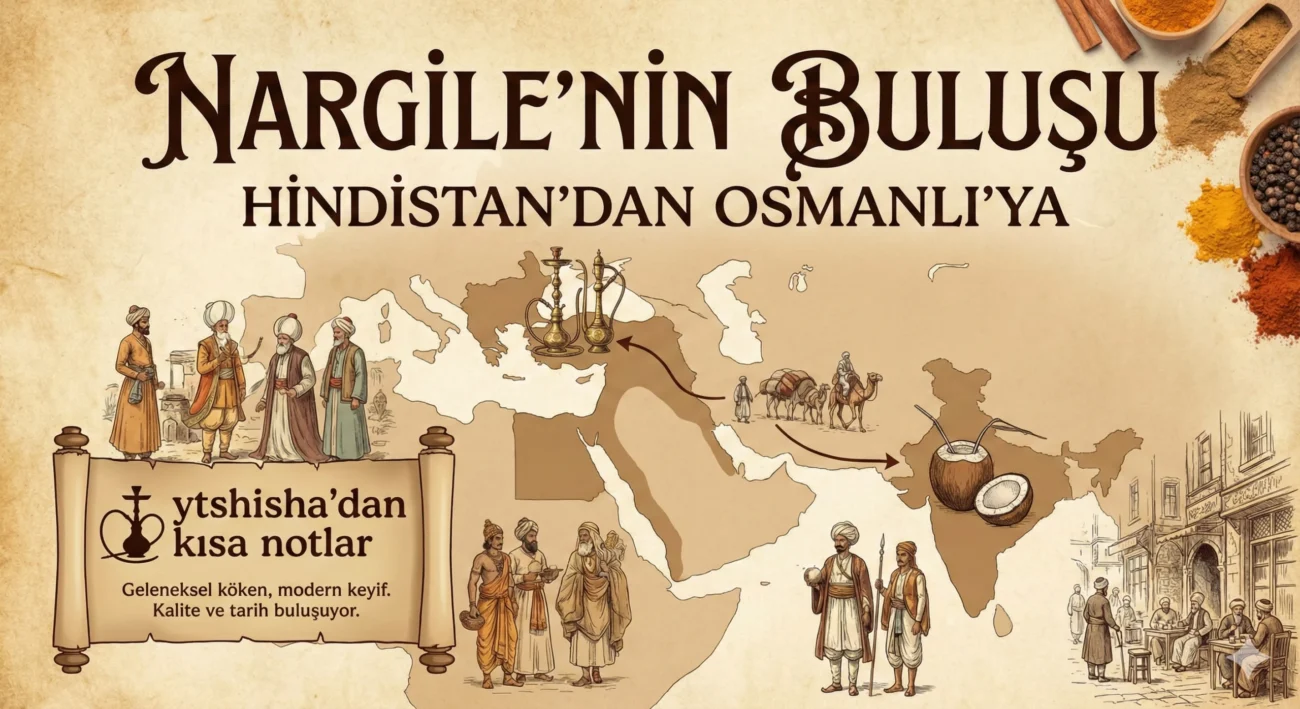
The Invention of the Hookah (From India to the Ottoman Empire: Brief Notes from ytshisha)
When you pick up a hookah, the following questions come to mind: Where did the hookah originate, who invented it, and for what purpose was it used? Today, it has become synonymous with pleasure and conversation hookah, It may have originated from a much simpler need in the early days. It is difficult to name a single person responsible for its invention, because the earliest examples are described in different ways in various sources.
According to the widely accepted account, the hookah’s roots trace back to India; it is said that the earliest versions were made from materials such as coconut shells, and that smoking was facilitated by a water chamber and a reed-like tube. It then made its way to Iran, where both its name and form took shape; the name “nargile” also became widespread, derived from the word “nargil” (coconut). With its arrival in the Ottoman Empire, it evolved from being merely a smoking device to becoming a natural part of long conversations in coffeehouses.
In this article, we’ll take a step-by-step look at the history of the hookah, starting with its earliest traces in India, tracing its development through Iran, and then examining how it reached the Ottoman Empire and became part of coffeehouse culture. Finally, we’ll discuss the tradition’s influence on the present day—specifically, why it’s still associated with the idea of “coming together.” Additionally, for those curious about the brand’s own story on the ytshisha side, on the website’s About Us We’ll also take a quick look at that page; because as hookah culture has evolved to the present day, modern production and design philosophies have also been an important part of that journey.
Where did the hookah first appear, and why was it invented?
The most commonly cited place as the origin of the hookah India, for that time period as well The Mughal Period. Although the “pleasure” aspect seems to take precedence today, the original idea stems from a more practical consideration: Instead of inhaling the smoke directly, soften by adding water. In short, you can think of the first hookah—rather than as a social accessory—as an attempt to make the smoke more “bearable.”
Although this origin story contains varying details depending on the source, it is widely accepted that the hookah evolved around the concept of water filtration. For the general overview: Hookah (Wikipedia) The page also provides a good introductory summary.
India during the Mughal period and the first modern concept of the hookah
New customs were spreading rapidly at the Mughal court (particularly during the reign of Akbar the Great). Life at the court was not solely dominated by politics and war; physicians, artisans, merchants, and, of course, newly arrived goods were all shaping daily life. Tobacco, too, was becoming a curiosity and rapidly spreading as a new habit during this period.
The person mentioned in this story Abu al-Fath of Gilan. Abu al-Fath, who is known as Akbar Shah’s physician, he built the first modern hookah This information is frequently cited. The emphasis on “modern” here is important; although primitive examples of drinking water are mentioned even before that, what Abu al-Fath did was to transform the idea into a more systematic framework.
At its core, the invention is based on a very simple principle: May the smoke trail go on and on, and may water come between us. You can think of it as letting a hot, strong cup of tea sit for a while to cool it down before drinking it, rather than drinking it right away. As the smoke passes through the water (it’s not exactly a “miracle,” but), it feels cooler and smoother. That’s the key difference that makes a hookah a hookah.
For a reliable historical framework regarding the Mughals TDV Encyclopedia of Islam, "The Baburids" entry ...and helps us understand the general atmosphere of the time.
What was the first hookah like, and what materials were used to make it?
When you compare the first hookah to today’s models, the difference is almost as striking as that between a “bicycle and a motorcycle.” The design described in the earliest accounts is quite simple:
- Coconut shell: It is being emptied; it is thought of as a kind of small reservoir, and inside it water is being poured.
- Reed-like tube: It serves as a simple pipe for drawing in smoke.
- A Simple Section on Tobacco: There is no extensive, fragmented system in the modern sense; rather, there is a more primitive “reservoir” logic.
The key point here is this: There were no glass bottles back then, no metal bodies, and no gaskets. In other words, it wasn’t a matter of “piecemeal engineering”; rather, it was a need that was met using the materials at hand. Coconuts are both easy to find and naturally suited to the shape of a reservoir. Reed works the same way—it quickly fulfills the need for a pipe.
This earliest form also explains why the hookah underwent constant changes in the centuries that followed. As its use became more widespread, so did the demands placed on it: better sealing, easier cleaning, a sturdier body, and a more stable smoking experience. It is therefore not surprising that glass, metal, and various craftsmanship techniques came into play in subsequent stages. This evolution also laid the groundwork for the hookah’s transformation from a mere “tool” into a “cultural object” by the time it reached the Ottoman Empire.
At this point, it’s worth adding that today, brands are carrying on this legacy in a different way. For example, if you’re curious about how YTShisha approaches production and design, check out the brand’s story About Us You can see it on the page. This historical timeline is actually a natural continuation of the evolution that began with the “coconut shell” and extends all the way to modern teams.
Where does the word "nargile" come from, and how did it develop in Iran?
The story of the hookah is not just the story of a “device,” but also a A Journey Through Names. The idea, which first emerged in India, took on a more familiar form—both in language and design—as it spread to Iran. The name and components of what we now call the “hookah” also took shape during these transitions.

Photo by Nima Gerivani
“From “Nārgīl” to “nargile”: Name, Meaning, and Cultural Traces
“The root of the word “nargile” is based on something more concrete than most people might guess: coconut. In Persian “"nārgīl" (According to some sources hookah) “It means “coconut.” This, in turn, derives from older forms in Sanskrit nārīkela It is reported to be related to . In other words, the word does not refer to the smoke itself, but rather to what was used in the earliest examples made of shell material bears traces of.
Think of it this way: The first contraption has no “brand,” no standard, and not even many parts. Whatever container is most suitable at hand is used. A coconut shell is both durable and has a shape that fits the container well. That’s why the name is more about the material indicates.
As the hookah spread to different regions over time, the same concept came to be known by different names. To avoid confusion, a brief overview will suffice:
- Common name in Iran: kalyan
- A common name in the Arab world: water pipe / shisha
- A name that became established in the Ottoman Empire and Turkey: hookah
There is a subtle cultural nuance here. Although the word “kalyan” is more common in Iran, the etymological root of “nargile” is hookah The name has left a lasting mark in both Ottoman Turkish and modern Turkish. In other words, on the one hand, the name evokes the original material from India, and on the other hand, it is part of the cultural transmission that took place via Iran.
If you’re curious about the broader context—such as how tobacco spread throughout the Eastern world and during which periods it was the subject of debate—the TDV’s tobacco This provision provides a reliable framework: https://islamansiklopedisi.org.tr/tutun
Design development: bottle, body, spout, mouthpiece
When the first simple setup from India made its way to Iran, people began to think of it more as a “set.” As its use became more widespread, people started asking the same questions: How can it be smoked more comfortably? Does it leak less? Is it easy to clean? It is at this point that the hookah begins to take shape, piece by piece.
You can understand today’s classic hookah set using simple logic as follows:
- Bottle (water reservoir): The bottom part of the hookah. The water sits here, and the smoke passes through it. There is a widespread belief that “the water cools the smoke and makes it smoother to inhale.” This is mostly feelings and experiences This is merely an observation and should not be interpreted as a health claim. Water lowers the temperature of the smoke, making it feel cooler, which may result in a gentler sensation in the throat.
- Body: The main component that connects the bottle to the top assembly. The main smoke path runs through here. Airtightness and balance are directly related to the craftsmanship of the body.
- Marpuç ((hose): The pipe you smoke through. It is one of the components that determine comfort. Its length, inner diameter, and material affect the “draw” sensation.
- Lüle: The part where the tobacco is placed. The way it conducts heat and “holds” the tobacco greatly affects the smoking experience.
- Tray: It prevents coal from falling and collects the ashes. It may look small, but it’s a lifesaver in practice.
As the design of the hookah matured in Iran, it ceased to be “something made at home by oneself” and craftsmanship and presentation It is evolving into a sturdy object. With glass bottles, sturdier bodies, and more balanced joints, the design we know today is taking shape.
If you want to see the parts one by one and grasp the concept more quickly, here’s a good example from the equipment side: hookah bowl category. Here you'll understand more clearly why the title (the name) is so defining: https://ytshisha.com/nargile-lulesi/
At this point, it’s worth making a brief note about modern production. The tradition dates back hundreds of years, but expectations have changed: better sealing, easier cleaning, and more consistent draw. YTShisha also positions itself on the modern side of this spectrum. If you’re curious about the brand’s history and its approach to production: https://ytshisha.com/hakkimizda/
When did the hookah first arrive in the Ottoman Empire, and how did it spread?
It is difficult to pinpoint a single day or a single name for the arrival of the hookah in the Ottoman Empire, because such customs generally do not spread “all at once” but rather in waves. Still, the general picture is clear: 16. the late 16th century and the early 17th century, This was the period when hookahs, along with tobacco, became a visible part of urban life. The “kalyan” tradition, which originated in Iran, changed both its name and its form of presentation in the Ottoman Empire, particularly Based in Istanbul It becomes a culture.
The driving force behind this transformation is actually quite simple: venue. In places where people gather, spend time together, and talk, the hookah ceases to be merely a “tool” and becomes a “companion.” From there, things quickly gain momentum: first the coffeehouse, then the mansion, then the palace, and finally, a custom that spreads to every neighborhood.

Photo by Emir Bozkurt
Coffeehouses and the Culture of Conversation: The Social Role of the Hookah
Imagine a coffeehouse setting: wooden chairs, small tables, a hookah bubbling away in the corner. No one is in a hurry. Because a hookah isn’t something you consume quickly, time that flows slowly ...and so on. That’s exactly why it’s perfect for long conversations where the topic keeps changing.
The popularity of hookah in coffeehouses has a lot to do with this “feeling”: time spent together. A cup of coffee is gone in a flash, tea is refilled, but the hookah stays on the table. It’s set up, the coals are adjusted, and the smoke settles. This process alone fosters a sense of togetherness.
If you’d like to explore the role of coffeehouse culture in Ottoman urban life from a broader perspective, check out the TDV’s Coffeehouse entry A good resource.
There are a few simple reasons why hookah has gained popularity in coffeehouses:
- A sense of ritual: The way it is prepared and presented sets the pace of the conversation.
- The Culture of Hospitality: Coffee, tea, Turkish delight, water; the hookah table functions much like a “hospitality” setup.
- Sense of community: Sitting at the same table doesn’t mean sharing the same smoke, but it does mean sharing the same moment.
If you’d like to take a closer look at this lineage, which stretches from the Ottoman Empire to the present day, along with its local practices,
Palaces, Mansions, and City Life: The Tömbeki Tradition
Tömbeki, To put it simply, the tobacco used in hookahs, which generally differs in its leaf structure and processing a special type of tobacco It is known as. Imagine a tradition different from that of modern flavored tobaccos; here, “the tobacco itself” takes center stage, and smoking habits are shaped accordingly.
What makes the hookah in the Ottoman Empire so interesting is that it wasn’t confined to a single social class. On one hand, there were coffeehouses; on the other, mansions and palaces. This transition made the hookah both a common practice does, and also from time to time reputation indicator It transforms. At the mansion, the hookah is served with greater care, while at the palace, the craftsmanship and quality of the materials become more apparent.
It’s no coincidence that certain neighborhoods in Istanbul are associated with hookah. For example, Tophane When people hear this, many think of a neighborhood culture synonymous with the hookah. The logic here is simple: craftsmanship, commerce, and crowds—when all these come together, the hookah becomes part of the “sound of the city.”
At this point, it’s nice to draw a small connection to the present. In the Ottoman Empire, the hookah evolved through craftsmanship. A similar tradition continues today. For those curious about the production side of YTShisha, these workshop photos convey that sense of craftsmanship more tangibly: https://ytshisha.com/uretim-atolyemiz-galeri/
Bans, fatwas, and the return: Why was this debated?
When tobacco was introduced to the Ottoman Empire, it wasn’t just a new product that arrived; a new habit It has arrived. New habits always spark debate. On one hand, there’s the concern that “social order is being disrupted”; on the other, religious interpretations; and on yet another, health concerns. The hookah, along with tobacco, has found itself right in the middle of these debates.
That is why, at certain times, restrictions We see that, particularly in the 17th century, tobacco and places where tobacco was smoked were sometimes targeted for various reasons. One of the most frequently cited examples is The Reign of Murad IV. It’s important to emphasize this: Prohibitions generally apply not only to “inside,” but also to, gathering ...is watching, too. A coffeehouse means a crowd; and a crowd sometimes means a risk to the government.
So what happens next? Restrictions ease, regulations change, and society adapts. Because the hookah isn’t just a passing fad; once it becomes part of daily life, it’s here to stay. Moreover, the commercial side is growing as well: the distribution of tobacco, the tax system, and the supply chain. In other words, it’s not just about “enjoyment,” The New Rhythm of City Life.
For those seeking a more academic perspective, here is an example of a comprehensive study examining the social and economic impacts of tobacco in the Ottoman Empire: https://www.academia.edu/en/68596206/Osmanl%C4%B1_%C4%B0mparatorlugunda_t%C3%BCt%C3%BCn_social_political_and_economic_analysis_1600_1883_Tobacco_in_the_Ottoman_Empire_Social_Political_and_Economic_Analysis_1600_1883_
How did the hookah spread to neighboring countries, and how did the modern hookah take shape?
The spread of the hookah is due more to factors other than a single “carrier” than to trade routes, urban culture, and crafts It all came about thanks to this. The idea, which first emerged in India, took on a name and form in Iran, became established in social life in the Ottoman Empire, and then acquired a regional identity in major urban centers such as Egypt and Damascus. What we call the “modern hookah” today is also the result of the needs that arose during this very journey—namely, easier cleaning, a sturdier body, and a more stable smoking experience.
The Cairo-Damascus Corridor: The Hookah’s Evolution into a Regional Identity
Think of it as a simple map: India → Iran → the Ottoman Empire → the Arab world (particularly the Egypt-Damascus route). At every stop, the hookah embodies the same concept, but the “presentation” and “smoking style” vary slightly. Just as the spices in the same dish differ from region to region, the hookah takes on the character of each city.
- India: The initial idea is more “practical.” A simple container, softening with water, a solution using whatever materials are on hand.
- Iran: Craftsmanship and form become more refined. The pieces take on a more defined shape, and the name “kalyan” becomes more widespread.
- Ottoman: The hookah, especially in coffeehouse culture a social ritual It changes. Presentation, manners, and setting become important.
- The Arab world (Egypt, Damascus, the Levant): “The term “şişe/shisha” comes to the fore; within cafes and urban life, the hookah becomes associated with a “culture of gathering.” This trend takes the hookah out of the home and into, public object of enjoyment turns it into.
The influence of the Cairo-Damascus axis becomes evident here: even the culture centered around the same hookah can vary. In one place, the hookah is more for “long sessions,” while in another, the flavors, serving style, and charcoal management take center stage. That is why there is no “one-size-fits-all hookah culture,” regional identities ...there is.
If you’d like to see a broader perspective on how tobacco spread throughout the Islamic world and how it was debated, the TDV’s entry on tobacco is a good reference: https://islamansiklopedisi.org.tr/tutun
Changes in materials and design: durability, aesthetics, ease of use
The modernization of the hookah is actually a very familiar story: As its use increases, people start saying, “It should be more durable,” “It should be easy to clean,” and “It should look good.” These three desires directly determine the choice of materials.
Glass Why was it loved?
- Cleaning: It's easier to detect odors and monitor sediment buildup.
- Appearance: The water level, color, and smoke flow—all of these become part of the visual experience.
- Ritual: The bottle is like the team’s “showcase.”
Metal (brass, stainless steel, etc.) Why did it stand out?
- Durability: It is more impact-resistant and has a longer service life.
- Airtightness and Stability: When combined with quality craftsmanship, it offers a more secure design.
- Ease of maintenance: Stainless steel surfaces are easier to maintain with regular care.
Porcelain and ceramics What did it bring?
- Thermal Management: In particular, the expectation is that heat will be distributed more evenly on the bowl side.
- Aesthetics and Tradition: A powerful language for those seeking an authentic look.
A brief “old vs. new” comparison would be helpful to clarify things for the reader:
| Title | The Old Approach | A modern approach |
|---|---|---|
| Body | Less fragmented, labor-intensive craftsmanship | Modular, detachable design |
| Bottle | Thick glass, locally produced | Various sizes and design options |
| Cleaning | Hard-to-reach channels | Easier access, more convenient maintenance |
| Usage | A single way of drinking, a local custom | Various nozzle, hose, and connection options |
When it comes to the production side of this modern trend in Turkey, the story of YTShisha offers an interesting example. According to real-time data, the brand traces its roots to 1967’and Yusuf Tekdemir’s pioneering role in hookah production in Turkey ...is based on this, while the growth of the modern YTShisha gained momentum around 2017 with an increased focus on retail expansion and production. In other words, at the stage the “modern hookah” has reached today, it is not just a matter of design aesthetics, but production discipline and standardization is also a determining factor.
If you'd like to see the variety of materials and models in today's hookah designs all in one place, here's an example of a collection page: https://ytshisha.com/nargile-takimlari/
Brief Notes on the History of Ytshisha and a Look at the Present
A hookah is not just about smoke and aroma; it is also craftsmanship, materials, and etiquette That’s what it’s all about. That’s why a brand’s positioning says more than just “which team it supports.” For ytshisha, the thread ties back to this: preserving the craftsmanship of the past while creating a more organized and practical experience that meets today’s expectations.
A brief historical note also supports this. According to recent posts, the roots of YT Shisha 1967 dates back to the year; at the heart of the family’s story is a company that has been a prominent name in the manufacturing sector in Turkey since its early days Yusuf Tekdemir ...is located here. You can see from the brand’s own narrative that this legacy is carried on today with a more modern approach to production: https://ytshisha.com/hakkimizda/
Why Is It Important to Explain Hookah Culture? Ytshisha’s Approach
Understanding the history of the hookah is not just for the sake of “nostalgia,” a smoother drink It’s useful for that. Because many of the choices you make today are actually a continuation of a legacy that has developed over the centuries.
Once you understand the historical context, you’ll be more aware of the following topics:
- Material Selection: Body options such as brass, steel, and aluminum aren’t just about appearance—they also influence cleaning and maintenance habits. The longevity of a set begins with regular maintenance and the right materials.
- Proper installation: The water level in the bottle, the seal, the hose connection, and the spout placement—these may seem like small details, but they directly affect the drinking experience.
- Respect for tradition: The hookah doesn’t really fit the “fast-paced” mindset. The setup, managing the embers, and the serving routine—all of these take time to fall into place. This creates a rhythm that prolongs the conversation and brings the atmosphere together.
ytshisha’s target audience is clear: people who love hookah, experiment with different setups, and ask themselves, “Why did that happen?” The language that resonates best with this audience is educational but not tedious a language. For example, when it comes to content and communication, an approach like this tends to be more well-received:
- Simple Explanation: “Instead of saying, “Put this part over there,” use result-oriented phrases like, “If you do it this way, the tension will ease.”
- Short checklists: So that both beginners can follow along and experienced users can quickly review it.
- Information focused on experience, not products: “Before saying, “This model is good,” make room for the question, “What kind of drink do you like?”
There is also a practical side to this approach. Someone who wants to choose the right pieces for their outfit will make more informed decisions even while simply looking at different outfit options: https://ytshisha.com/nargile-takimlari/
From the Past to the Present: A Message of Tradition, Craftsmanship, and Responsible Consumption
Bringing hookah culture into the present isn't just about recounting the past; Proper use, etiquette for sharing, and a respectful environment That’s what it means. When these three come together, the experience becomes even more enjoyable.
A brief and practical framework is as follows:
- Clean use: Simply cleaning the bottle and internal parts after each use helps reduce odor buildup. Maintaining the hygiene of the hose and mouthpiece makes a real difference, especially in crowded settings.
- Netiquette: Avoiding the use of shared mouthpieces, not mixing up mouthpieces, and handling the hookah carefully at the table—these may seem like “small courtesies,” but they help keep the atmosphere pleasant.
- Preserving Traditional Crafts: The production workshop, craftsmanship, and material quality—these are what prevent the hookah from being a “disposable” item. In short, caring for your hookah is also honoring tradition. If you’re curious, here’s a glimpse into the workshop: https://ytshisha.com/uretim-atolyemiz-galeri/
One final reminder: The hookah is associated with tobacco products and Tobacco products carry risks. Without ignoring this reality, it is more appropriate and respectful to discuss culture and craftsmanship.
Conclusion
The invention of the hookah is not a single moment when one person said, “I invented it,” but rather a journey spanning centuries. It originated in India with the idea of softening smoke with water, took on its name and form in Iran, and became associated with coffeehouses in the Ottoman Empire chat It became part of the culture. It was adopted in various forms along the route from Egypt to Damascus, and today it has become more practical thanks to the use of glass, metal, and modular components.
This story is a vivid example of how cultures influence one another. The same idea evolved slightly in each region, but at its core, it carried the sense of “coming together.” YTShisha’s production heritage, dating back to 1967, follows this same thread, striving to blend the essence of traditional craftsmanship with today’s expectations.
Turn the details you’ve read into a short checklist for your next setup: water level, seal, bowl, and charcoal management. What do you value most in your hookah routine—the ritual, the flavor, or the social aspect? If you share your thoughts, this moment will become even more meaningful.



Write a reply