

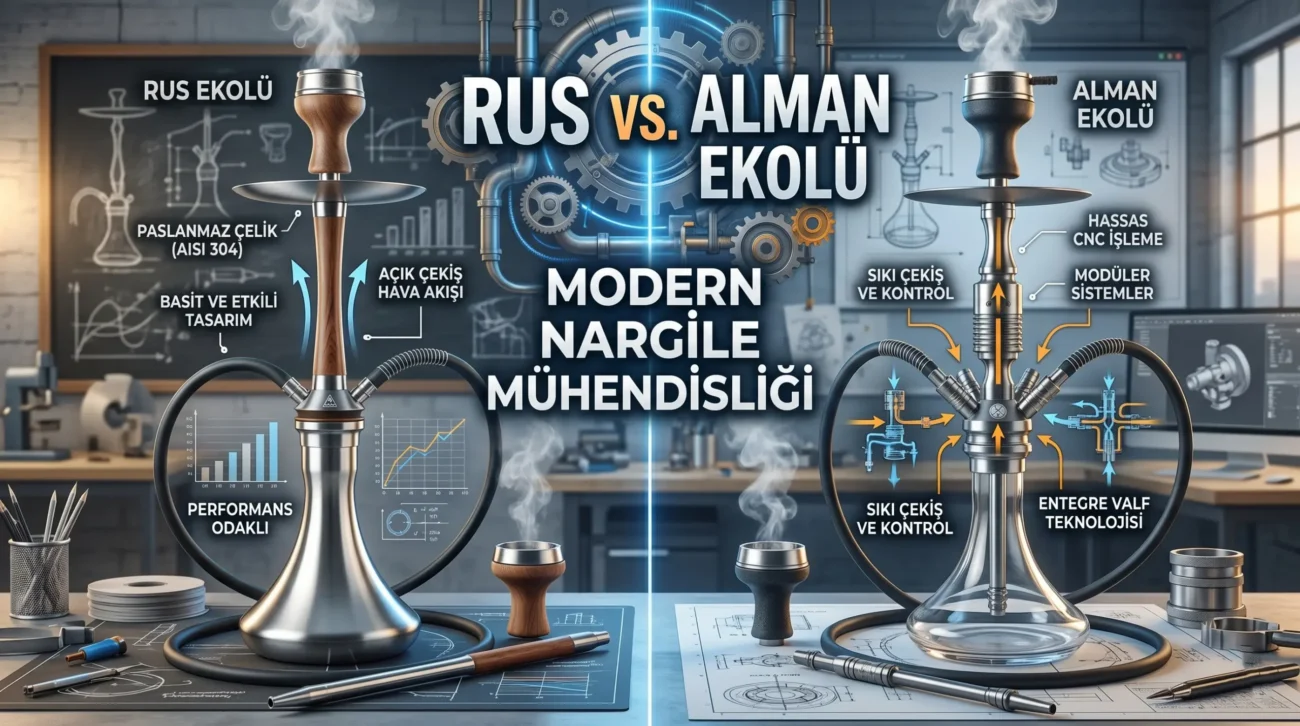
The Russian vs. German School – A Battle of the Titans in Modern Hookah Engineering
Traditional hookah culture has undergone a transformation over the past decade, giving way to marvels of advanced engineering. Today, the world of hookah is dominated by two major schools of thought: Russia and Germany. On one hand, the Germans, who have turned material quality and stability into a fetish; on the other, the Russians, who are rewriting the rules of innovation, aesthetics, and drinking dynamics.
In this article, we will take an in-depth look at these two poles of modern hookah engineering—from material selection to drainage systems, and from draw (diffuser) technologies to design philosophies.
1. The German School: Industrial Excellence and Stainless Steel (V2A/V4A)
The first word that comes to mind when you think of German hookah engineering “"Solid" (Sturdiness). German brands (MIG, Aeon, Steamulation) view the hookah not merely as a device for smoking tobacco, but as a machine component that will last a lifetime.
Material Quality and Workmanship
The German school uses surgical-grade stainless steel (usually V2A or with higher corrosion resistance V4A) ensured its standardization. This choice of material ensures that the hookah does not retain flavors, does not rust, and retains its original condition for years.
Key Technical Features
-
CNC Machining: Each part is machined on CNC machines with micron-level precision. The grooves (teeth) are so smooth that they feel like “butter” during assembly.
-
Heavy and Stable: German sets are generally heavy. This provides stability that prevents them from tipping over on the table.
-
Modularity: Many German teams allow the length to be adjusted by adding or removing parts.
2. The Russian School: Innovation, Aesthetics, and Functional Art
Russia is like the “Silicon Valley” of the hookah world. Russian engineers (Alpha Hookah, MattPear, Hoob, Union Hookah) have combined technology not only with the act of smoking hookah but also with the user experience.
The Purge Revolution
The Russian school’s greatest legacy to the world are innovative drainage systems. Instead of the smoke escaping through a hole in the tray, the Russians pioneered the practice of venting it upward from inside the body, horizontally, or through the decorative lids. Alpha Hookah Model X Models like these have made this visual style their signature.
Variety of Materials
The Russians aren't satisfied with just steel. Polyacetal (POM), By using materials such as aerospace-grade aluminum, stabilized wood, and carbon fiber, they make the sets both lighter and turn them into a visual feast.
3. Engineering Comparison: Which One Is Right for You?
| Feature | German School (e.g., MIG) | Russian School (e.g., Alpha Hookah) |
| Main Material | Pure V2A/V4A Stainless Steel | Steel + Polyacetal + Carbon/Wood |
| Towing Type | More resilient (Similar to traditional) | Generally clear and fluid (Whisper) |
| Connection Type | Plug-in or Rifled | Typically, Sliding and O-Ring/Magnet |
| Design Language | Industrial, Brutalist | Modern, Colorful, Artistic |
| Eviction | Standard or Regulated Valves | A Visual Feast (360 Degrees, Hidden) |
4. Flow Dynamics and Diffuser Technology
In modern engineering, “airflow” is the most critical factor in determining the character of a hookah.
The German Approach: Precise Control
German engineers focus on adjusting the traction according to the user's preferences. Steamulation "Airflow Control" systems developed by brands such as [brand names] allow you to adjust the drag resistance of each tire independently. This is the pinnacle of engineering.
The Russian Approach: Comfortable and Quiet
Adjustable or removable diffusers are standard on most Russian-made sets. The Russians have designed them to minimize the sound (gurgling) produced by the smoke as it passes through the water and to make the draw feel as light as if you were “drinking water.” “"Open Draw" They prefer that system.
5. Connection Systems: Magnet vs. Gear System
Engineering lies in the details. Even the way the hose is attached to the tool illustrates the difference between these two schools of thought.
-
The German Method: Precision grooves (threads) typically made of stainless steel, or “"Ground Joint" Conical metal joints—which do not require gaskets—are used. This guarantees 100% airtightness.
-
The Russian Method: Russians value practicality. Magnetic hose These connectors are an invention of the Russian school. They offer ease of attachment and removal but require high-quality coatings to prevent the magnets from corroding over time.
6. Aesthetics and Customization
Russian engineers view the hookah as an “accessory.” Sleeve (Thanks to "body cover" technology, you can completely transform the appearance of a Russian hookah—giving it a different color or texture (wood, carbon, resin)—by replacing just one part.
The Germans, on the other hand, adhere to the principle that “form follows function.” Their designs are more subdued, dominated by silver-colored steel, and exude an air of prestige.
7. Conclusion: Which One Should You Choose?
Which style is better depends entirely on what you “expect from a hookah.”
Choose the GERMAN SCHOOL in the following situations:
-
If you're looking for a set that will be passed down from generation to generation.
-
If you like heavy, sturdy, and industrial designs.
-
If precision engineering details and metalwork are a priority for you.
Choose the RUS EKOLÜ in the following situations:
-
If you're looking for modern, colorful, and unique designs.
-
If the evacuation scene (smoke show) is important to you.
-
If you prefer lighter, more practical, and innovative solutions (magnets, polyacetal).
Keyword Notes for SEO:
-
Modern Hookah Engineering
-
Russian hookah brands vs. German hookah brands
-
Stainless steel hookah sets
-
Hookah draw systems and diffusers
-
Best Hookah Set of 2026
Editor's Note: Keep in mind that no matter how advanced hookah engineering becomes, proper tobacco preparation and charcoal management (using an HMD) are still the most important factors for a good smoking experience. Engineering is there to help make this process as comfortable and stable as possible.


Write a reply