

How to Choose a Hookah Hose: Silicone, Leather, Metal, and Length

Summarize this article with AI
Discover the key points with your preferred tool.
The title, article link and text context are sent to your chosen tool.
What matters most in choosing a hose isn't one superior material; it's how well the hose fits your cleaning routine, your grip preference, and your set's connection size. Silicone hoses are usually designed to be washable. Traditional leather- or fabric-covered hoses, on the other hand, are usually sensitive to water. Metal shows up mostly in the handle and end pieces rather than in the hose itself.
This guide compares hose materials, handles, length, weight, mouthpiece compatibility, and connection size from an equipment perspective. It doesn't recommend any brand or model; for details such as size, length, and whether washing is allowed, your model's own manual is the reference. Checks should be done on cool, empty equipment with no charcoal.
What parts make up what we call a hose?
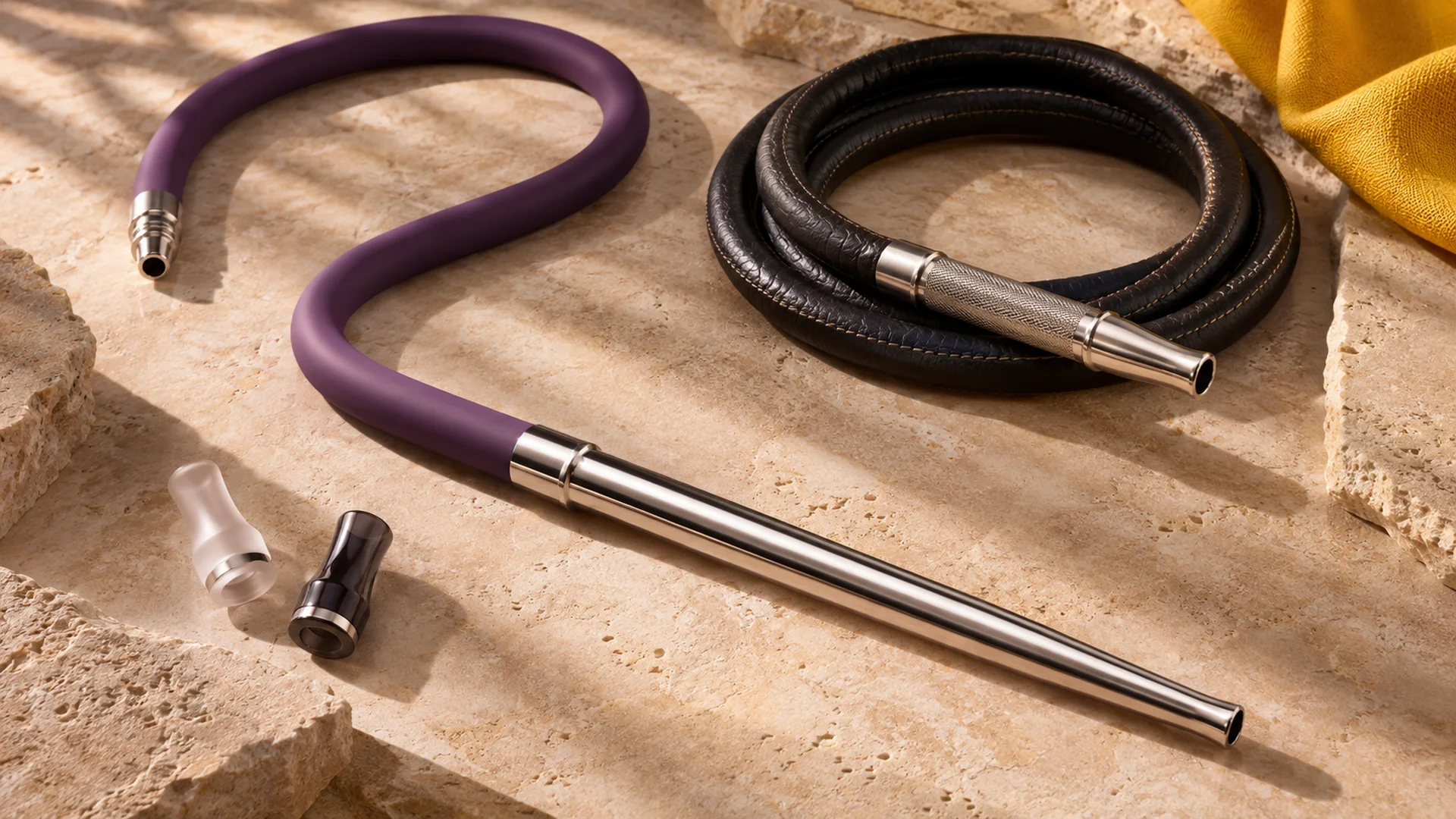
In everyday speech, “hose” sometimes means only the flexible tube and sometimes the tube together with the handle and end pieces. When comparing, you first need to be clear about which part you mean, because a different handle or mouthpiece can be fitted to the same hose.
- Hose body The flexible section that carries the airway. It can be silicone, leather- or fabric-covered, vinyl, or plastic.
- Handle The rigid section you hold in your hand. It can be metal, resin, wood, or coated.
- Mouthpiece The tip that goes to your mouth. It may be a separate piece that fits onto the handle; on some models, it's built into the handle.
- Heel and connector end The end of the hose that sits in the stem or the hose port. This is where size compatibility matters most.
Hose materials: silicone, leather- or fabric-covered, and metal-reinforced
The hose material is the decision that most affects how you care for it and how long it lasts. A hose's outer surface alone doesn't show whether it's washable. That's why the material information on the label and the model's instructions are the first places to look.
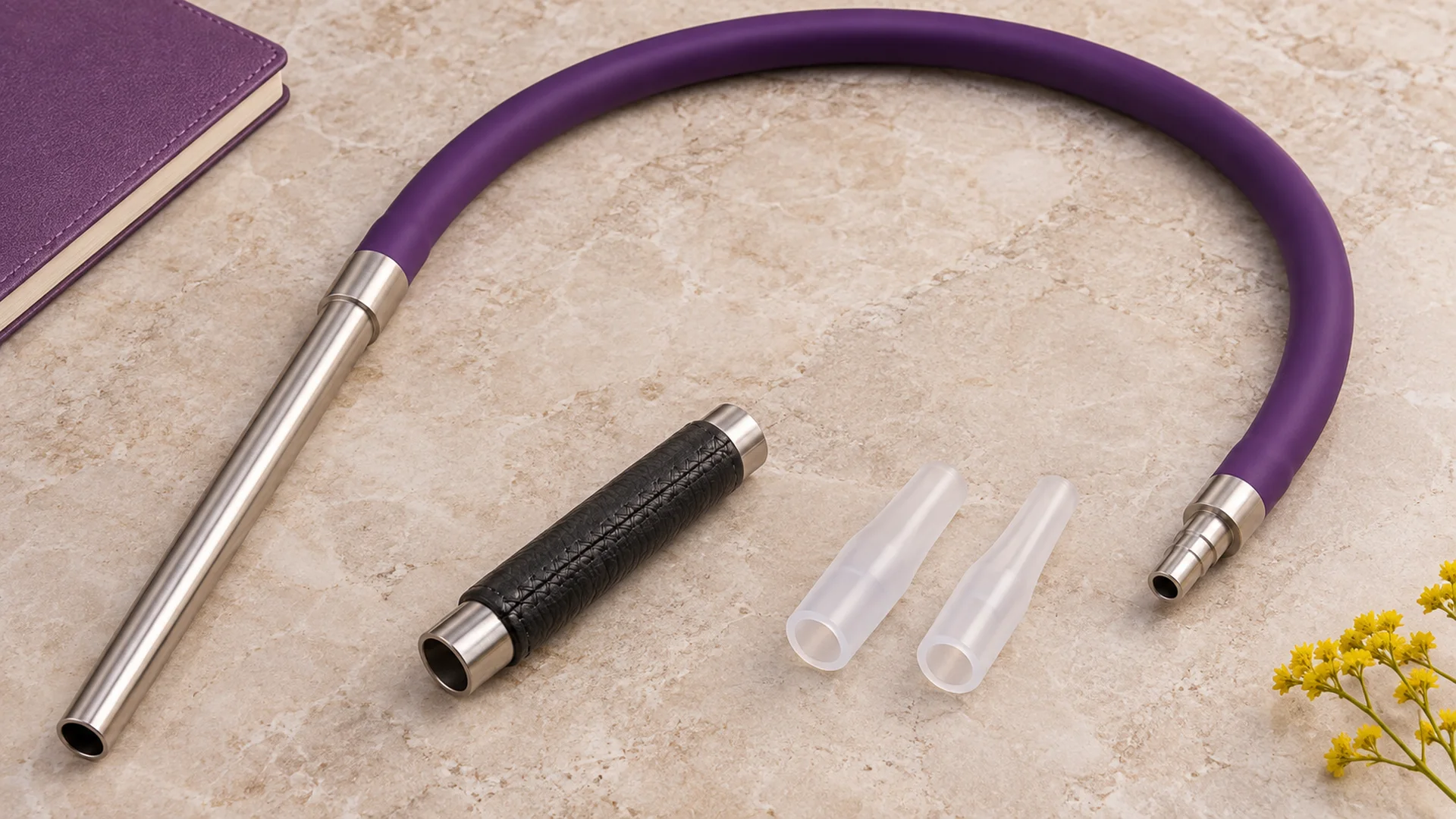
- Silicone hose Retail and information pages usually describe it as the washable, flexible option that holds on to old flavors less. Durability depends on the quality of the product. For washing temperature and cleaners, follow the model's instructions.
- Leather- or fabric-covered hose It offers a traditional look; however, most hoses of this type aren't washed with water and can retain residue over time. They are said to need more care and to wear out faster. A common recommendation is to blow air through them after use and let them dry.
- Hybrid construction Some hoses have a leather exterior and a silicone inner tube. A construction like this may be washable, but that depends on the label and the manufacturer's description.
- Metal-reinforced or spiral-frame hose Traditional hoses may have a metal coil under the covering. This frame can be sensitive to water and can be damaged by sharp bends. You can't tell from the outside whether there's metal reinforcement.
A second factor in choosing is how often you use the hose. If you clean it after every use, a washable construction can reduce the maintenance load. If you use it occasionally and are used to drying the hose by blowing air through it, a traditional construction is also worth considering.
Limiting the difference between silicone and leather to washability leaves things out. The feel, stiffness, and bending behavior of the hose also change. These qualities vary from model to model; read the catalog and the product description together.
Material comparison table: cleaning, lifespan, and grip
The table below summarizes general tendencies; it is not an exact measurement or a product promise. Results may differ for individual products.
| Material | Cleaning | Lifespan and care | Grip and feel |
|---|---|---|---|
| Silicone hose | Washable on most models; check the instructions | Can last a long time depending on quality; watch for wear and odor | Flexible, bends easily |
| Leather- or fabric-covered hose | Usually not washed with water; air is blown through it | Needs more careful maintenance; the covering can wear over time | Traditional look, stiffer or more structured feel |
| Hybrid (leather outside, silicone inside) | Depends on the manufacturer's washing information | Documentation matters because the layers behave differently | Classic look, flexible inside |
| Metal or spiral-frame hose | Using water is uncertain because of the frame; instructions are needed | Watch for kink and crush points | Can hold its shape better; may have a bending limit |
| Metal handle | Cleaned separately if it can be detached | Check the surface coating and the thread opening | Often feels heavier than resin or plastic |
Cleaning and lifespan go hand in hand. If you can't see inside the hose, don't assume it's fine after cleaning. For this, you can follow the steps in the can you wash a hookah hose guide. If you notice odor or changes to the inner surface, the odor and mold in silicone hoses article can point you in the right direction.
For a hose documented as washable, the care routine generally goes as follows. At each step, your model's own instructions take priority.
- Make sure the hose is completely cool and empty.
- Remove the handle, mouthpiece, and heel parts the manufacturer allows you to detach; don't force parts that are stuck together.
- Follow the instructions for water temperature and cleaners; don't insert sharp tools into the inner channel.
- Hang the hose and let the inside dry completely, and don't put it in a closed bag while it's damp.
- Before assembling, check for cracks, hardening, stickiness, or a lingering odor.
Rather than trying to fix a hose that shows signs of wear by cleaning it, it's better to set it aside. Cracks on the outer surface, looseness around the handle, or restricted airflow are signs it needs replacing. For parts lists and spare parts, you can also check the grommets and replacement parts category.
Length, weight, and grip
There's no single right hose length. Some retail sources say common hoses are about 180 cm (72 inches) in total. In another example, a 150 cm hose is described as long in terms of freedom of movement. So these figures are examples from the market, not a standard.
- Short hose Takes up little space at a table and tangles less. It may fall short for people sitting far from the stem.
- Long hose Gives room to move around the seating area. If it's too long, it can drag on the floor, get crushed, and be harder to dry after cleaning.
- Weight A metal handle or thick outer covering can make the end of the hose heavier. When held for a long time, you may feel strain in your wrist and elbow.
- Grip A smooth, slippery surface and a textured surface feel different. The handle length should also suit the size of your hand.
Keep the hose away from heat sources. Don't run it over a hot heat management device, charcoal, or ash; silicone and covering materials can be damaged on hot surfaces, and there's a risk of burns. Gather up the hose without tangling it, after the equipment has cooled completely.

Mouthpiece and connection size compatibility
You can choose hoses and mouthpieces independently of each other, but not every combination fits. Some sources note that because washable hoses tend to have similar diameters, handles and heel parts are often interchangeable between brands. Even so, compatibility varies by model; some hoses are designed only for their own set.
It's also noted that an extra ring or adapter may be needed to fix a loose connection. Still, rather than trying to make the size fit on your own, check your set's connection information. Otherwise, a connection that leaks or sits crooked can affect the airway.
- Identify your set's hose port type from the manual or the product page.
- Check that the hose's heel end is made for the same connection type.
- Find out whether the handle comes with a mouthpiece or separately.
- If you're buying a new mouthpiece, read the connection information in the hookah mouthpieces product descriptions.
- Once fitted, check the connection for any play on a cool, empty system.
Problems such as water coming through the hose may be caused by the connection or setup; for details, see the water coming through the hose guide.
Quick decision guide: which one for which situation?
The suggestions below are general tendencies. Before deciding, read the material and care information on the product page.
- If you clean often If the manufacturer allows washing, a silicone hose is an easy option to maintain.
- If you want a traditional look A leather- or fabric-covered hose is worth considering; keep in mind that it can't be washed with water and will need more careful care.
- If you want both looks and washability Choose a hybrid construction only if washing is documented as allowed.
- If the weight in your hand tires you Look for a lightweight handle and a shorter hose.
- If you want to use a different mouthpiece Choose a model with a handle whose mouthpiece can be removed.
- If your set has a proprietary connection Confirm compatibility first, then choose the material.
This checklist gives you a quick way to narrow things down before buying. If there's an item you can't answer, ask the seller or manufacturer for information.
- Material Does the product description list the outer covering and the inner tube separately?
- Washing allowed Does it clearly state that it can be cleaned with water?
- Connection Does the heel end match your set's port type?
- Length Does it suit your seating and storage setup?
- Replaceable parts Can the handle or mouthpiece be bought separately?
For where and how to dry it, the drying hookah parts guide is helpful. If you've decided on a new hose, compare the product descriptions in the hookah hoses category in terms of material, length, and connection information.
Frequently asked questions
Is a silicone hose always better than a leather hose?
No. Silicone usually makes washing and odor easier, while leather offers a different look and feel. Which one suits you depends on your care habits and your set.
Can I wash a leather-covered hose with water?
Water isn't recommended for most traditional leather- or fabric-covered hoses. For a hybrid construction, whether washing is allowed depends on the manufacturer. If there's no documentation, don't test it by running water through it.
How should I choose the hose length?
Consider your seating distance, table layout, and cleaning area. A very long hose can drag on the floor and kink. A very short hose, on the other hand, limits comfortable seating.
Will another brand's handle or mouthpiece fit?
With some washable hoses, parts are interchangeable between brands, but this isn't a hard rule. Check the model information for connection type and diameter. If you're not sure, ask the seller to confirm.
When does a hose need replacing?
If there's wear, cracking, restricted airflow, or a lingering odor that doesn't go away with cleaning, it's time to evaluate it. When you notice any of these signs, set the part aside and consult the manufacturer's information.
Sources and scope
This article is about choosing and caring for equipment; it doesn't recommend any particular product, brand, or smoking habit. Size, length, and washing information was compiled from retail and information pages; these sources may have a commercial angle. Your model's manual always takes priority.
- Hookah.com, Hookah Hoses 101: hose types, washability, common length, and interchangeable handle and heel parts.
- The Hookah Lab, hose guide: notes on silicone vs. leather, care, lifespan, and connection compatibility.