

Nargile vs Shisha vs Hookah: Name Origins and Style Differences

Summarize this article with AI
Discover the key points with your preferred tool.
The title, article link and text context are sent to your chosen tool.
Nargile, shisha and hookah are names for the same device in three different languages: a water pipe in which tobacco is heated in the bowl and the smoke passes through water before being drawn through the hose. The difference between nargile, shisha and hookah lies not in the device's construction but in the language the word comes from and the region where it is used. Real design differences show up in styles such as brass Kahveci, Russian-style and modern steel, not in the names.
This article covers the origins of the three names, which one is preferred in which country, and what is meant by a “style”. It does not present any style as superior to another. Origin information is based on dictionary and encyclopedia records; accounts that give no exact date are reported as such. Hookah is a tobacco product and is not sold or served to anyone under 18.
Nargile vs shisha vs hookah: the same device, different names
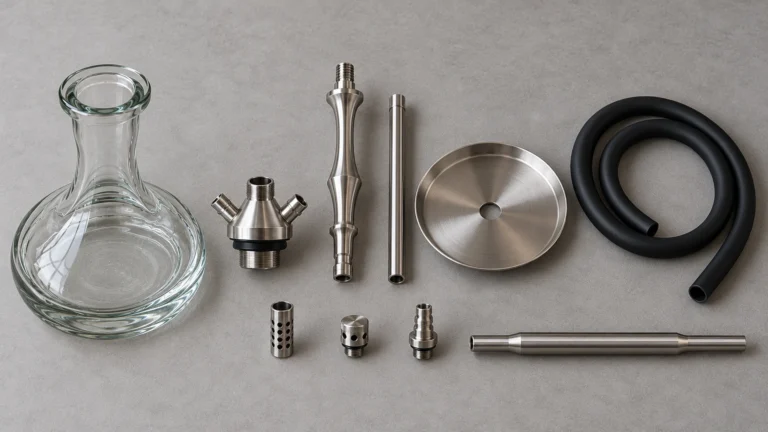
The basic layout of a hookah set is the same in every language. At the top are the bowl holding the tobacco and the heat source, in the middle the long stem, and at the bottom the base containing water and the hose that carries the smoke to your mouth. Turkish Wikipedia's part definitions follow the same layout: the “ser” is the long stem, the lüle (bowl) is the perforated part where the tobacco goes, the marpuç (hose) carries the smoke from the base to the mouth, and the şişe (base) holds the water the smoke passes through.
This layout is the same in Istanbul, Cairo and London. The only thing that changes is the name given to the device. Turkish uses “nargile”, Egypt and much of the Arab world use “shisha” (şişa), and English uses “hookah”. In German-speaking countries, “Shisha” is also the common name for the device. So it would be wrong to expect a structural difference between a “hookah” bought abroad and a hookah set sold in Turkey simply because of their names.
This matters when shopping, too. When evaluating a model, let the stem material, connection design and package contents on the product page guide you, not the name. To see the parts' names and functions in detail, check out our hookah parts and names article are available to browse.
Word origins: coconut, glass vessel and jar
Each of the three names refers to a different aspect of the device. One reflects the material of the earliest chamber, one the glass vessel holding the water, and one the general meaning of a vessel or jar. That is why all three are correct; each simply highlights a different detail.
Hookah
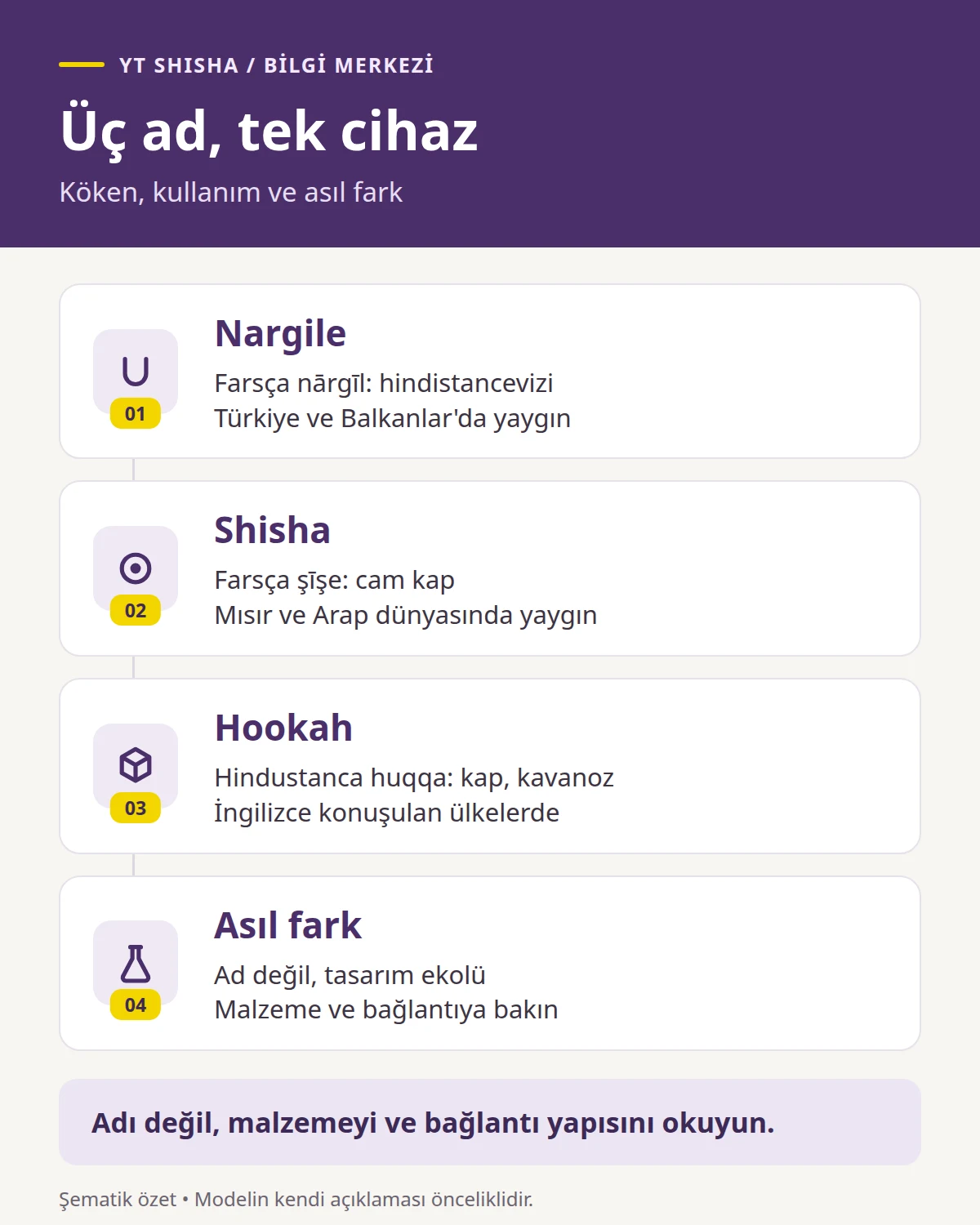
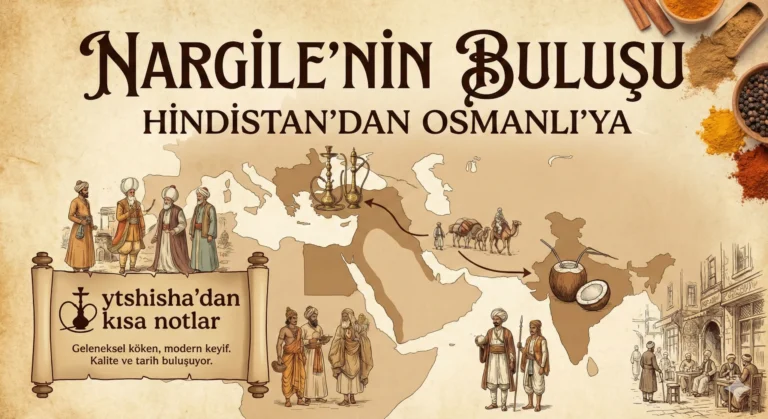
According to Turkish Wikipedia, the word nargile derives from the Persian nārgīl, which in turn goes back to the Sanskrit root nārikela, meaning “coconut”. English Wikipedia makes the same connection and notes that the first water pipe chambers may have been made from coconut shells. Besides Turkish, the word is used in similar forms in the Balkans, Greece, Cyprus and Israel. The same source reports that the hookah became part of Turkish and Balkan culture from the 17th century onward.
Shisha
Shisha passed into Arabic from the Persian šīše, meaning “glass, glass vessel”, by way of the Ottoman Turkish “şişe”. Wiktionary writes that the English word shisha was borrowed from Egyptian Arabic and that this chain reaches back to Persian through Ottoman Turkish. In short, the word that names the whole device in the Arab world today is, in Turkish, only the name of the part that holds the water.
Wiktionary also records a second meaning for shisha: the tobacco smoked in a hookah, mixed with molasses and flavoring. This double meaning is why some European sales pages use the word “shisha” for the tobacco rather than the device.
Hookah
Hookah comes from the Hindustani word huqqa, which in turn is linked to the Arabic root ḥuqqa, meaning “vessel, jar”. According to the Online Etymology Dictionary entry cited by Wiktionary, the word has been documented in English since 1763. English Wikipedia notes that the word took hold in English largely during the British colonial period in India.
| Name | Origin | Root meaning | Where it is common |
|---|---|---|---|
| Hookah | Persian nārgīl, Sanskrit nārikela | Coconut | Turkey, the Balkans, Greece, Cyprus, Israel |
| Shisha (şişa) | Persian šīše, Ottoman Turkish şişe | Glass, glass vessel | Egypt, Sudan, North Africa, German-speaking countries |
| Hookah | Hindustani huqqa, Arabic ḥuqqa | Vessel, jar | English-speaking countries |
| Argile (arjīlah) | Arabic | A name related to nargile | Lebanon, Syria, Jordan, Palestine, Iraq, Kuwait |
| Kalyan (ghalyān) | Persian; Arabic ghalyūn (“pipe”) | Pipe | Iran and Persian-speaking countries; Russian-speaking countries |
The regions in the table are compiled from the naming section of English Wikipedia and do not draw strict boundaries. Several names can be used side by side in the same country; in Turkey, too, the word “shisha” appears especially in brand and venue names.
Argile, kalyan and other names
Beyond the three common names, there are many local names for the device. Knowing them is useful, especially when reading a product description or setup video from a foreign source.
- Argile The most common Arabic name in Lebanon, Syria, Jordan, Palestine, Kuwait and Iraq. Its sound kinship with the Turkish nargile is easy to spot.
- Kalyan Used in Persian-speaking countries. English Wikipedia notes that in Armenia it is also called “kalyan” under Russian influence; that is why the name appears so often on international sales pages for Russian-style sets.
- Hubbly bubbly A colloquial name used in South Africa. It refers to the bubbling sound the water makes.
- Water pipe A descriptive phrase used in Turkish encyclopedic texts and translations to describe the hookah; it is not a trade name.
None of these names defines a particular material, height or connection type. Although a listing that says “kalyan” often describes a Russian-style set, don't treat this as a firm rule, and read the model's technical details separately.
Style differences: the real distinction is in the design, not the name
While the names describe the same device, design styles genuinely offer different experiences. A “style” here does not mean a standard; it means shared design choices that stand out in a particular region or manufacturing tradition. The modern developments section of English Wikipedia sums up this shift: manufacturers increasingly use stainless steel and aluminum instead of copper, brass and low-grade alloys, and silicone is replacing leather in hoses.
| Style | Typical look | Construction tendency | Who it suits |
|---|---|---|---|
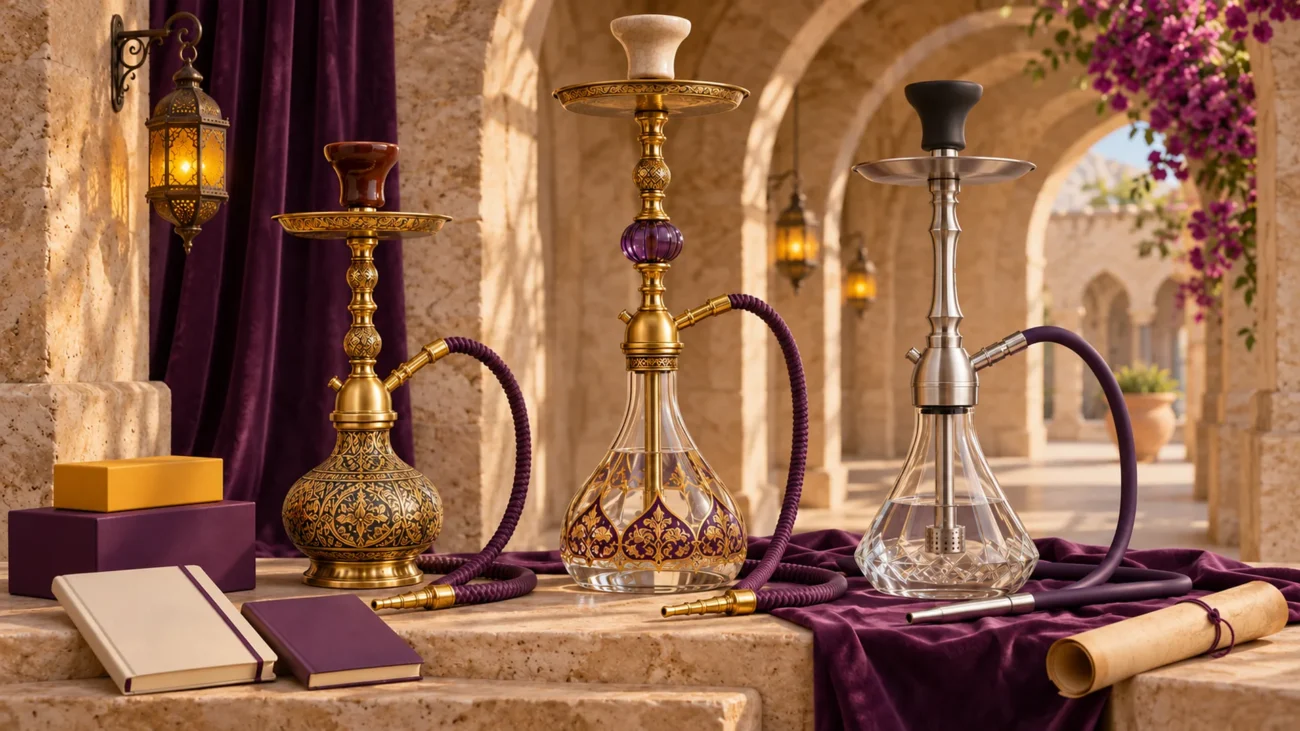
| Traditional Turkish (Kahveci) | Mostly brass, often an engraved stem, a wide glass base | A one-piece stem; the connection type varies by model | Those who want a classic, decorative table setup |
| Arab and Egyptian coffeehouse tradition | Stem and base shapes that vary by region and workshop | Depends on the local manufacturing tradition | Those drawn to a traditional look |
| Russian-style | Plain, modular, technical look | Mostly detachable parts, with a purge valve and diffuser setup | Those who want to replace and adjust parts individually |
| Modern steel and aluminum | Lines finished in metallic, colored or cut glass | Stem material and surface finish vary from model to model | Those looking for a contemporary look with relatively simple maintenance |
This table is not a ranking, and not every model follows these tendencies. For example, some Kahveci models may have threaded connections, while some modern sets keep the classic stem shape. To get to know the traditional form, see our article on Kahveci (brass) hookahs, and to compare Russian and German design approaches, see our article on the Russian and German styles is a useful reference.
As a brand that has been making hookahs in Istanbul since 1967, YT Shisha offers several of these styles under one roof. Brass Kahveci hookah sets represents the classic form, and Russian hookah sets the modular design. If you'd like to see all the groups together, the hookah sets page, with its material and usage filters, is a good place to start.
Which word means what in Turkey?
In everyday Turkish, the word “nargile” refers both to the device and to the habit of smoking it. “Hookah set”, or “nargile seti”, refers to the complete set you can buy, made up of the stem, the base and usually a tray. The bowl, hose and heat management device are included in the package with some models and bought separately with others.
In Turkey, the word “shisha” is seen mostly in brand, venue and international product names. Although this usage carries a kinship based on the word's shared origin with the Ottoman Turkish “şişe”, for a Turkish speaker “şişe” is still the part that holds the water. “Hookah”, meanwhile, shows up in Turkey almost only in English product titles and on foreign websites.
If you're curious about the cultural background, our articles on the invention and historical journey of the hookah with hookah culture around the world cover the traditions of different regions in more depth.
Name confusion when shopping: what to look for
Different names can cause confusion, especially with products from abroad or on multilingual sites. It is normal for the same model to be listed as “hookah” on one page, “shisha” on another and “nargile takımı” on a Turkish page. Make your decision based on these questions, not the name:
- Device or tobacco? On a European page, the word “shisha” may refer to the tobacco. Check the product photo and package contents.
- Body material It can be brass, stainless steel, aluminum or glass. The name doesn't tell you this; the technical specifications section does.
- Connection design Is the base push-fit or threaded? Is the grommet size specified? This information matters if you are planning to buy spare parts.
- Package contents Are the bowl, hose and tongs included in the package, or do they need to be bought separately?
- Usage type Tabletop or floor-standing? Does the total height fit the space where you'll use it?
These five questions are far more decisive than “nargile, shisha or hookah?”. Checking the dimensions and materials on the product page largely clears up the ambiguity the names create.
Frequently asked questions
Is there a structural difference between shisha and nargile?
No. Both describe the same water pipe. Shisha is the common name in Arabic- and German-speaking countries, nargile in Turkey and the Balkans. Structural differences depend on the model's design, not the name.
Where does the word hookah come from?
It comes from the Hindustani word huqqa, which is linked to the Arabic root ḥuqqa, meaning “vessel, jar”. The word entered English in the 18th century by way of India.
What does the word nargile have to do with coconuts?
Nargile derives from the Persian word nārgīl, meaning coconut. Sources note that the first water pipe chambers may have been made from coconut shells. This is reported as a possibility, and no exact date is given.
Does a set called kalyan mean a Russian-style hookah?
Kalyan is a name of Persian origin that is also used in Russian-speaking countries. That is why it often appears in listings for Russian-style sets. However, the name alone does not guarantee the design; check the model's construction in the product description.
Will hookah accessories I buy abroad fit a Turkish hookah?
You can't tell from the name. Compatibility depends on measurements such as the bowl seat diameter, hose port, grommet size and base connection. Compare these measurements on both products' pages.
Sources and scope
This article is general information about the origins of the names nargile, shisha and hookah and about design styles; it makes no health claims and does not encourage tobacco use. Word origins are drawn from dictionary and encyclopedia records; usage information by country reflects general trends. The style table is not a definitive classification; the material and connection details of each model should be verified separately on its product page.
Sources reviewed: Wikipedia, Hookah, Wikipedia (Turkish), Nargile, Wiktionary, hookah and Wiktionary, shisha. These are community-edited sources; origin information should be read together with their own references.

Leave a Reply