

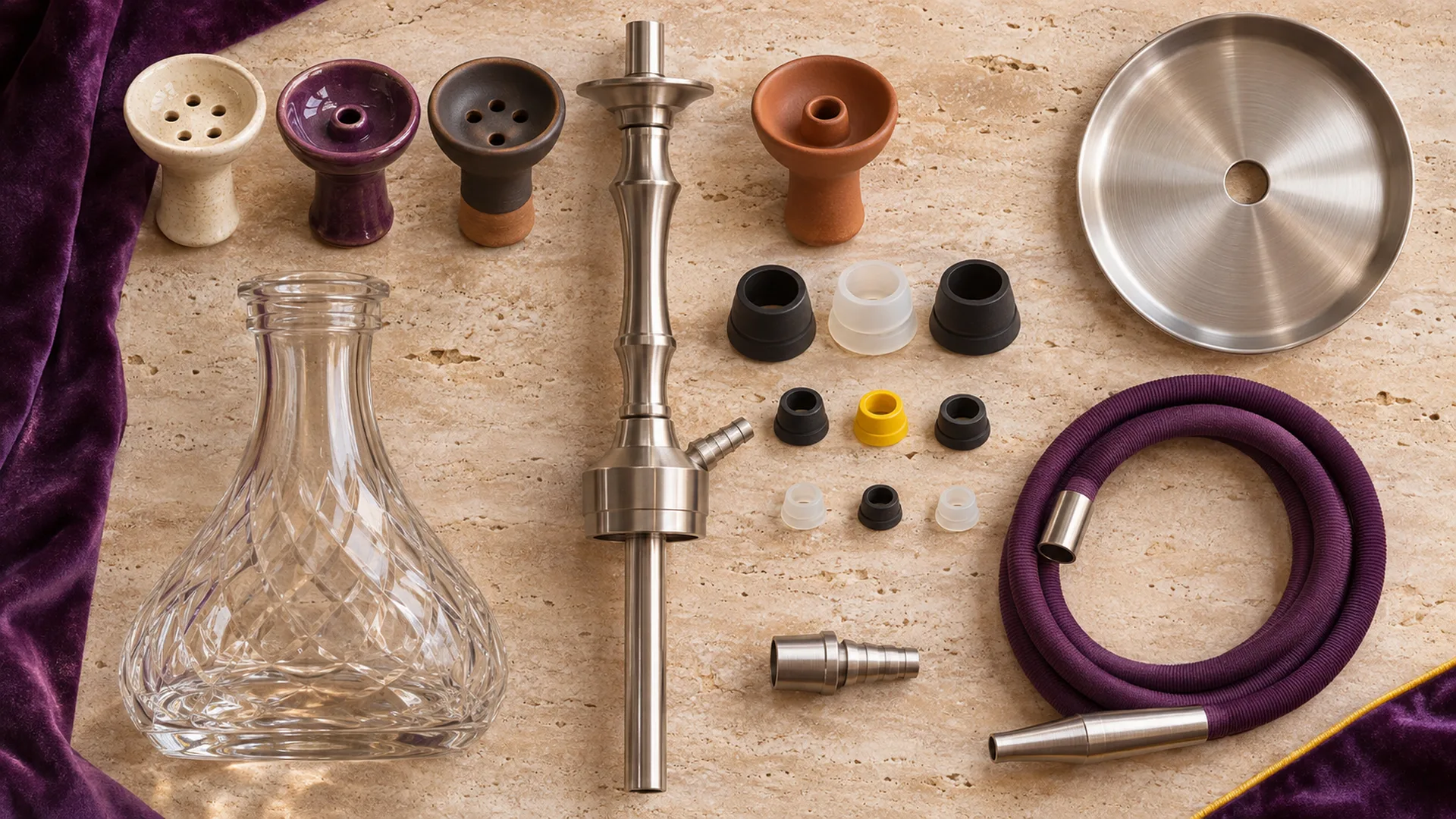
Hookah Set Parts Compatibility Chart: Bowl, Grommet, Stem and Base

Summarize this article with AI
Discover the key points with your preferred tool.
The title, article link and text context are sent to your chosen tool.
Compatibility between hookah set parts is determined by the measurements at the connection points, not by overall height. Check the opening and grommet on the bowl, the connection type and opening inner diameter on the stem and base, the water depth on the downstem, and the port and adapter diameter on the hose. When buying spare parts, record these measurements the same way each time.
This guide explains step by step which part connects to which in a hookah set, which measurement matters at each connection, and how to take that measurement. It does not give millimeter values for specific models; every manufacturer's sizes differ, and exact figures come from the size information on the product page. Do all checks on a cold, empty set with no charcoal.
Hookah set parts and their connection points
A hookah set may look like a single unit from the outside, but it actually works through a series of connections. Air enters through the bowl, passes through the stem and downstem into the water in the base, rises out of the water into the space at the top of the base and reaches you through the hose. Every joint along this path raises a fit question.
For the names and functions of the parts, see our hookah parts and names article — here the focus is not on the parts themselves but on how they connect to one another.
- Bowl and stem The bowl sits on the top end of the stem, either directly or on a grommet. On Kahveci-style sets, a ser grommet is usually used at this point.
- Stem and base The stem attaches to the base opening with a grommet push-fit, a threaded ring or a manufacturer-specific lock. Comparing diameters without knowing the connection type is misleading.
- Downstem and water The downstem runs down from the stem and its tip sits in the water. Some models have a diffuser on the tip.
- Hose and port The hose connects to the port on the stem or base head directly, with a grommet, or through an adapter.
- Eviction On models with a purge valve, the ball, seat and cap work together; these three must also match one another.
Parts lists for YT Shisha sets also vary by model; some packages include a bowl, hose and tongs, while others contain only the stem, base and tray. When replacing a missing part, checking the package contents on the product page first helps you avoid unnecessary purchases.
Compatibility chart: which measurement matters at each connection?
The chart below summarizes what to check at each connection between hookah set parts. It is not a list of sizes but a checklist template showing which measurements to record.
| Connection | Key measurement | How to check | Common mistake |
|---|---|---|---|
| Bowl – stem | Inner diameter and depth of the bowl's bottom opening, grommet thickness | Measure the bowl opening with the inside jaws and the stem end with the outside jaws | Looking at the bowl's top diameter without measuring the bottom opening |
| Gasket | Inner diameter and cross-section thickness | Measure the old grommet on a flat surface without stretching it | Noting only the outer diameter |
| Stem – base | Connection type, opening inner diameter, seating depth | Identify the connection type first, then measure the diameter | Assuming a base of the same height will fit |
| Downstem – water | Downstem length and inner height of the base | With the stem fitted, check the distance from the downstem tip to the bottom of the base | Pairing a long downstem with a short base |
| Hose – port | Port diameter, adapter type (grommet, magnetic, threaded) | Record the inner and outer diameter of the port separately | Assuming the adapter is included in the package |
| Eviction | Ball diameter, seat and cap size | Inspect the ball and seat together | Using a ball from another model |
Each row in the chart is a separate question. A good fit at one connection does not mean the others fit too. For example, the base opening may seat on the stem while the downstem still touches the bottom of the base; in that case the connection fits but the internal layout does not.
How to measure: tools and method
The most practical measuring tool is a caliper. A ruler or tape measure can help with outer dimensions, but the margin of error grows on small diameters such as openings and grommets. The caliper's outside jaws measure a part's outer diameter, and the inside jaws measure the inner opening of a hole; don't mix up the two.
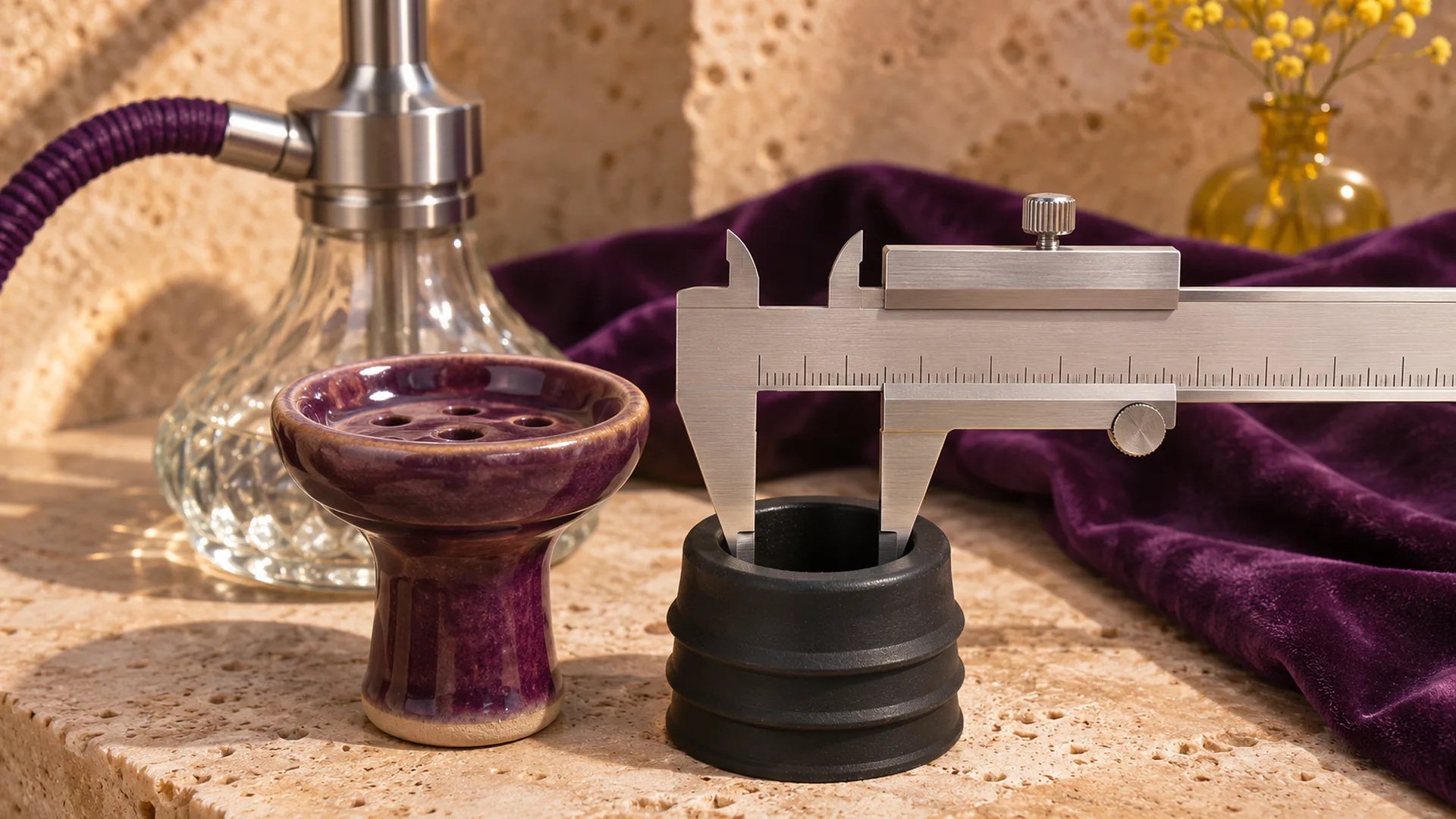
Grommets are usually described by two measurements: inner diameter and cross-section thickness. General technical sources also define the size of ring-shaped seals (O-rings) by these two values. The outer diameter can be derived from them, but on its own it does not describe the grommet.
- Prepare the hookah set Remove the charcoal, let the set cool completely, empty the water and dry the parts.
- Note the connection type Is it push-fit, threaded or locking? Take a photo to keep a record.
- Measure inner and outer diameter separately Write down the inner diameter for each opening and the outer diameter for each male end. Always note which one each measurement is.
- Measure from more than one direction Measure the same opening from two different directions; if the values differ, write down both.
- Don't forget depth Record the seating depth separately for the bowl opening and the base neck.
- Don't stretch the grommet Measure the grommet on a flat surface without squeezing or pulling it. The size of a hardened or flattened grommet can be misleading; note that as well.
Do not squeeze cracked glass or a damaged bowl with a caliper. Don't try to reassemble a broken part to measure it either; in that case the model name and the size information on the product page are a safer starting point.
Bowl and grommet fit
What determines bowl fit is how the grommet fills the gap between the bowl's bottom opening and the stem end. The practical rule passed on by vendor sources is this: if the bowl sits loosely on the stem and wobbles sideways, try a thicker grommet; if the bowl rides up or won't seat at all, try a thinner one. The goal is for the bowl to sit upright, steady and without forcing.
On Kahveci-style sets, the bowl usually sits on a ser grommet. On Russian-style sets, the bowl usually fits onto an adapter that carries a grommet, and the bowl's bottom opening may be narrower. That is why bowls from the two systems cannot always be swapped. When replacing a bowl, also record which system the old bowl belongs to.
- Bowl is loose The grommet may be thinned, hardened or the wrong thickness. First check that the grommet is sitting flat.
- Bowl rides up The grommet may be too thick or the contact surfaces may be slippery. For a detailed checking order, see our bowl rides up guide for more.
- Bowl sits crooked The grommet may be twisted or not fully seated in its groove. Remove the bowl and reseat the grommet; don't try to fix it by pressing down.
Grommet material matters even more in the area close to the heat. The hookah grommet size and replacement guide which covers measuring and replacement timing in detail, complements this section. If you're looking for a suitable bowl, you can browse our hookah bowl options and confirm the bowl's bottom opening size on the product page.
Stem and base fit
When replacing a base, the first question is the connection type, not the size. A grommet push-fit stem won't fit a base with a threaded ring; of two bases that look alike, one may need an extra ring. Once you have identified the connection type, check these measurements:
- Opening inner diameter The opening the stem or grommet goes into. The outer diameter of the glass doesn't give you this value, because the glass thickness gets in the way.
- Neck depth How much space the grommet or push-fit section takes up inside the base.
- Inner height of the base The clearance needed for the downstem tip to sit in the water without touching the bottom.
- Base width For the set's balance and the space it will stand in.
How deep the downstem sits in the water directly affects the draw. General sources note that the downstem should be submerged only a few centimeters and that deeper water makes the draw harder. When a long downstem is paired with a short base, adjusting the water level gets harder; that is why the inner height of the base is also a fit measurement.
For a detailed look at why measurements get mixed up when choosing a replacement base, the replacement glass size compatibility guide has the full explanation. If a threaded connection resists on the first turn, stop and follow the checks in our threaded connection and cross-threading guide before continuing. You can find base options on our hookah bases page — verify the opening type and diameter separately for each model.
Hose port, adapter and purge valve
Hose connections come in three forms: a plain connection where the hose fits straight into the port, a push-fit adapter carrying a grommet or O-ring, and a magnetic or threaded connector. When replacing a hose, check whether the end that fits the port is included in the package. In adapter systems, the hose and adapter may be sold separately.
The purge valve is a small system, but fit tolerances are tight. If the ball does not sit fully in its seat, an air leak occurs. A ball from another model may look the same but have a different diameter. Assess the ball, seat and cap together; residue in the seat can also keep the ball from seating.
If you suspect an air leak, find where it is before replacing any parts. On a cold set with no charcoal, cover the top of the bowl with your palm and draw gently from the hose; if air comes through, there is a leak. Then check the purge valve, the hose connection and finally the stem-to-base connection in that order. This way you identify the faulty part by observation, not by guesswork.
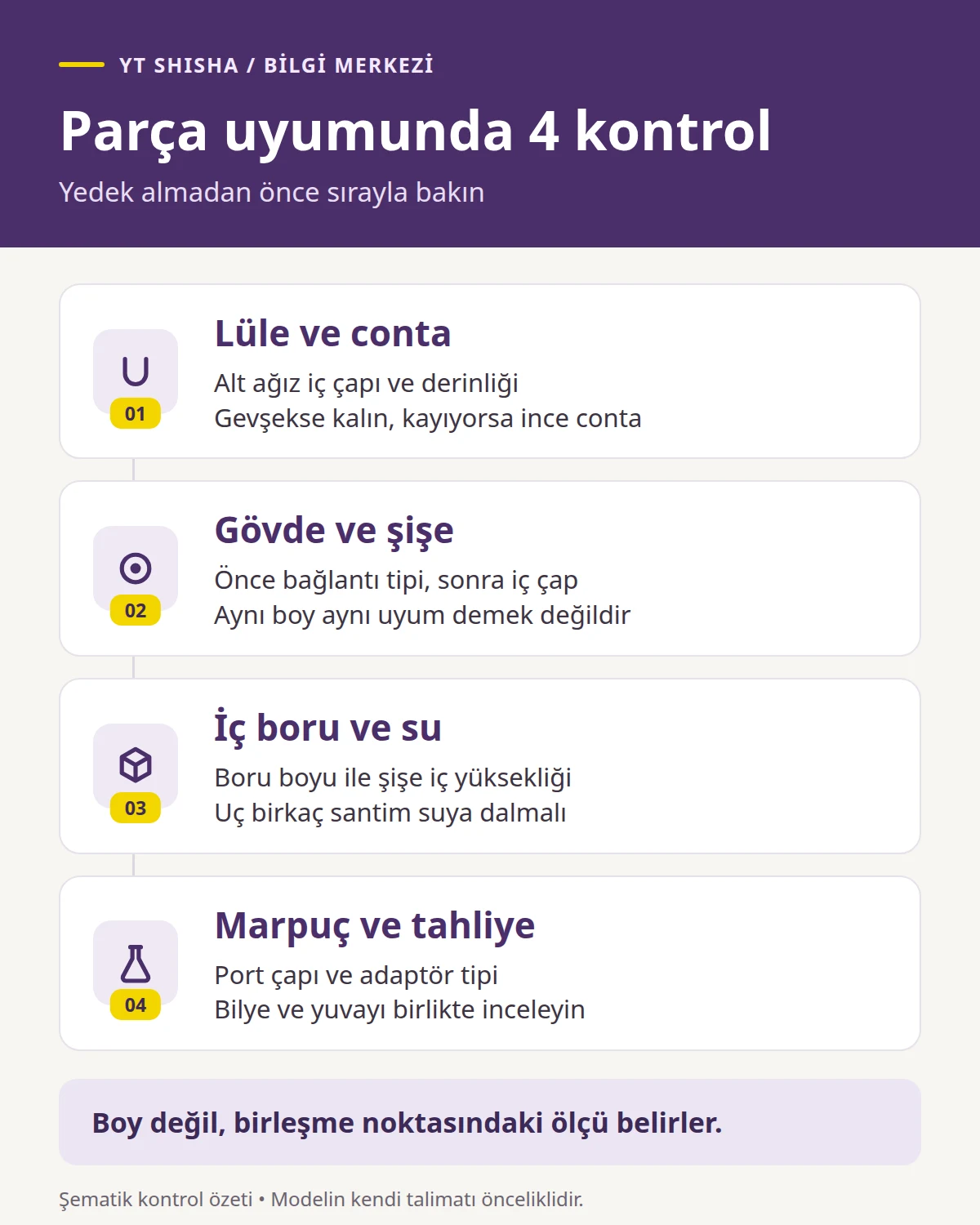
Parts record card: what to have ready when buying spares
Once you have collected the measurements, keeping them in a single note makes every future purchase easier. The table below shows which information to record for each part.
| Part | Information to record | Note |
|---|---|---|
| The set itself | Brand, model name, purchase date | The model name is the first answer to most fit questions |
| Bowl | Bottom opening inner diameter, seating depth, type | Record Kahveci and Russian-style separately |
| Gasket | Location, inner diameter, cross-section thickness, color | A single set may have more than one grommet |
| Bottle | Connection type, opening inner diameter, inner height | Keep it together with a photo |
| Downstem and diffuser | Downstem length, tip diameter, diffuser type | Note whether it is removable |
| Hose connection | Port diameter, adapter type | Magnetic and threaded systems are different |
| Eviction | Ball diameter, cap type | Choose a spare ball from the same model |
With your record card ready, finding spares takes less time. Hookah set spare parts include items such as the Kahveci ser grommet, the inner steel tube and the purge valve fitting; read the product description to see which stem types they fit. Keeping a spare of the small parts that wear out often means your set won't become unusable when a grommet wears out.
The same logic works when choosing a new set. When deciding among Hookah Sets consider the package contents, connection types and later availability of spare parts together. On YT Shisha sets, the model name appears in the technical specifications section of the product page; using that name when looking for spares makes matching easier.
Frequently asked questions
Why don't two bases of the same height fit the same stem?
Overall height is not one of the measurements that determine the connection. If the opening inner diameter, neck depth and connection type differ, two bases of the same height will not fit the same stem. Compare the connection type first, then the inner diameter.
How should I describe a grommet size?
Describe it by inner diameter and cross-section thickness. The outer diameter alone is not enough. Measure the grommet on a flat surface without stretching it, and also note where the grommet sits on the set.
Can I use the bowl from a Kahveci hookah set on a Russian-style set?
Usually it won't fit directly, because the bowl's bottom opening and grommet arrangement can differ between the two systems. Don't decide without comparing the bowl's bottom opening size with the stem's connection end.
If the bowl is loose, is stacking two grommets a fix?
Some vendor sources mention this method for getting an in-between thickness, but the grommets may sit crooked and cause an air leak. Try to find a single grommet of the right thickness first.
What happens if the downstem touches the bottom of the base?
When the downstem tip touches the bottom, it becomes harder to set the water level correctly and the glass becomes vulnerable to impact. In this case the base's inner height and the downstem length don't match; you need a different base or a part made for the model.
Sources and scope
This guide explains the general logic of hookah set part compatibility; it does not give exact sizes or a compatibility guarantee for any specific model. The practical rules on grommet thickness are taken from vendor accounts and may not give the same result on every set. Always measure and replace parts on a cold, empty set with no charcoal. Hookah is a tobacco product and is not sold or served to anyone under 18.
Sources reviewed: Hookah.com article on choosing a bowl grommet (vendor content), Wikipedia, O-ring and Wikipedia, Hookah.