

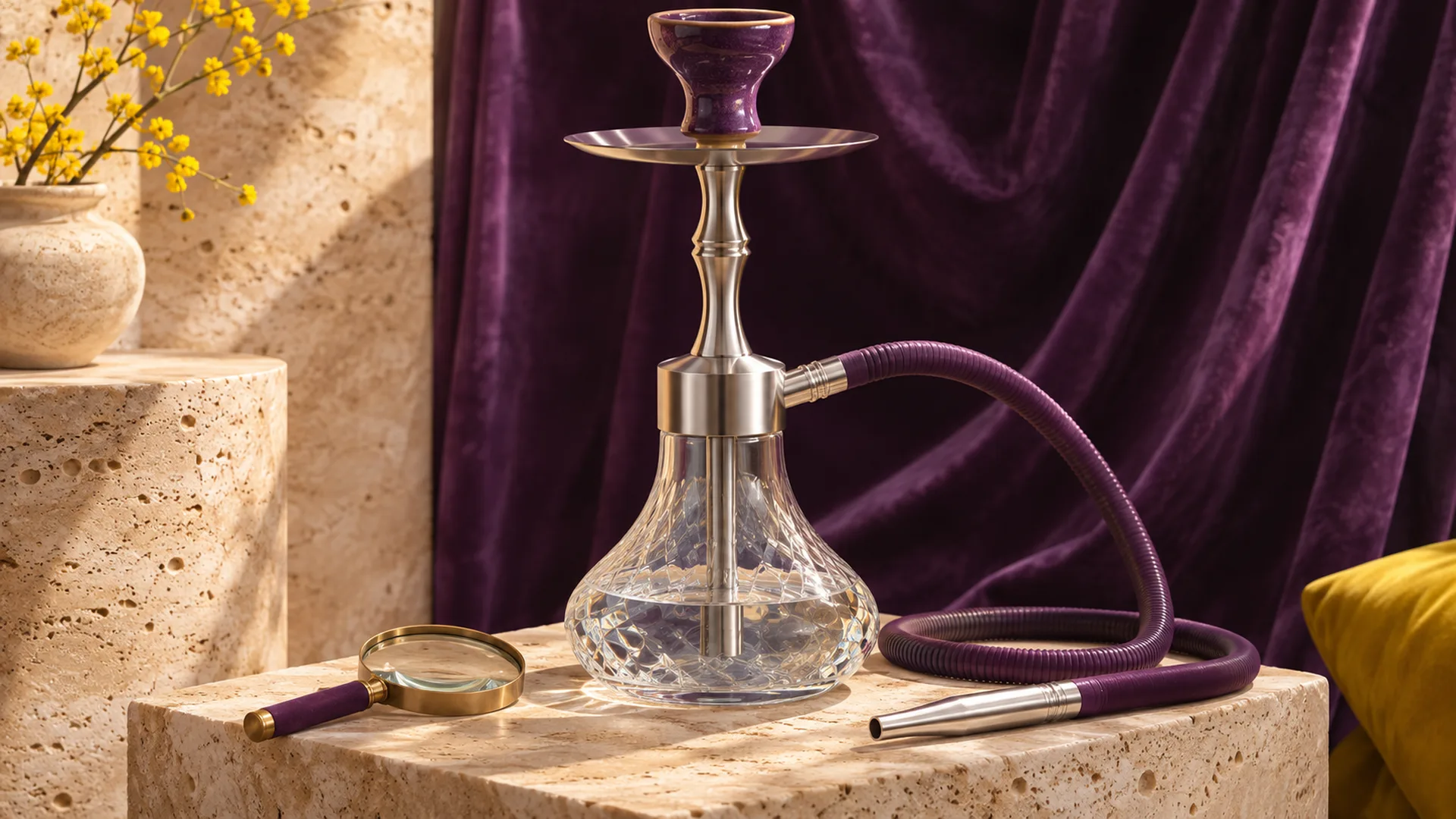
What Makes a Good Hookah Set? A 15-Point Check Before You Buy

Summarize this article with AI
Discover the key points with your preferred tool.
The title, article link and text context are sent to your chosen tool.
The short answer to what makes a good hookah set: one whose materials are clearly listed part by part, whose connections don't leak air, whose airflow path is cleanly machined, that can be taken apart and cleaned, and whose spare parts can be found. Looks and price only become meaningful points of comparison after these basic checks. The 15 points below are meant for you to check in order before buying a hookah set.
This guide covers the checks common to steel, brass Kahveci, Russian-style and aluminum sets. It doesn't rank brands or promise sizes or durability for any specific model. We wrote each point so you can check it using the information on the product page, or by eye and by hand when you hold the set. Hookah is a tobacco product and is not sold or served to anyone under 18.
What makes a good hookah set: five basic criteria
Before getting into the 15 points, it helps to know the five criteria they're all based on. These five headings usually determine how satisfied you'll be with a set in everyday use:
- Clear information The materials of the stem, downstem, tray and base are listed separately. General phrases such as “metal” or “quality material” are not enough.
- Airtightness The base, stem, hose inlet and purge valve connections don't leak air. A leaky set draws poorly even with the best tobacco.
- Airflow path The downstem, hose inlet and bowl seat are cleanly machined, with no burrs or sharp transitions inside.
- Ease of maintenance The set can be taken apart as far as needed for cleaning, and the parts can be dried easily.
- Long-term support Parts such as grommets, bases and bowls can be found later; the model name and measurements are known.
These five criteria apply whatever the type of set. To narrow down different hookah sets, you can use the material, base type and usage filters on the hookah sets page. If you'd like to see the general selection logic step by step, our hookah set selection article is a good place to start.
Stem and material: points 1–4
The first four points relate to the set's stem. You can check them largely from the product page and photos.
- Are the materials listed part by part? The materials of the stem, downstem, tray and connecting parts should be listed separately. An outer stem made of brass or steel doesn't mean the downstem is made of the same material.
- Is the steel grade specified? Stainless steel is not a single material. For example, thanks to its molybdenum content, grade 316 shows higher resistance to localized corrosion than 304 in chloride environments. If the grade is listed, it shapes your care expectations; if not, don't make assumptions.
- Are the joints clean? Welds or solder joints should be smooth, free of pores and without sharp edges. If close-up photos show joint marks, color differences or overflow, make a note of it.
- Is the surface finish described? Is the stem bare metal, plated, painted or gilded? A plated surface needs different care from bare metal, and the wrong cleaning can damage the plating.
For a detailed look at how to tell grade and quality differences on steel sets, see our 304 or 316 article as well. YT Shisha machines its brass and steel sets on lathes and CNC in its own workshop and finishes them by hand; you can see the production stages on the hookah production and manufacturing page.
Connections and sealing: points 5–8
What affects a hookah set's draw the most is how airtight it is. If even one connection point leaks air, the smoke weakens and the draw gets heavier.
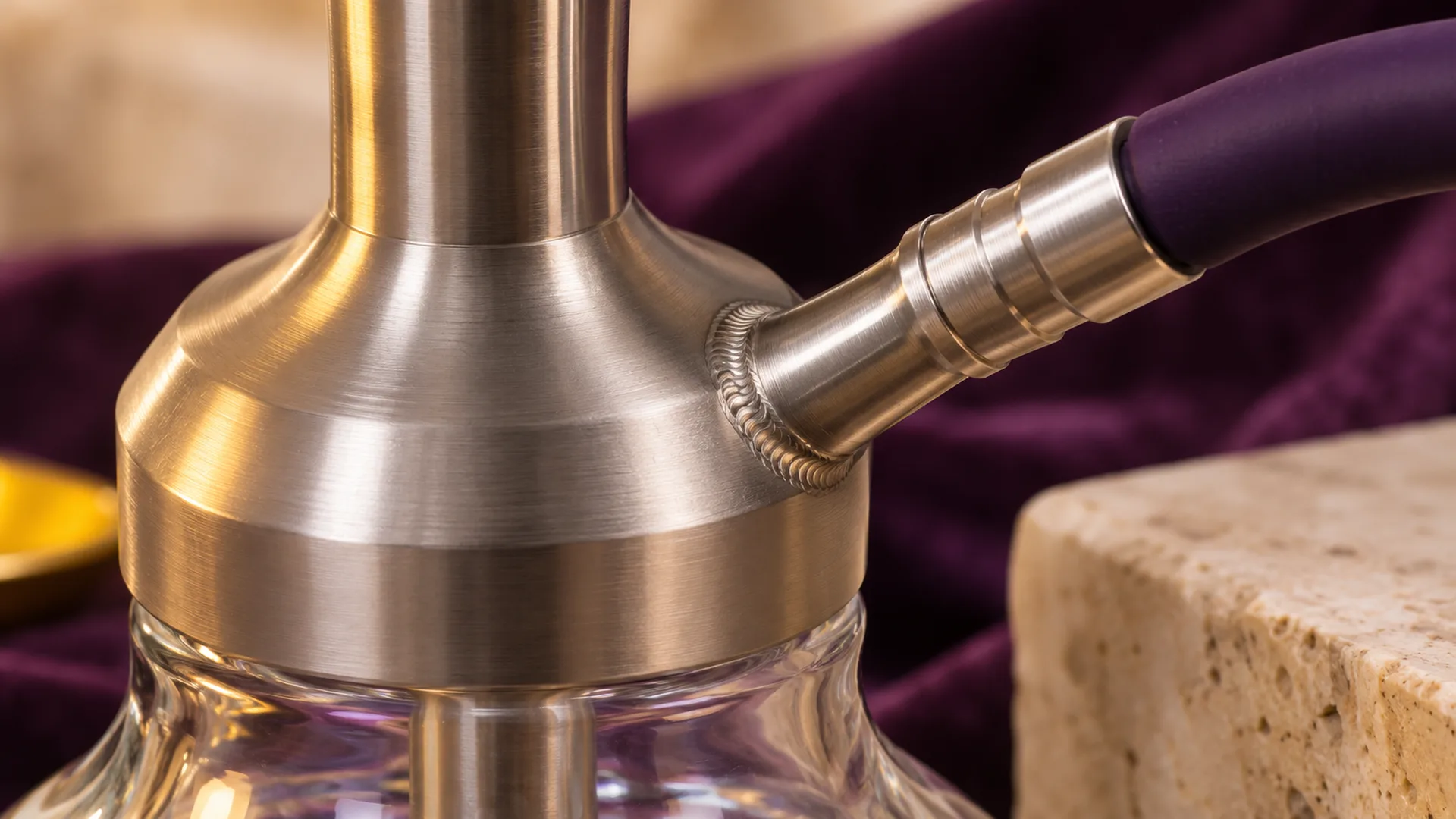
- How does the base connect? Does the stem push-fit or screw onto the base? With push-fit systems the grommet size matters; with threaded systems, the thread design does. You'll also need this information when buying a replacement base.
- Are the grommets in good shape? Grommets should be untwisted, uncracked and fully seated in their grooves. Having the grommet size listed on the product page makes later replacement easier.
- Is the hose inlet tight? When the hose or hose adapter is seated in the inlet, there should be no gap. On sets with more than one hose inlet, it should be possible to close off the unused inlet.
- Does the purge valve work? The purge valve lets stale smoke out when you blow gently into the hose. The ball inside should sit properly in its seat and not leak air when the valve isn't in use.
A practical way to check the seal is to assemble the set before adding water, cover the end of the hose and draw gently. If the air meets clear resistance, the connections are tight. To find which part is leaking, you can use the air leak check guide and follow its order; for grommet sizes, see our hookah grommet guide is a useful reference.
Airflow path and draw: points 9–11
Once the seal is in place, what determines the draw is the path the smoke takes from the bowl to the base and from the base to the hose.
- How are the downstem and diffuser? The inside of the downstem should be cleanly machined, with no burrs at the tip. If there is a diffuser, being removable makes cleaning easier. A diffuser makes the bubbles smaller and reduces noise, but it shouldn't restrict airflow more than necessary.
- Does the bowl seat fit? The bowl should sit firmly and straight on the stem with a grommet or adapter. If the set doesn't come with a bowl, it should state which bowl type it fits.
- What's the result of a draw test without charcoal? Take a draw with the bowl fitted, water in the base and no charcoal. The draw should be smooth and steady, with no whistling or rattling sound. An overly heavy or overly loose draw can point to a problem in the airflow path.
Draw preference is personal: some users want a lighter draw, others a more restrictive one. What matters is that the draw is balanced and repeatable. If the same set draws differently every time you set it up, the problem is most likely a connection or a grommet.

Use, care and long-term support: points 12–15
The last four points relate to the set's life after day one. These are the points most often skipped when buying.
- Can the set be taken apart for cleaning? The stem, downstem and bowl seat should come apart enough to be cleaned. Once the parts are separated, you should be able to see inside them and dry them.
- Are spare parts available? Can the base, grommets and bowl for the same model be bought later? If the model name and measurements are known, so is the answer to this question.
- Are the measurements and box contents listed? Is the overall height given with the bowl and base included? Are the hose, hose handle, bowl and tray included in the package? This information directly affects total cost and where the set will fit.
- Is the seller and manufacturer information clear? Who made the product, where it ships from and the return conditions should be clearly stated. If you notice a difference between the product description and the product you receive, document it with photos.
If the answer to any of these four points is unclear, even a good set can cause you trouble later when a part breaks or a grommet wears out. That's why reading the measurement information on the product page and noting it down is a good habit.
15-point checklist table
You can keep the table below open on screen before buying or use it while inspecting a set in a store. The warning sign column shows what to watch out for on each point.
| No. | Check | How to check | Warning sign |
|---|---|---|---|
| 1 | Material breakdown | Technical information on the product page | Only says “metal” |
| 2 | Steel grade | Technical information, product description | No grade listed, but claims are made |
| 3 | Joints | Close-up photos or by hand | Pores, overflow, sharp edges |
| 4 | Surface finish | Product description | Plated, but no care note |
| 5 | Base connection | Technical information, photos | Unclear whether push-fit or threaded |
| 6 | Grommets | By hand and by eye | Twisting, cracks, loose fit |
| 7 | Hose inlet | With the hose fitted | Gaps, wobbling |
| 8 | Purge valve | Gentle blow test | Ball stuck or leaking air |
| 9 | Downstem and diffuser | By taking the part off and looking | Burrs, diffuser that can't be removed |
| 10 | Bowl seat | By fitting the bowl while cold | Sits crooked, rides up |
| 11 | Draw without charcoal | Draw test without charcoal | Whistling, uneven draw |
| 12 | Disassembly | Manual, product description | Can't reach the inside |
| 13 | Spare parts | The seller's parts for the same model | No model name or measurements |
| 14 | Measurements and box contents | Product page | Unclear what the height includes |
| 15 | Seller and return information | Contact and returns page on the site | No address or return conditions |
You don't need to know the answer to every point in the table; but if several of the situations in the “warning sign” column come together on the same set, it's a good idea to fill in the missing information before deciding.
Priority checks by set type
The 15 points apply to every set, but some points carry more weight for certain set types. The table below summarizes that weighting.
| Set type | Key points | Why |
|---|---|---|
| Stainless steel | 2, 3, 9 | Grade, joint quality and internal machining set the care expectations for steel |
| Brass Coffee Shop | 1, 4, 5 | Which parts are brass, the plating and the base connection change the care needed |
| Russian-style modular | 6, 10, 13 | With a multi-piece design, grommets, bowl seating and part compatibility come first |
| Aluminum | 4, 12, 14 | Colored surface finish, cleaning method and measurement information matter |
You can browse steel-stem models on the Steel Hookah Sets page and classic brass-stem models on the brass Kahveci sets page. For an additional checklist specific to steel sets, take a look at our what to watch for when buying a steel hookah set article.
Frequently asked questions
Is an expensive hookah set always better?
No. Price differences often come from surface craftsmanship, base type, decoration or import costs. Whether a set is good is determined first by its seal, how clearly its materials are described and spare part availability.
Does a good hookah set have to have a diffuser?
It's not required. A diffuser makes the bubbles smaller and reduces noise, but if it restricts airflow more than necessary, it can make the draw heavier. If there is one, being removable is an advantage for cleaning.
How can I tell whether a set leaks air before buying it?
If you can inspect it in a store, cover the end of the hose and take a gentle draw; clear resistance is a sign of a good seal. When buying online, check whether grommet and connection information is listed.
Is the bowl that comes with the set good enough?
It may be enough for most use, but bowl preference is personal. What matters is that the bowl sits properly on the stem and that it's stated which bowl type it fits.
Are all the points on the checklist equally important?
No. Sealing and clear material information are basic points for every set. The weight of the other points varies with the set type and how you use it.
Sources and scope
This guide offers a general checklist for evaluating a hookah set; it does not guarantee the materials, measurements or durability of any specific model. Information on steel grades is based on general materials sources. Part names and functions are described similarly in vendor guides. The model's own manual and product page always take priority.
Sources reviewed: Wikipedia, SAE 316L stainless steel, Hookah Vault hookah buying guide and Hookah.com glossary of hookah terms— the last two sources are vendor content and may highlight their own products.