

304 Or 316? How to Identify Steel Quality in a Hookah

Summarize this article with AI
Discover the key points with your preferred tool.
The title, article link and text context are sent to your chosen tool.
Hookah steel quality is assessed by alloy grade, surface workmanship, and clean joints, as well as the body’s shine. The main difference between 304 and 316 is that 316 contains molybdenum, providing greater corrosion resistance in chloride environments. A magnet test cannot definitively distinguish these grades; ask the seller about the steel grade and which parts use it before buying.
In this article
- The basics of understanding steel quality
- 304 and 316 comparison
- Limitations of the magnet test
- Weld and surface inspection
- Weight and coating assessment
- Questions to ask the seller
- Selection based on use
- Frequently asked questions
What does steel quality mean in a hookah?
A product description that says only “metal body” does not establish that the material is stainless steel. The word “stainless” alone does not confirm a 304 or 316 grade either. Break your assessment into three questions: Which alloy is used, which parts contain it, and how were the parts manufactured? This lets you compare decorative appearance and technical information without confusing them.
A thin protective oxide layer on the surface plays a role in stainless steel's corrosion resistance. The surface condition is therefore as important as the material choice. Narrow gaps that collect water, channels that cannot be cleaned, and dirt left from manufacturing all matter. A correct grade label does not make a poorly designed joint easier to maintain; a smooth-looking surface does not document an unknown alloy either.
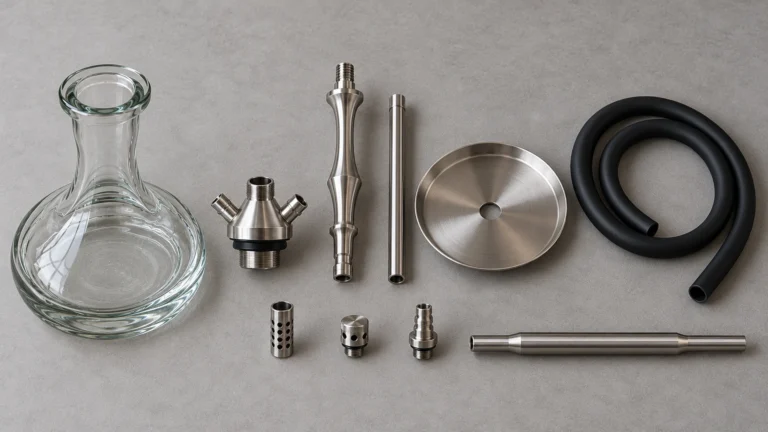
The body, downstem, connection adapter, and exterior decoration do not have to be made of the same material. Find out whether the seller's “steel” description covers the entire set or only certain parts. Ask for separate information on parts that contact water in particular. The models in the steel sets category when examining them, applying the same questions to every product makes the comparison more consistent.
304 or 316: table of key differences
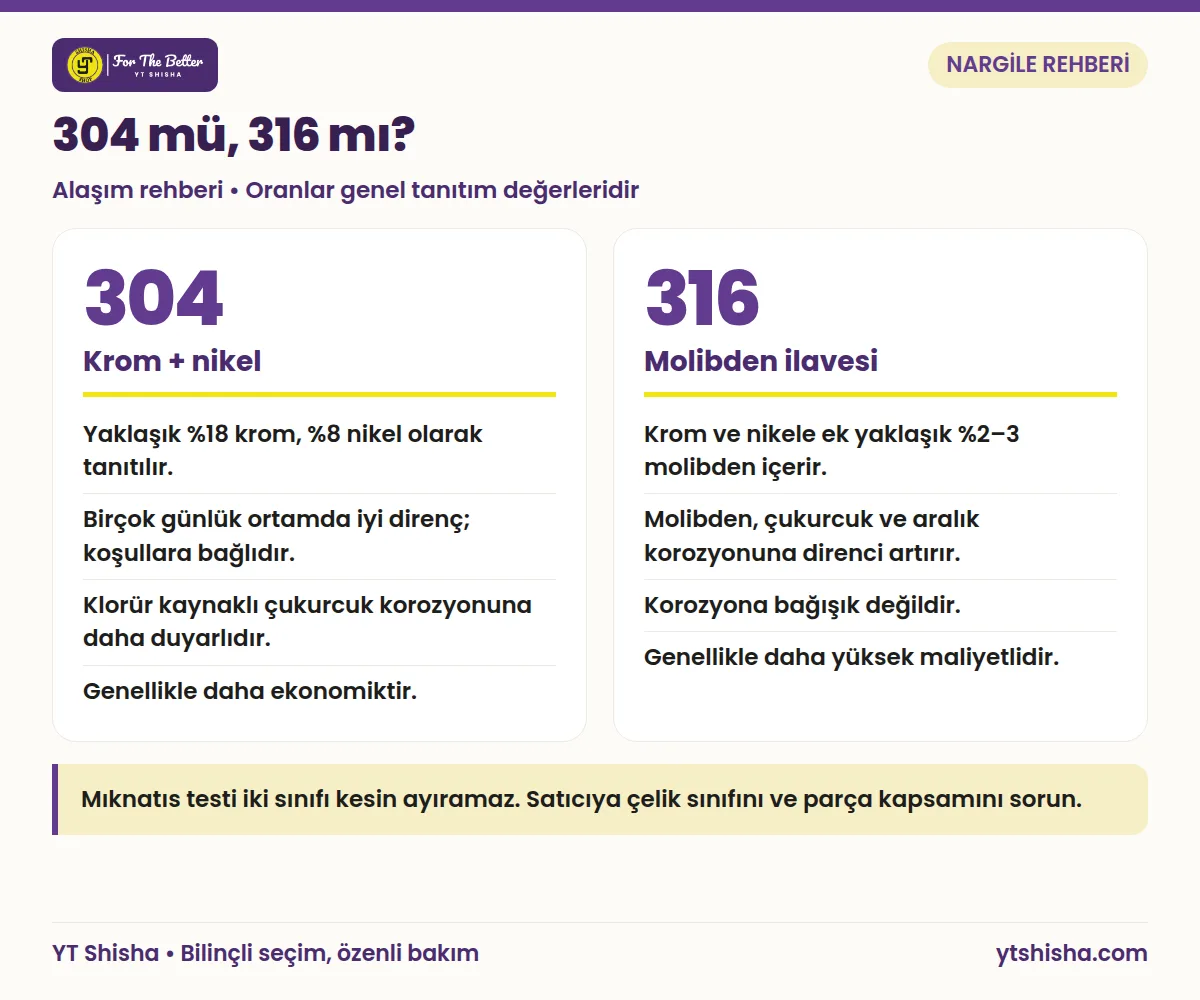
304 and 316 are common austenitic stainless steel grades. The 18/8 designation used for 304 describes approximate chromium and nickel proportions. The distinguishing feature of 316 is the addition of molybdenum. The proportions below are general introductory values; exact chemical limits should be assessed according to the relevant standard and material certificate. Do not read the table as an analysis of a specific product.
| Criterion | 304 | 316 |
|---|---|---|
| Basic composition | An alloy containing chromium and nickel; described as approximately 18 percent chromium and 8 percent nickel. | Contains approximately 2–3 percent molybdenum in addition to chromium and nickel. |
| General corrosion behavior | Provides good resistance in many everyday settings; depends on conditions. | It offers greater resistance, especially in certain demanding environments. |
| Effects of chlorides and salt | More susceptible to chloride-induced pitting corrosion. | The addition of molybdenum increases resistance to pitting and crevice corrosion; it is not immune. |
| Magnet response | It may show weak attraction depending on its processing condition. | It generally shows a weak response; the response alone is not proof of grade. |
| Material cost | Generally more economical. | It is generally more expensive due to its alloy composition. |
Chloride refers to the ion found in salts; cleaning products containing chlorine need to be considered separately. The phrase “better salt resistance” does not imply resistance to bleach. The chemical type, concentration, temperature, and contact time affect the result. Therefore, a 316 designation is no reason to use harsh cleaners or leave parts in water for days.
304’labeling it as poor quality outright and 316 as unconditionally superior is misleading. The workmanship, disassembly options, and part compatibility of two sets may differ. Nor can denser smoke, a better draw, or a particular flavor result be expected from the alloy grade alone. The purpose of comparing materials is to find durability suited to the intended environment and product information that can be explained.
What Does a Magnet Test Show, and What Doesn't It?
“The rule “If a magnet sticks, it’s fake; if it doesn’t, it’s 316” is incorrect. In their annealed state, 304 and 316 generally show a low magnetic response. However, cold forming can change the structure, particularly in 304, making some areas more magnetic. The structure around a weld can also affect the response. It is therefore possible to feel different levels of attraction at different points on the same part.
It is also important to note that some other stainless steel families can show noticeable magnetism. A strong pull from a magnet does not necessarily mean the material is ordinary coated steel. On the other hand, no attraction does not prove that the part is stainless or that it matches the grade stated in the description. Use the test only as an additional observation; do not make it the sole basis for a purchase decision.
Do not attempt home tests involving acid drops, sparks, or scratching the body. The product may be damaged, and the resulting mark may not provide reliable grade information. Professional material verification measures alloying elements with suitable instruments. XRF analysis can help distinguish 304 from 316 using chromium, nickel, and molybdenum; the result applies to the measured part and its surface conditions.
There is another limitation here: Common handheld XRF devices cannot measure carbon, so they cannot independently confirm the distinction between 316 and low-carbon 316L. If a document includes the “L” suffix, a magnet or standard XRF reading alone is not enough to substantiate it. A reasonable first step for consumers is to request the complete grade declaration and any relevant material documentation.
How do you inspect welds and surface finishing?
Inspect the insides of joints too
On a welded model, inspect the area around the joint under good lighting. Ask for clarification if you see cracks, sharp protrusions, obvious pores, or gaps that could trap dirt. Weld strength cannot be measured by appearance alone; nevertheless, visible irregularities are concrete issues to raise before purchasing. With threaded joints, the threads should turn smoothly and the parts should fit without force.
Although the exterior is smooth, an inaccessible section of the inner tube may be rough. Within what the seller permits, ask for parts to be disassembled, the internal channel to be illuminated, and an explanation of whether a brush can pass through. This check by planning your visit using the store information you can do on site. When shopping online, request close-up photos or written descriptions of the same points.
Do Not Treat Shine as Proof of Quality
A mirror polish, brushed appearance, or matte surface is a finish choice. None of these alone indicates grade 304 or 316. What matters is that the surface is uniform, free of burrs, and accessible for cleaning. Heavy heat discoloration around visible welds also warrants asking about finishing; an alloy cannot be identified directly by color.
Heat discoloration and surface contamination after welding can affect corrosion behavior. Manufacturing cleaning and surface treatments are therefore meaningful. However, do not try to imitate professional surface treatments at home with strong acids. The production and manufacturing page when examining, you can also request information about the specific model's joining method and final surface treatment; a general description of manufacturing does not replace model-specific documentation.
Weight and coating: distinguish misleading clues
Holding a heavy body may give a sense of sturdiness, but weight does not confirm the alloy grade. Length, wall thickness, solid or tubular construction, and decoration all change the total mass. The densities of 304 and 316 are close. Weighing different designs cannot establish that one is definitely 316. Evaluate weight first in terms of stability on the table and ease of carrying.
Compare parts of similar dimensions whenever possible. Instead of assuming “heavier means higher quality,” ask about the material and dimensions of the tube that enters the water. The same approach aluminum models also applies when evaluating: light weight may reflect a different material and design choice. Light weight alone does not mean a product is defective or misrepresented.
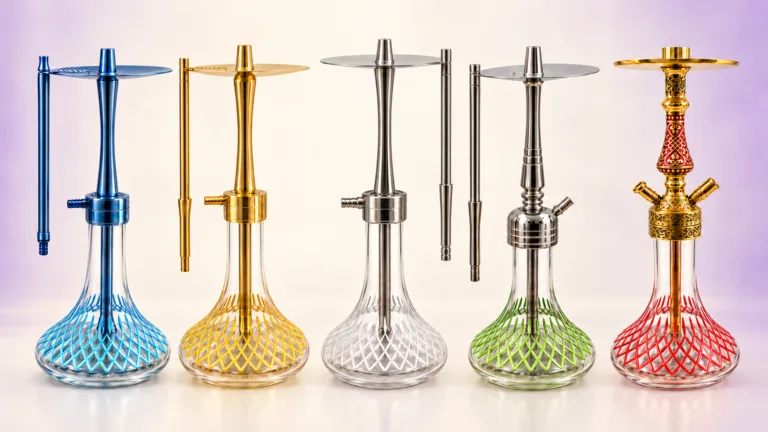
A colored exterior is not proof of a counterfeit product; a stainless steel part may have a decorative coating. Conversely, a shiny chrome appearance does not show that the underlying metal is stainless steel. Ask separately about the coating type, the surfaces it covers, and the underlying material. A color or visual effect in the product name should not substitute for technical material information.
If you see existing peeling, blistering, or a differently colored layer at an edge, photograph it and show the seller. Do not create new damage by scraping the product. A single stain does not provide a definitive diagnosis either: deposits, dirt transferred to the surface, and corrosion must be distinguished. With recurring localized deterioration, clarifying the part's condition is more useful than concealing its appearance with polish.
Six questions to ask before buying
Use the short list below instead of memorizing technical terms. If possible, keep the answers in writing alongside the product description. This lets you compare different models using the same criteria and clarify vague statements before ordering.
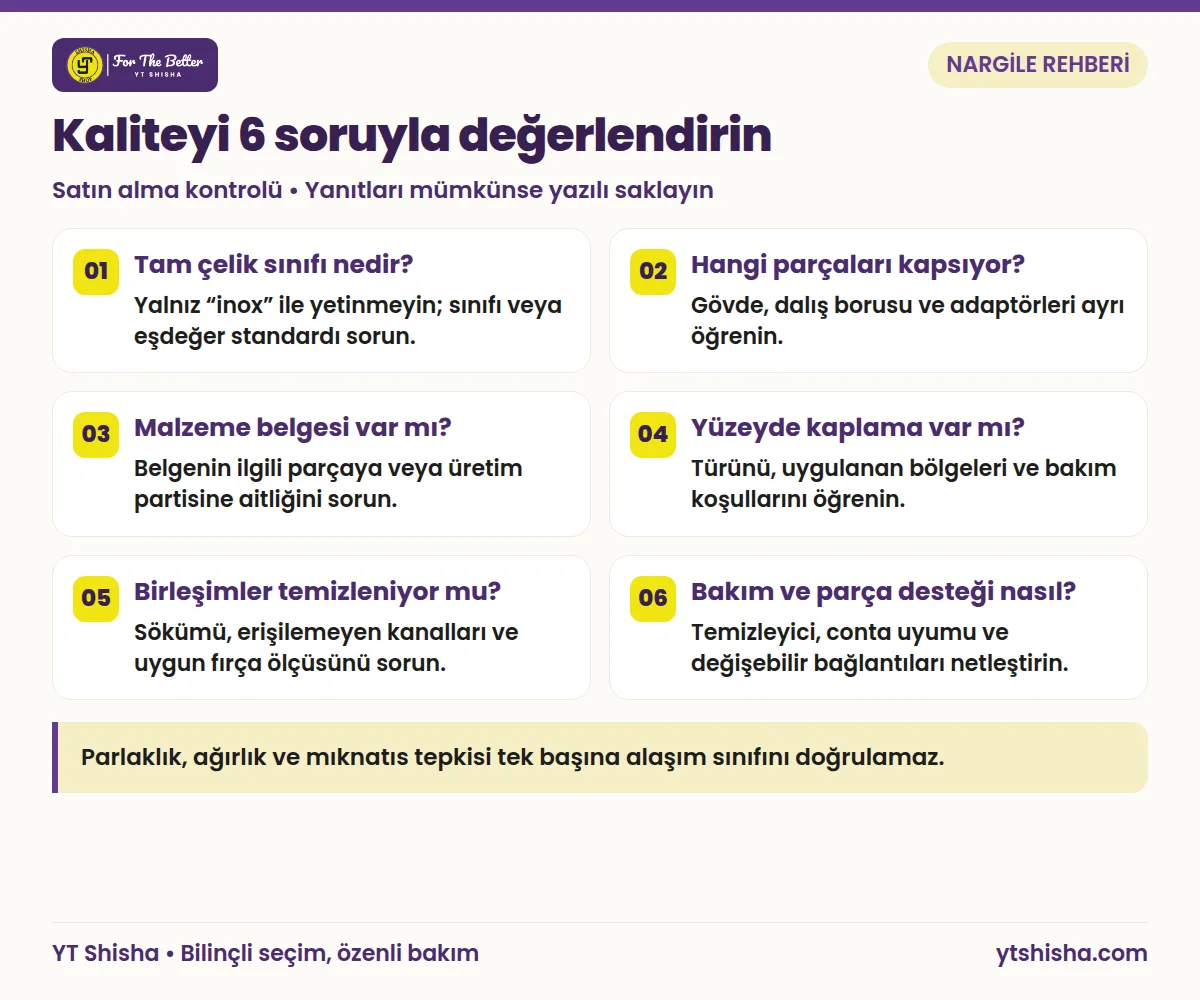
- What is the exact steel grade? Do not settle for the answer “inox”; ask for a 304, 316, or equivalent standard designation if available.
- Which parts does this grade cover? Find out the materials of the body, downstem, and adapters separately; evaluate the exterior decoration separately as well.
- Is material documentation available? If documentation exists, ask which part or production batch it covers; do not treat a generic image as an analysis of the product.
- Is the surface coated? If present, learn its type, the areas where it is applied, and what to watch for during cleaning.
- How are the joints cleaned? Ask which parts can be removed, whether there are inaccessible internal channels, and what brush size is suitable.
- What maintenance and parts support is available? Clarify cleaner recommendations, grommet compatibility, and whether worn connections can be replaced before ordering.
For example YT Bullet Hookah Set or YT Everest Steel Hookah Set when reviewing the page, you can request information using this list. No steel grade is assumed in these examples. A model name, photo, or inclusion in a category does not substitute for a 304 or 316 declaration.
How do you decide based on your usage?
The main criteria are whether the specified alloy suits the conditions of use and how easy the product is to maintain. When deciding between a well-described 304 option and a product with an unspecified grade, do not simply look for a higher number. Even with a model labeled 316, check which parts the claim covers, the joints, and the surface. You do not need to spend more solely for a label before clarifying your needs.
If conditions include storage near the coast, saltwater splashes, or constant humidity, discuss corrosion resistance specifically. 316 may offer an advantage in this assessment; nevertheless, salt deposits should not be left on it. After every use, clean according to the manufacturer’s recommendations, rinse well, and dry. Do not choose chlorine bleach or abrasive metal scrubbers for routine cleaning.
Steel grade is a property of the body; it does not describe the entire set. Hose for its material and ease of cleaning hose options examine separately. Complete your purchase by considering verifiable material information alongside practical use. The best comparison is between models for which you receive clear answers to the same questions, understand the parts, and can maintain proper care.
Frequently asked questions about hookah steel quality
304 steel hookah is it necessarily insufficient for?
No. 304 provides good corrosion resistance in many everyday environments. Suitability should be assessed alongside usage conditions, design, surface workmanship, and care. The 304 designation alone does not mean the product is inadequate.
Does 316 Steel Never Rust?
No. Molybdenum gives 316 an advantage over 304 in chloride environments, but it is not immune to corrosion under all conditions. Harsh chemicals, salt buildup, temperature, and prolonged contact may affect the outcome.
Does a magnet sticking mean the product is counterfeit?
No. Cold forming and welding can cause a magnetic response in some areas of austenitic stainless steel. Some stainless steel types are also naturally magnetic. A magnet test alone does not verify the grade or establish counterfeiting.
Can 304 and 316 Be Distinguished by Sight?
Color, shine, and weight do not provide a reliable distinction. First, ask the seller for a grade declaration by part and any available material documentation. When necessary, the composition of the part being measured is assessed through appropriate professional alloy analysis.
Does a colored coating mean the steel is low quality?
No. Stainless steel may have a decorative coating. You need to learn the coating type and underlying material separately. If there is peeling or bubbling, photograph it without scraping the product and ask the seller for an explanation.
Is a heavier body higher quality?
Weight alone is not a measure of quality or alloy grade. Size, wall thickness, solid parts, and decoration change the weight. Consider balance, workmanship, and the material description together.
What should I ask the seller about steel first?
Before buying, ask the seller for the steel grade and which parts use that grade. Then clarify any available documentation, surface coating, disassembly options, and recommended care method.
Supplementary Guides

Steel or Aluminium? Which Hookah Set Should You Buy?
Compare steel and aluminium hookah bodies in terms of weight, care, durability and budget. A table and checklist to help you decide based on…

How to Clean a Stainless Steel Hookah: A Step-by-Step Guide
Explore the supplies list, eight-step care sequence and cleaning recommendations for each part of a steel hookah. Learn the right approach to stains, tarnishing…

10 Things to Consider When Buying a Steel Hookah Set
When buying a hookah set, consider materials, connection compatibility, balance and access for maintenance together. Clarify your purchasing decision with a ten-item list and…

Leave a Reply