

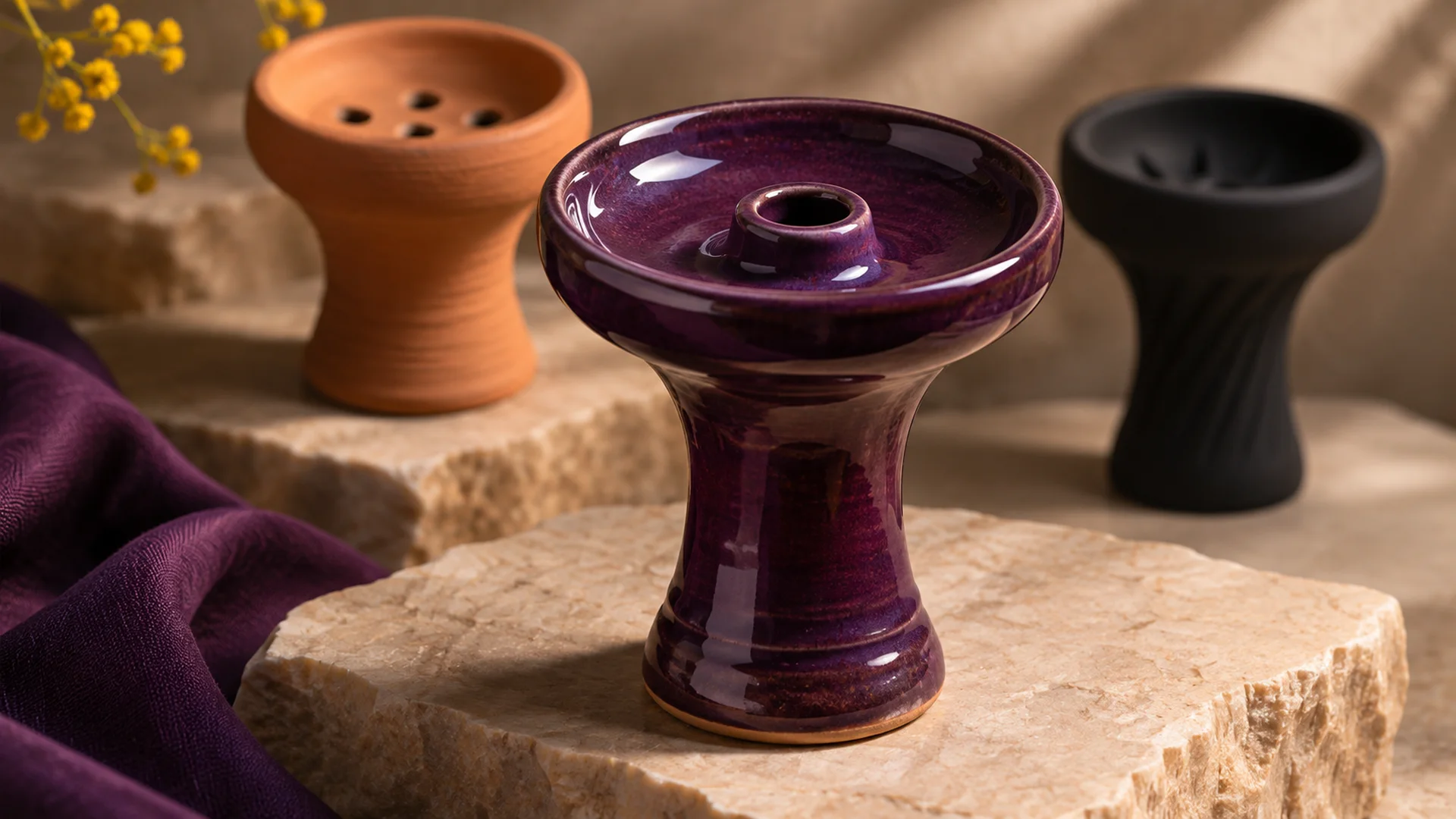
How to Choose a Russian-Style Hookah Bowl: Bowl Types, Volume, and Heat Distribution

Summarize this article with AI
Discover the key points with your preferred tool.
The title, article link and text context are sent to your chosen tool.
When choosing a Russian-style bowl, first consider the pack volume and charcoal setup, then the shape and material, and finally how it seats on the stem and diffuser, all together. Phunnel, vortex, and classic multi-hole bowls can show different airflow paths and heat behavior even at the same volume. Ceramic, clay, silicone, and metal bodies conduct heat differently; none of them is the single right choice for every user.
This guide compares bowl types, materials, how volume works, heat distribution, connection fit, and lifespan from a technical point of view. It doesn't rank brands or promise measurements for any particular model. The gram and heat figures used in the sources are approximate; your model's manual always takes priority.
Bowl types: classic, phunnel, vortex, and others
The first thing that sets bowls apart is where the airflow passes. A classic (Turkish-style) bowl has several holes in the base, and air passes through the packed layer. A phunnel bowl has a raised spire in the center with a single wide hole; air doesn't have to pass through the pack.
The name vortex is used for designs with three or four small holes on the side of a phunnel-like spire. One source notes that this name is less a distinct type and more of a brand style. Because sources define the difference between phunnel and vortex differently, you need to check the technical description on the product page.
| Type | Airflow path | General behavior | What to watch for |
|---|---|---|---|
| Classic (Turkish-style) | Several holes in the base | Heats up quickly; good for learning heat management | Can overheat more easily; liquid can drip through the holes into the stem |
| Phunnel | Single hole in the center spire | The draw is smooth because air doesn't pass through the pack | The center hole must stay open; if foil sags, it can block the hole |
| Vortex | Small holes on the side of the spire | Reported to have more restricted airflow than a phunnel | The definition varies by manufacturer |
| Thick-walled, flat-bottomed | Five or seven holes in the base | Carries high heat with its mass | May need a significant heat input to warm up |
Use the table not as a decision template but to see which issue is linked to which design. Two bowls with the same name can have different wall thicknesses and hole layouts.
Material: ceramic, clay, silicone, and metal
Material affects how quickly and how evenly heat reaches the pack. Sources describe the clay bowl as the traditional option that holds heat. A glazed surface is said to reduce liquid soaking into the body and to make changing the pack easier.
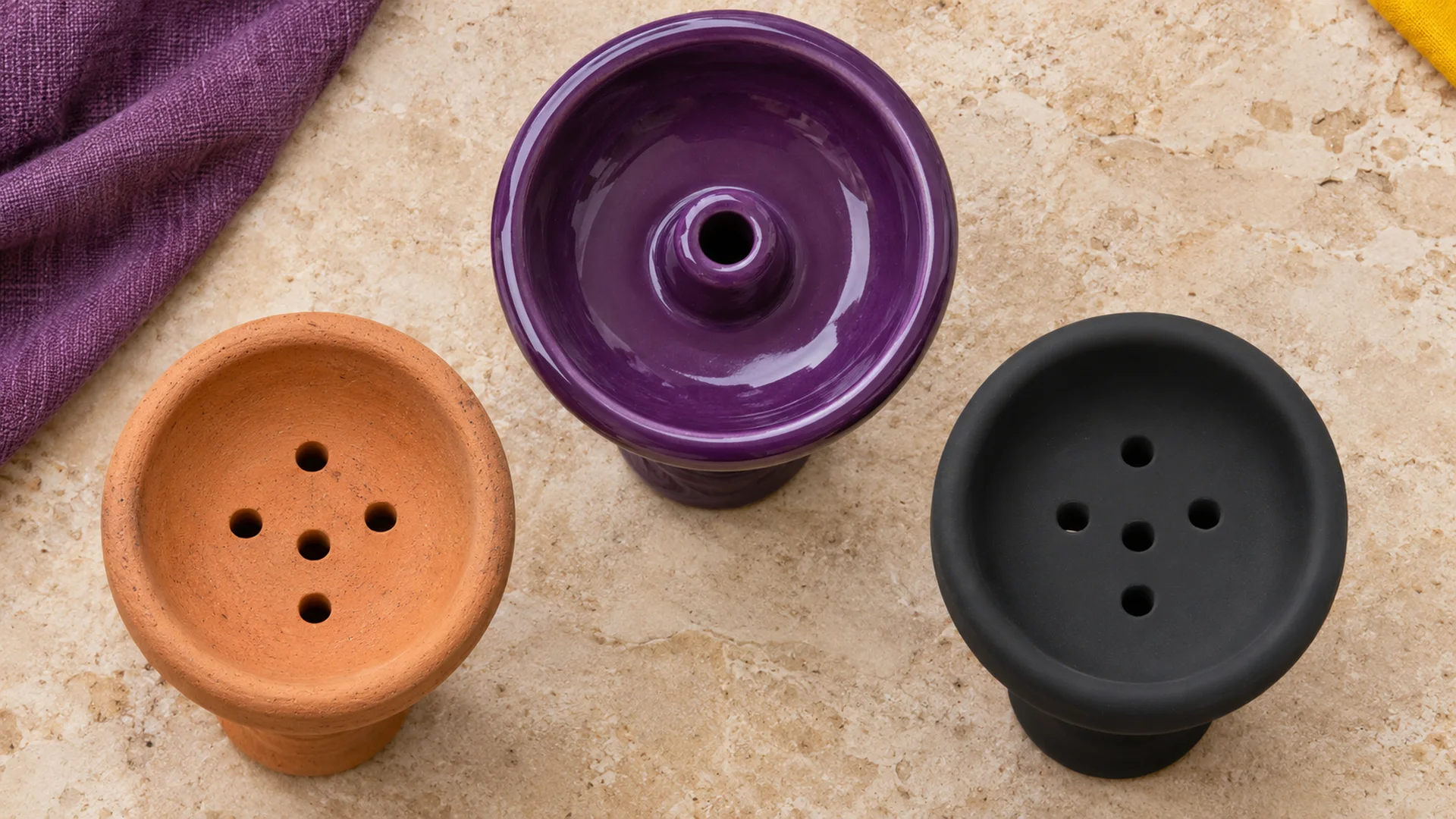
- Clay Known for holding heat, but can be fragile against impacts and sudden temperature changes.
- Ceramic Described as having a smooth surface that's easy to clean. Sources disagree about how fast it heats up; some say it heats faster, others that it distributes heat evenly.
- Silicone Resistant to breaking and easy to clean. Some users say it doesn't distribute heat as evenly as clay, which is why it's seen as better suited to travel and simple use.
- Metal (for example, aluminum) Conducts heat quickly, and in some designs fins on the body are used to draw excess heat away from the pack. Because of the risk of overheating, heat control needs more attention.
Glass bowls mostly appear in special systems that work with a heat management body. Sources note that glass doesn't hold heat as well as clay or ceramic and is fragile. Always confirm the material of the part used in Russian-style sets on the product page.
If you see a crack or glaze loss on a ceramic bowl, you should stop using it. In that case, see the ceramic bowl crack and glaze damage guide is a useful reference.
How volume and packing work
Bowl volume should be considered together with the charcoal setup and heated area rather than session length. Sources give small bowls at about 10-12 grams, medium bowls at around 15-20 grams, and large ones at 20 grams and up. These figures are estimated ranges; actual capacity varies with the type of pack and the packing method.
For one person, a large bowl often just means more pack than you need. One seller's guide states that deep bowls are better suited to a light pack and shallow bowls to a dense pack. So read volume not only in grams but also in terms of depth and opening width.
The general principle for packing is to place it loosely and leave a small gap between the heat source and the pack. In one manufacturer's example, this gap is given as 2-3 mm; the manual for your bowl and device may say otherwise. In a phunnel, the center hole should stay open; in a classic bowl, the base holes shouldn't be blocked.
- Check the bowl and heat management device while they're completely cold and clean.
- Confirm that the base or center hole is open.
- Place the pack loosely and level the surface without forming a mound.
- Leave the gap your manual specifies between the heat management device or foil and the pack.
- With a smaller volume, reduce the amount of charcoal too; take the number from your model's instructions.
Heat distribution and charcoal management
Heat distribution is the combined result of the bowl's material, wall thickness, shape, and the heat management device on top. Thick-walled clay bowls are known for holding heat more evenly; with thin bodies or ones that conduct heat quickly, the charcoal setup should be reviewed more often. The same number of coals won't give the same result in a different bowl.
A heat management device (HMD) holds the charcoal without letting it touch the pack directly. But not every bowl accepts one; some bowls have an inner lip that holds the device in place, while bowls with a bridged spire can only be used with foil. If the foil sags, it can block the center hole, especially in a phunnel.
As a general approach, a small-volume bowl needs less heat and a large-volume bowl needs more. Take the exact number of coals from the bowl's and device's own manuals, not from a blog post. For charcoal type and size, see the hookah charcoal category You can review it.
Safety always comes first. Keep burning charcoal on a stable, non-flammable surface, away from children and pets. Don't check the bowl, device, and tray by hand until they've cooled completely; don't test the temperature with your bare hand. With problems such as a stuck lid, wait for it to cool; for details, see the stuck heat management device lid guide for more.
Fit with the stem and diffuser, cleaning, and lifespan
A bowl's value isn't measured only by its own quality but also by how securely it seats on the stem. In Russian-style sets, the bowl usually sits on an adapter with a grommet. A thicker grommet doesn't always give a better grip; the tapered surface and seating depth also matter.
If the bowl rides up, instead of pressing it down, you can find a detailed check in the bowl riding up guide . Before buying, ask the seller for the model name, the bowl connection type, and the grommet size. For a spare grommet, see the grommets and spare parts category for a closer look.
- Check the bowl's bottom socket for cracks, glaze loss, or chips.
- Confirm that the grommet isn't twisted and is seated properly.
- Place the bowl cold and empty until you feel the first resistance; don't force it.
- If it sits tilted or on one side, don't use the part, and make a note of it.
When cleaning, go by the limits of the material and follow the method the manufacturer describes. In general, a soft brush and a non-abrasive cloth are a safer starting point than hard tools. Hard tools can scratch the surface and make later inspection harder. For general material and care principles, read the Russian hookah sets material and care guide for more.
Quick decision guide
The table below shows which aspect stands out in which use case. These are tendencies; actual suitability comes from the product's own technical information.
| User situation | Leading choice | Why | Caution |
|---|---|---|---|
| One person, short use | Small-volume phunnel or mini classic | Needs less pack and less heat | Reduce the amount of charcoal too |
| Moist, juicy pack | Phunnel | Liquid doesn't drip into the stem; the airflow path stays clear | The center hole must stay open |
| Dry pack | Classic multi-hole bowl | Air passes through the packed layer | Watch out for overheating |
| Wants to keep heat steady | Thick-walled glazed clay | Known for holding heat | Fragile against drops and sudden temperature differences |
| Looking for durability or travels often | Silicone | Unbreakable and easy to clean | Heat distribution may not be as even as clay |
| Uses a heat management device | Bowl with a lip that accepts the device | Holds the device in place | Not every bowl accepts a device |
To find bowls that fit your set, see the Russian hookah bowls page, and for complete sets, the Russian hookah sets page.
Frequently asked questions
Is a phunnel bowl always better than a classic bowl?
No, this choice depends entirely on how you use it. A phunnel is known for keeping liquid away from the stem with a moist pack; a classic bowl passes airflow through the packed layer with a dry pack. It can't be stated as a general rule that one type is better than the other.
Does a silicone bowl hold heat as well as clay?
Some sources hold that silicone is heat-resistant but doesn't distribute heat as evenly as clay or ceramic. This view is not a precise measurement. Heat behavior varies with the bowl's thickness and the device used.
Should I choose bowl volume based on session length?
Time isn't the only measure. The charcoal setup, the type of pack, and the depth of the bowl also affect the result. First choose a reasonable volume that fits how often you use it and your heat setup, then check the capacity information in the product listing.
How can I tell whether the bowl fits the stem?
Place it cold and empty, and stop at the first resistance. If the bowl sits tilted, seats on one side, or rises back up, there may be a mismatch. Ask the seller to confirm, giving the model name and grommet information.
Can I keep using a bowl that is cracked or has lost its glaze?
Using it isn't recommended. Testing it with heat or sealing it with adhesive won't make it fit for use. Set the part aside, photograph it, and refer to the manufacturer's care information.
Sources and scope
This guide is for general technical information; it doesn't guarantee the measurements, temperatures, or compatibility of any particular model. The gram ranges and heat comments are approximate values compiled from different sellers' and manufacturers' descriptions. Always put fire and burn safety first when working with burning charcoal.
Sources reviewed: Regal Hookah bowl types explainer, Karma bowl packing guide and Hookah Vault bowl materials guide. These are seller content and may promote their own products.