


Setting Up a Hookah Corner at Home: Layout, Ventilation and Storage

Summarize this article with AI
Discover the key points with your preferred tool.
The title, article link and text context are sent to your chosen tool.
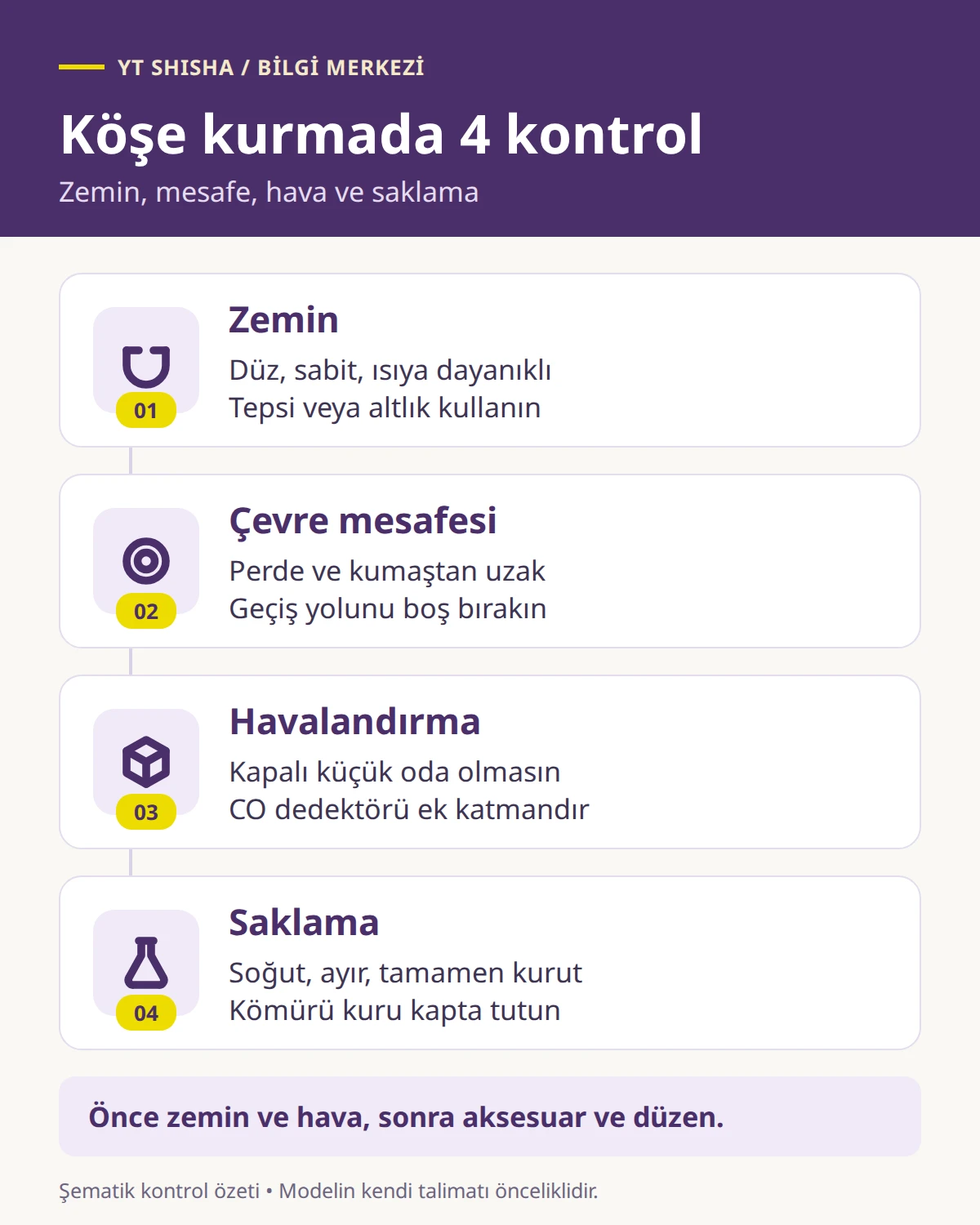
Three rules stand out for a hookah corner at home: a stable, heat-resistant surface, a clear distance from flammable items, and never lighting charcoal in a closed room. Everything else, from the tray and molasses catcher to storage and being considerate of neighbors, is built around these three rules. Even a simple setup involves a few small decisions, from the height of the table to the curtains.
This guide covers equipment placement, ventilation, carbon monoxide (CO), the role of accessories, and storage from a technical point of view. It does not encourage hookah or tobacco use and is not intended for anyone under 18. The measurements and times given are a general framework; your model's manual and your building's rules take priority.
Placement: surface, stability, and nearby objects
A hookah is a tall, heavy piece of equipment with a narrow base; if it tips over, the glass base can break and charcoal can spill onto a rug or sofa. That's why the first decision is where the parts will go. A coffee table with an overhanging edge, a slipping tablecloth, or a sloped surface should be ruled out from the start.
- Stable surface Choose a flat, sturdy table or spot that doesn't wobble. If you use floor cushions, put a hard, flat board underneath; on a soft rug, the base can tip over.
- Heat-resistant surface Charcoal, ash, and a hot heat management device should never touch wood, plastic, or varnished surfaces directly. A heat-resistant tray or mat protects the surface.
- Clearance Keep curtains, sheers, paper, upholstery, and cushions away from the equipment. Rather than fixing the distance to a number, leave clear the area that a spark or a dropped piece of charcoal could reach.
- Walkway Keep the hose and legs out of doorways and busy walking paths. A snagged hose can pull the whole set over.
Keeping it out of reach of children and pets is a separate precaution. Never leave the equipment unattended while charcoal is burning. For the heat side, see the heat management device guide, and for the charcoal side, the guide to choosing hookah charcoal is a useful reference.
Tray, molasses catcher, and ash bowl: what does each one do?
These three items are the quiet helpers outside the set itself, and they largely shape how the corner is organized. Each has a different job; one can't replace another.
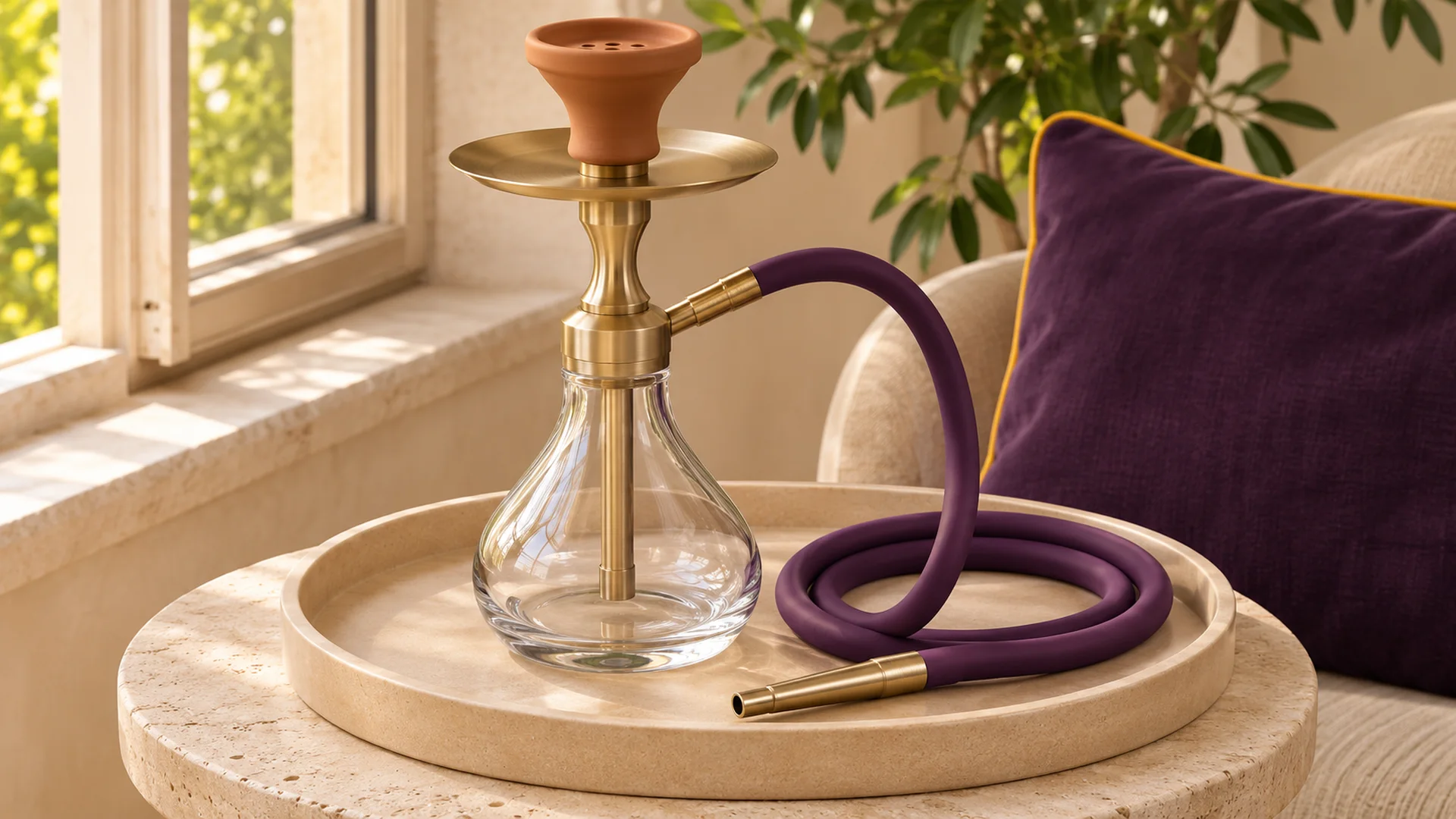
- Tray It sits under the stem and catches spilled ash, a dropped piece of charcoal, or overflowing liquid. Since the diameter and stem connection vary by model, choose from our hookah trays in the size that fits your set's base.
- Molasses catcher It catches molasses that would otherwise drip into the base, keeping the stem and the surface clean. It indirectly helps reduce slippery surfaces, and with them the risk of slipping and tipping over. Molasses catcher — see this category for glass options and versions with attachments.
- Ash bowl A separate, heat-resistant container for collecting cooling charcoal and ash. Use a container set aside for this job instead of repurposing a bowl or plastic container on the table.
- Heat management device and wind cover It keeps the charcoal sitting on the bowl and manages the heat. For selection details, see the guide to choosing a heat management device and wind cover and hookah heat management devices category.
None of these items eliminates the fire risk. They only limit uncontrolled drops, spills, and scattering. Before moving the equipment, first make sure the charcoal has cooled completely.
Ventilation and carbon monoxide: why a separate section?
Carbon monoxide is a colorless, odorless gas that can form wherever there is combustion. The U.S. Centers for Disease Control and Prevention (CDC) states that charcoal gives off CO while burning, whatever its color, and should never be burned indoors. This is a general fuel warning; hookah charcoal is also burning charcoal, and the same logic applies.
Symptoms include headache, dizziness, weakness, nausea, vomiting, chest pain, and confusion. The CDC also notes that people who are asleep or under the influence of alcohol or other substances can be harmed without feeling any symptoms. Because the symptoms can look like the flu, they can be hard to recognize.
A public warning specific to hookahs says hookahs should not be used in small or poorly ventilated spaces such as basements, sheds, dorm rooms, vehicles, or attics. The risk depends on the size of the space, the number of coals burning at once, and ventilation. A news summary of a systematic review reports that 23 of 68 cases of hookah-related CO poisoning were incidents clustered indoors.
- Opening a window Airflow dilutes the gas, but on its own it doesn't count as a safeguard for charcoal burned in a closed room. The answer is still to avoid enclosed spaces.
- CO detector The CDC recommends installing a battery-operated or battery-backup CO detector near every sleeping area. Check the batteries when the clocks change, and replace the device according to the manufacturer's instructions or the 5-year interval the CDC specifies.
- A detector isn't enough A detector is a second layer of safety; it doesn't replace ventilation or choosing the right space. If the alarm goes off, leave the area, get into fresh air, and call for emergency help.
In an emergency in Turkey, you can call 112; for poisoning questions, the National Poison Information Center can be reached at 114. If you feel symptoms, get into fresh air and seek medical help without delay.
Recommendations by room and space: living room, balcony, and shared living
Every home is different, but we've put together a table to make the decision easier. Use it not as a list of permissions, but to see what risk each space carries.
| Room / space | Main risk | Recommendation |
|---|---|---|
| Small, closed room (bedroom, study) | No fresh air, CO buildup, people sleeping | Not suitable for a charcoal-burning hookah; consider another space for your setup |
| Large living room | Proximity to curtains and upholstery, tipping over | Stable table, heat-resistant tray, clear space around it; airflow through a window and door left ajar, a CO detector nearby |
| Open balcony | Wind, sparks, slippery floor | Wind cover, low and stable table, placement away from the railing, dry floor |
| Glassed-in balcony | Gas can't escape | Treat it like a closed room; keeping the windows open alone is not considered enough |
| Shared space (garden, terrace, rooftop) | Disturbing neighbors, building rules | Check the building's management rules; keep the wind direction and neighbors' windows in mind |
| Storage room, pantry, garage | Poor ventilation and nearby flammable materials | Use it only for storage; don't choose it as a place to smoke |
Outdoors, the gas dilutes, but if there are several coals side by side in a corner with no breeze, the risk isn't fully gone. On a balcony, wind can blow charcoal around and carry ash onto a neighbor's laundry. That's why a wind cover and a heat management device with a lid become especially important outdoors.
When it comes to neighbors and shared living, a few simple habits prevent most problems. Make sure the smell and smoke aren't carried by the wind to a neighbor's window. Don't use it late at night, and keep music and conversation at a low volume. Smoke or a burning smell can set off some building smoke detectors; instead of turning off or trying to disable the detector, change your location.
Storage and cleaning routine
Good storage determines the lifespan of the parts and the safety of your next session more than the look of the corner. The routine has three stages: cooling, taking apart, and drying. Instead of doing everything at once, finish each stage in order.
- Make sure the charcoal and ash have cooled completely; check the heat source and the heat management device without touching them by hand.
- Put the ash in a heat-resistant container, and don't throw it in the trash until you're sure it has cooled.
- Take apart the stem, base, hose, and bowl and wash them according to the model's care instructions; don't mix different chemicals.
- Dry all parts completely. Don't put damp parts in a closed bag or cabinet.
- Support the glass base and heavy metal parts separately; hang the hose without kinking it or lay it down loosely.
- Store charcoal in a dry, closed container out of children's reach.
Which cleaner suits which material is outside the scope of this article; the part manufacturer's instructions take precedence. For a set that won't be used for a long time, the long-term storage guide offers a more detailed plan. Common setup mistakes are rounded up in 7 mistakes people make when using a hookah for quick reference.
Safety checklist
A few minutes of checking before each session often gives you a chance to catch a problem before it happens. The list below is a general framework.
- Surface Is the table or floor flat, sturdy, and heat-resistant? Is the tray or mat in place?
- Surroundings Are curtains, sheers, paper, and fabric far enough away? Is there a hose across the walkway?
- Ventilation Did you choose a small, closed room? Is there an outdoor area or a large, well-ventilated space instead?
- CO detector Is the device working, and are its batteries and expiration date OK?
- Ash and charcoal Is there a heat-resistant ash bowl nearby? Are the charcoal and heat management device never left unattended until they cool?
- Environment Is smoke staying away from neighbors' windows? Are children and pets at a distance?
- Emergency Is a phone nearby, and do you know the 112 and 114 numbers?
If you can't answer an item on the list, postpone the session. This guide is not a product suitability or safety guarantee; checking the equipment while it's cool and empty and following the manufacturer's instructions is what matters.
Frequently asked questions
What is the minimum you need for a hookah corner?
The basics are a sturdy table, a heat-resistant tray, an ash bowl, and an open area free of flammable items. A well-ventilated space and a working CO detector complete the picture.
Does opening a window eliminate the CO risk?
No. Airflow dilutes the gas, but on its own it's not considered enough for charcoal burned in a closed room. The CDC states that charcoal should not be burned indoors; opening a window doesn't override that warning.
Where should I install a CO detector?
The CDC recommends a battery-operated or battery-backup detector near every sleeping area. The product's manual determines the exact location. If you want to add a device in the area where the hookah is used, again follow the manufacturer's instructions.
Is it safer to use a hookah on the balcony?
Open air dilutes the gas, but wind can blow charcoal around, and a glassed-in balcony behaves like a closed room. So rather than calling it “safer,” it's more accurate to say the type of risk changes. On an open balcony, a wind cover and a stable table become important.
What can I do to avoid disturbing the neighbors?
Keep your hours reasonable, choose a spot where smoke and smell don't drift toward neighbors' windows, and check your building's management rules. Some buildings may have additional rules on shared spaces and open flames. If needed, talking to your neighbor ahead of time solves most problems.
Sources and scope
This guide provides general home setup and safety information; it doesn't guarantee that any product or building is suitable. It doesn't eliminate the risk of fire, burns, or CO; it only offers a general framework for reducing it. Building management, landlords, and local laws and regulations should also be taken into account.
Sources reviewed: CDC carbon monoxide poisoning basics (not burning charcoal indoors, symptoms, detector recommendation), Montclair (US) fire department's hookah CO warning (avoiding small, poorly ventilated spaces), and 2026 systematic review news summary (clustering of cases indoors). The last one is a secondary news summary; the full original study was not read.


Leave a Reply