


8 Spare Parts to Keep at Home: A Hookah Emergency Kit

Summarize this article with AI
Discover the key points with your preferred tool.
The title, article link and text context are sent to your chosen tool.
A hookah emergency kit means keeping spares on hand for eight small parts that often wear out, go missing or break: grommet, hose, hose, bowl, purge ball, mouthpiece, cleaning brush and tongs. The goal isn't to set up a shop at home; it's to avoid being unable to use your equipment for days because a part unexpectedly starts leaking air, letting water through or cracks one evening.
This article explains what each part does, which symptoms mean it needs replacing and what to look at for size compatibility. It doesn't recommend brands, models or sizes, because grommet, ball, hose handle and bowl sizes vary by model and the model's manual always takes priority. When replacing parts, the equipment must be cold, empty and without charcoal; this article is intended only for equipment care by users aged 18 and over.
Why are spare parts a care habit?
Most parts of a hookah set last for years without trouble; the ones that cause problems are usually small, flexible or fragile. These parts are lost in three different ways, and the spares plan follows from that.
- Wear parts Grommets, hoses and brushes harden, crack, flatten or shed bristles with use. Replacing them doesn't come suddenly; symptoms build up gradually.
- Breakable parts Rigid parts like the bowl, mouthpiece and hose handle are damaged by impact or a sudden temperature change. They often crack without warning.
- Easily lost parts Tiny parts like the purge ball can slip down the sink or off the table onto the floor during cleaning. A part with no spare on hand when you notice it's missing takes the whole set out of action.
The practical rule is simple: first get spares for the cheap, small parts you take apart often. For large, expensive parts, recording the size information instead of keeping a spare is usually enough.
The 8 parts in the kit: function, when to replace and size compatibility
The table below summarizes each part's function, when it may need replacing and what to go by when choosing a spare. I'm not giving time frames; the decision to replace is based on symptoms, not age.
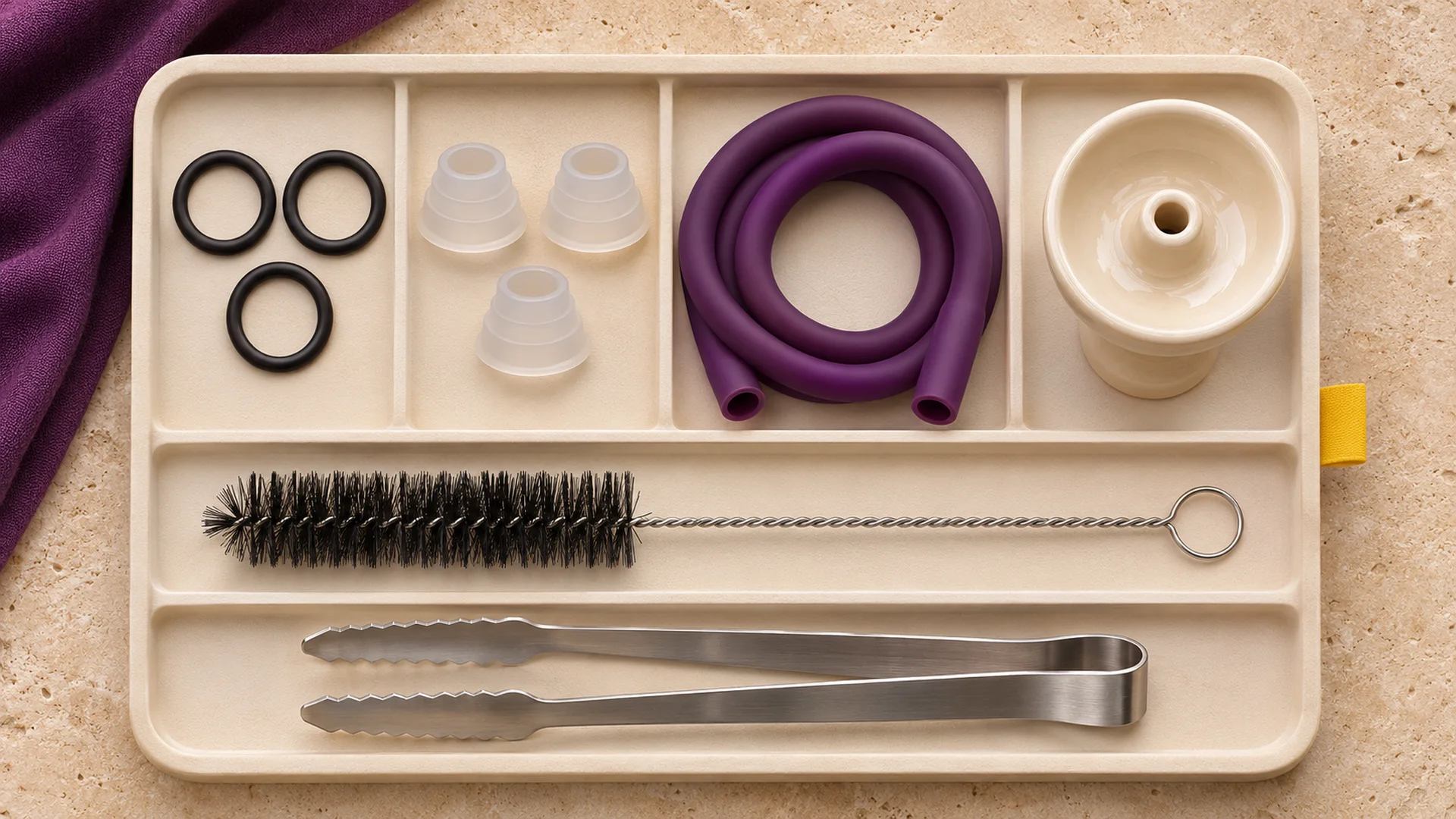
| Part | What it does | When to replace | Size compatibility |
|---|---|---|---|
| 1. Grommet (O-ring) | Prevents air leaks between two joined parts | Cracking, hardening, flattening or moving around in the groove | Inner diameter and cross-section thickness; the model's parts list |
| 2. Hose | Carries air from the stem to the mouthpiece | Cracks, permanent kinks, a smell that won't go away or looseness at the end | End connection diameter and length; the model's manual |
| 3. Hose | Forms the port where the hose connects to the stem | Cracks, a loose push-fit, a valve that won't close | Connection type (push-fit or threaded) and diameter |
| 4. Bowl | The vessel that holds the tobacco | Cracks, breakage or glaze damage | Opening diameter and how it seats on the stem |
| 5. Purge ball | The small part that lets the purge valve open and close | When it's lost or doesn't seal in its seat | Ball diameter and material are model-specific |
| 6. Mouthpiece | The part at the end of the hose that touches your mouth | Breakage, scratches, a loose fit | Fitting size for the hose end |
| 7. Cleaning brush | Cleans the inside of the hose, stem and base | When bristles fall out or bend out of shape | Thick enough to fit the hose's inner diameter and the base neck |
| 8. Tongs | Moves hot charcoal without touching it by hand | When the hinge loosens or the tips no longer grip charcoal | Length and tip shape; no size compatibility needed |
The “size compatibility” column shows which information to record when choosing a spare. I'm not giving numbers, because a part with the same name can come in different sizes from different manufacturers.
Four parts that wear over time: grommet, hose, mouthpiece, brush
This group is the expected replacement group. When to replace them can be noticed early from the part's appearance and behavior.
- Gasket According to industrial O-ring information, a grommet exposed to heat for long periods can become permanently flattened, harden and crack (O-Ring Handbook failure modes). On a hookah, the connections near the bowl and the heat management device are under more strain in this respect. When buying a spare grommet, follow the grommet size and replacement guide for the inner diameter and cross-section.
- Hose Because you can't see the inside of the hose, it's the part whose problems are most often noticed late. Cracks, permanent kinks, looseness at the end or a smell that won't wash out are signs it needs replacing. Choose a spare hose by the diameter and length of its connection end.
- Mouthpiece Some mouthpieces can crack when dropped or fit loosely on the hose end. A loose mouthpiece can feel similar to an air leak. That's why keeping a separate mouthpiece helps you quickly isolate the problem.
- Cleaning brush A brush with missing or bent bristles can no longer reach the inner surface. A spare brush looks minor, but it keeps cleaning on a regular schedule. Choose the length to get through the hose and the thickness to fit the base neck.
When replacing these parts, take a photo and note the size of the old one before throwing it away. That way, next time you shop you'll be working from records instead of guesswork.
Four parts that break or go missing: bowl, hose handle, purge ball, tongs
This group fails unexpectedly; without a spare, you lose days, not just a session.
- Bowl Ceramic and clay bowls are stressed by sudden temperature changes and can crack. Digitalfire explains that ceramic is hard but brittle and easily spreads cracks (Digitalfire thermal shock explanation). Look for a replacement bowl on the Hookah Bowl page, based on the diameter of the opening that sits on the stem.
- Hose On this part, which carries the hose connection, a crack or loose push-fit can affect the draw and the flow of water. If water is coming through the hose, first see the water in the hose guide for more. For a spare hose handle, check the connection type and diameter in the Hookah Hoses category.
- Purge ball The tiny balls that move inside the valve are easily lost, and they can't seal if residue sticks to the seat surface. If the part is missing, don't try just any ball; the diameter and material must match the model's parts diagram. For details, the purge ball and air leak guide will help.
- Tongs Tongs are the part you manage charcoal with, and when their hinge loosens, hot charcoal can fall. Spare tongs don't need size compatibility; a firm grip, enough length and a non-flammable surface are what matter. Handle charcoal over a separate non-flammable pan.

From symptom to part: what to check first?
The same symptom can come from more than one part, so the table is not a “definite diagnosis” but the order to check things in first. To shorten the sequence, the air leak check order guide goes section by section.
| Symptom | Likely part | First check |
|---|---|---|
| The draw has weakened, or there's a whistling or rustling sound | Grommet, hose end, mouthpiece fit | Check whether the parts sit flat and fully in their seats |
| Water is coming through the hose or there's gurgling | Water left in the hose, hose handle connection | Empty the hose and check the connection surface and grommet |
| The purge valve won't close | Purge ball, seat, cap | Is the ball there, is the seat clean, is the cap right? |
| Smell or cracks in the hose | Hose | Hold the inside up to the light and look for cracks and residue |
| The bowl is cracked or wobbles on the stem | Bowl, grommet | Inspect the line at the bowl's opening and the seating surface |
| The mouthpiece is loose or scratched | Mouthpiece, hose end | Try another mouthpiece and compare |
| The inside is still dirty after cleaning | Brush | Check whether the bristles have fallen out or bent |
| Charcoal slips out of the tongs | Tongs | Check the hinge and tips for wear |
The value of spare parts is that they let you immediately swap in the first suspect part from this table and test. If replacing a part doesn't fix the problem, move on to the other connections; don't replace everything at once.
Building, storing and checking your spare parts kit
Setting up the kit once and keeping it in a separate box saves you the trouble of searching later. The steps below suggest a simple setup.
- Write the brand, model and, if any, version information of your set on a note card.
- Add a size note for each part: grommet inner diameter and cross-section, hose end, bowl opening diameter, ball diameter. If you don't have calipers, take a photo of the old part with a ruler next to it.
- Separate small parts (grommets, balls) into lidded compartments or labeled bags.
- Store the box in a cool, dry place out of direct sunlight; don't leave grommets near heat or chemical cleaners.
- When a part is used, add its replacement to the list right away.
The short checklist below keeps the kit both safe and ready to use.
- Cold and empty Replace parts only on equipment that has fully cooled, with no charcoal and no packed bowl.
- Records Keep the model name, size notes and part photos inside the box.
- Compatibility Match a new part by size and model information, not because it looks the same.
- Fire safety Handle charcoal and tongs on a non-flammable surface, away from children and pets.
- Order Symptom first, then part; don't replace more than one part at a time.
For grommets, balls and similar small parts in the store, you can check the Gaskets and Spare Parts category. If you mix up the names of parts, our hookah parts and their names article works as a glossary.
Frequently asked questions
Do I need spares for all eight parts?
No. Start with the small parts you take apart often: the grommet, purge ball and mouthpiece. For the bowl, hose and hose handle, recording the model information may be enough; whether you need spares depends on how often you use it.
Will a part that looks the same from another hookah fit my set?
Looks don't guarantee a fit. The inner diameter, cross-section, connection type and material may differ. Confirm the size first, and if you're not sure, check model compatibility with the seller or manufacturer.
How long before a grommet needs replacing?
It wouldn't be right to give a fixed interval; how often you use it, heat and cleaning method all play a part. Replace it when you see cracking, hardening, flattening or movement in the groove. Regular checks are a more reliable guide than a calendar.
If the purge ball gets lost, can I use a different ball?
I'd advise against trying just any ball. The diameter and material are determined by the model's valve design; an incompatible ball can create a new mismatch instead of fixing the leak. Check the parts diagram or share the model information with the seller.
Where and how should I store spare parts?
Store them in a cool, dry container out of the light, labeled, with small parts kept separate. Keep grommets away from heat and chemical cleaners. Put the model and size notes in the box too.
Sources and scope
This article provides general care information; the model's manual and the seller's parts information take priority. For types of grommet damage, the O-Ring Handbook failure modes, and for the effect of sudden temperature changes on ceramics, the Digitalfire thermal shock explanation were reviewed. These sources describe industrial O-rings and ceramic technique; they don't apply directly to hookah models. The tables are general summaries prepared for this article and contain no exact sizes.


Leave a Reply