

How to Choose a Hookah Heat Management Device and Wind Cover: Types and a Decision Table

Summarize this article with AI
Discover the key points with your preferred tool.
The title, article link and text context are sent to your chosen tool.
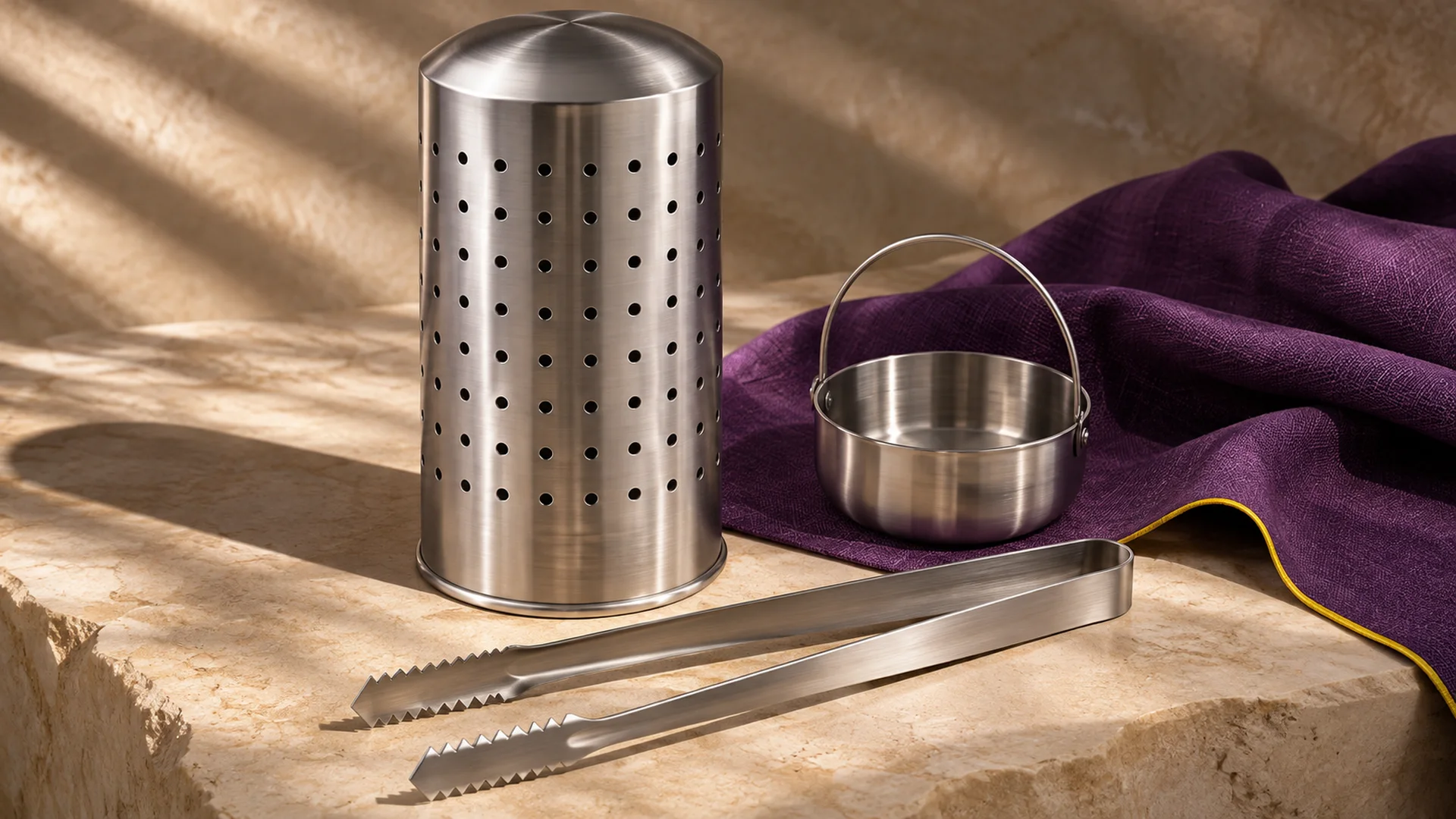
The heat management device is the part that holds the charcoal above the bowl and directs the airflow; the wind cover is the outer shell that protects that heat from wind and blowing ash. The right choice depends first not on material but on size fit with the bowl, the hole pattern that provides airflow, and the environment you'll use it in. The charcoal burner, tongs, and tray complete the preparation and cleanup side of this setup.
This guide compares the roles of the heat management device (charcoal holder, called a közlük in some regions), the charcoal burner, the wind cover (chimney), the tongs, and the tray in terms of material, hole design, size, and wind protection outdoors. There's no brand ranking and no heat-rating claim. Because naming varies from manufacturer to manufacturer, the model's own manual and the measurements in the product description always take priority.
What do the heat management device, charcoal burner, wind cover, tongs, and tray do?
These five parts come into play at different stages of the same job. One holds the charcoal, one prepares it, one protects it, one handles it, and one collects the ash. Separating their roles is enough to figure out which ones you need.
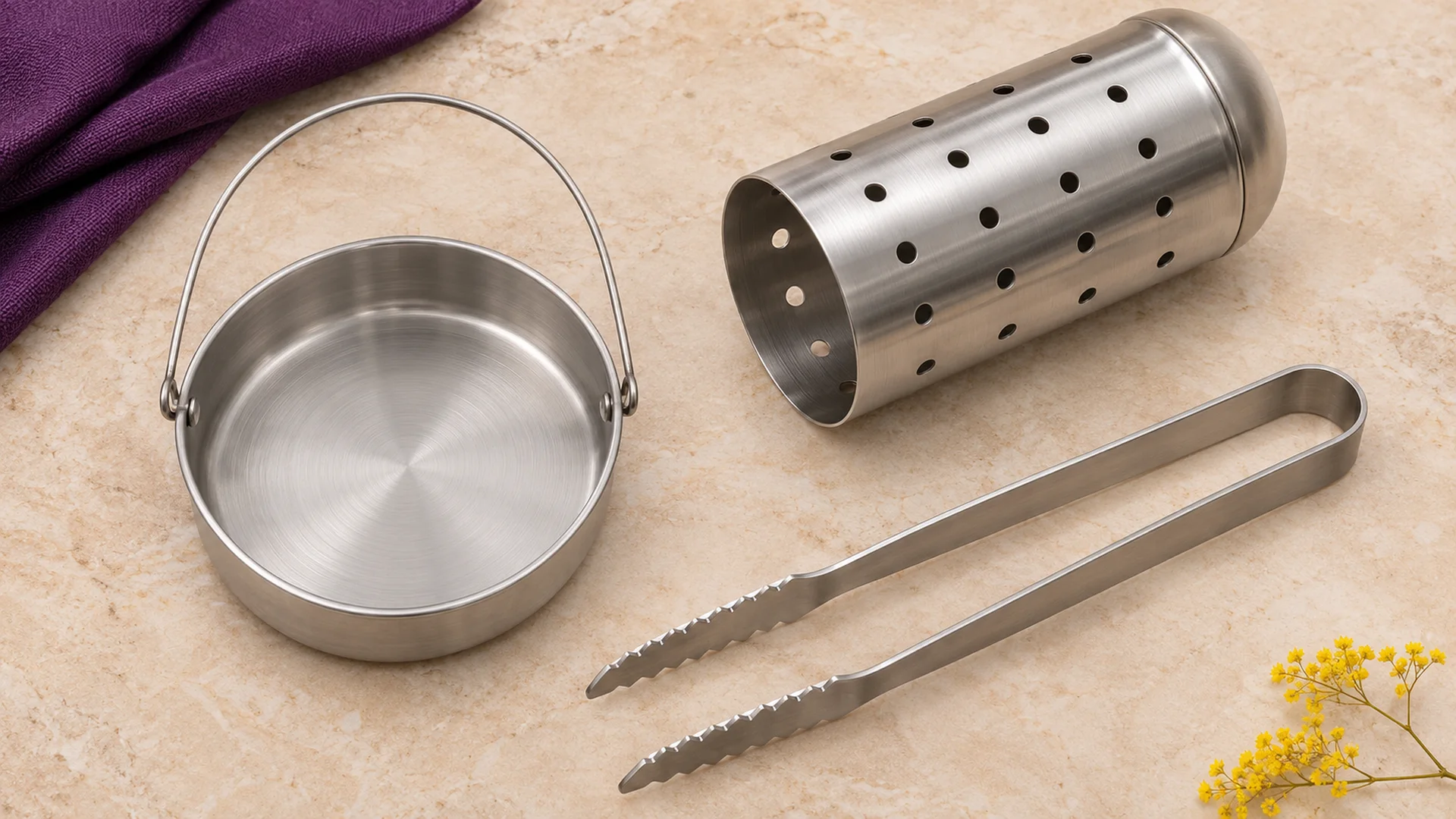
- Heat management device (charcoal holder) The container the charcoal sits in, letting air pass beneath and around it. Because it's the intermediate part between the bowl and the charcoal, size fit matters most here.
- Charcoal burner An electric, coil, or grate-type heater used to heat the charcoal before putting it in the heat management device. It lets you prepare the charcoal in a separate place instead of lighting it directly on the bowl.
- Wind cover (chimney) A perforated, usually cylindrical guard that surrounds the top or sides of the heat management device. It aims to reduce how quickly wind burns through the charcoal and how much ash blows around.
- Tongs Removes the need for hand contact when moving hot charcoal from the burner to the heat management device and adjusting its position.
- Tray A non-flammable surface that holds the burner, the tongs, and any spilled ash. It protects the table and floor.
When choosing tongs, look at the length, the tip shape, and how the handle heats up. The tip should be serrated or curved enough to hold the charcoal without it slipping. Tongs that are too short bring your hand close to hot surfaces, and tongs with a very loose hinge can drop the charcoal. When choosing a tray, rim height and insulation underneath also matter.
In the store, these parts are listed separately in the Hookah Heat Management Device, Hookah Charcoal Burners and Chimney Tongs Pan categories.
Choosing a heat management device and wind cover by material
The material determines how quickly it conducts heat, how heavy it is, and how it changes over time. Each material has a strength and a limit that needs attention. The table below summarizes general tendencies; for the heat resistance of a specific model, the manufacturer's information is what counts.
| Material | Strength | What to watch for |
|---|---|---|
| Stainless steel | Durable, not easily affected by ash and moisture | Thin sheet is prone to deformation; the handle can heat up quickly |
| Aluminum | Light and spreads heat quickly | Can warp at high heat; the surface can scratch or turn dull |
| Brass | Heavy, stable, and decorative | Darkens over time, needs care |
| Ceramic, terracotta | Holds heat, gives a classic look | Fragile, can crack from sudden temperature changes |
| Painted or coated metal | Offers visual variety | Paint or coating can break down at high heat |
With ceramic, the main risk is sudden temperature difference. Ceramic bodies can be stressed by sudden temperature changes and, because they are brittle, can crack (Digitalfire thermal shock explanation). So don't let a hot ceramic part touch a cold surface or water. For details on bowl cracks, see the ceramic bowl crack and glaze guide is a useful reference.
Surface changes on brass and aluminum parts are mostly a matter of care. For discoloration and protective coatings, see the brass tarnish and care guide; for matte or stained aluminum surfaces, the aluminum cleaning guide; and for how surface coatings behave, the rust, tarnish, and coating guide for protecting the gaps in the pattern and the decorated glass.
Hole pattern, airflow, and size fit with the bowl
The holes in a heat management device aren't just decoration; they carry air under and around the charcoal and let the ash fall through. If there are too few or too small holes, the charcoal can't get enough air and may weaken sooner than expected. Holes that are too wide or too many can make the charcoal burn out quickly. This balance is a general tendency; the actual result depends on the type and size of charcoal and the environment.
The holes in a wind cover do a different job. They let air in while breaking up direct gusts. A closed design with no holes at all can cut off the charcoal's air and weaken the burn.
A perforated, tall enough design usually gives a more balanced flow. The more evenly the holes are spread, the more evenly air reaches the charcoal.
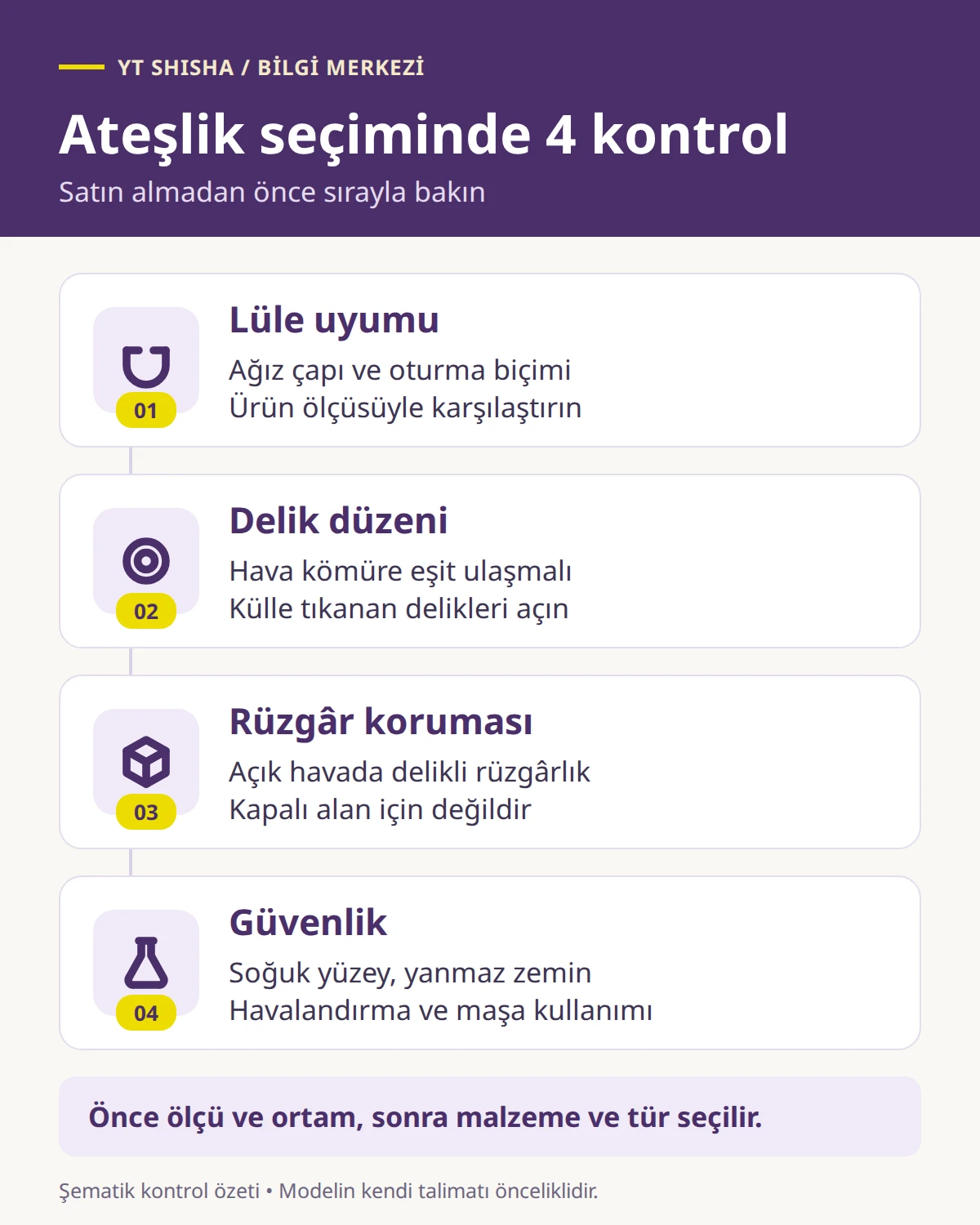
Two measurements should be considered together for size fit. The first is the base diameter of the heat management device and how it sits on the bowl's opening. The second is whether the charcoal fits inside the device; the store's charcoal category lists 26, 27, and 28 mm cubes as well as half-moon and tunnel shapes. The space left between the charcoal and the device affects both airflow and whether the lid closes.
- Compare the inner and outer diameter of the bowl opening with the measurement in the product description.
- Check that the heat management device sits evenly on the bowl without wobbling.
- Choose the charcoal size based on the spacing of the heat management device and the burner grate; check the sizes listed in the Hookah Charcoal category.
- If you'll use a wind cover or lid, check the clearance it leaves above the heat management device.
- For any measurement you're unsure of, check the model's manual or ask the seller.
Wind protection outdoors, and burn and fire safety
Outdoors, a breeze can burn the charcoal faster than needed, blow the ash around, and unsettle the heat management device. That's why a wind cover makes a noticeable difference on balconies, in gardens, and on terraces. When wind comes from all around, a design with a wide surface and evenly spaced holes usually behaves more consistently.
Height also matters. A wind cover that's too low lets the breeze pass over the charcoal, while one that's too tall and narrow can restrict airflow. A base that sits firmly on the heat management device lowers the risk of tipping and blowing ash. Use a lightweight wind cover on a sturdy tray or a non-flammable base.
A wind cover is not a safety measure. Burning charcoal produces carbon monoxide, a colorless, odorless gas. A public health notice warning against using burning charcoal in small, poorly ventilated enclosed spaces states that the risk depends on the room size, the number of people, and ventilation (NJ Poison Information and Education System notice). That's why wind protection only makes outdoor use easier, not indoor use.
- Cold check Before handling the parts, make sure the heat management device, wind cover, and burner have cooled completely. Metal handles and bodies can stay hot for a long time.
- Stable, non-flammable surface Keep the heat management device and burner on a flat, non-flammable surface away from flammable covers, paper, or curtains.
- Tongs for moving Move hot charcoal with tongs, not by hand; transfer the charcoal from the burner to the heat management device slowly.
- Children and pets Leave hot equipment somewhere they can't reach, and don't leave it unattended.
- Ventilation Don't burn charcoal in small, enclosed spaces, and keep a carbon monoxide detector nearby.
Don't try to force the lid or wind cover off while it's hot. If it's stuck, wait for it to cool completely.
Ash cleaning and part lifespan
When ash fills the holes, it quietly reduces airflow. Tap out the heat management device and wind cover after every use, once they've cooled completely. Clean built-up ash out of the holes with a brush or a soft stick; avoid hard tips that would strain the metal.
Always transfer ash into a closed, non-flammable container, and only once you're sure it has cooled. A layer that looks like ash on top can hold embers underneath. Storing it in a closed container also lowers the fire risk from blowing ash. Dumping ash straight into a trash bag can let an ember you thought was out flare up.
- Make sure the parts have cooled completely.
- Tap the ash out of the heat management device into a non-flammable container.
- Clean the holes with a soft brush, avoiding tips that could damage the metal.
- Wipe the surface with a damp cloth suited to the material and dry it completely.
- Check the hinge, handle, and seating surface for bending or cracks.
Lifespan depends as much on usage habits as on material. Parts that overheat, are repeatedly cooled while hot, or take impacts can show deformation and cracks. Don't clean painted surfaces with an abrasive paste. Regularly check moving points such as the handle and hinge for loosening or bending.
Quick decision guide: need and recommended type
The table below is a list of needs; it isn't a recommendation for a specific model. First determine where you'll use it, then your bowl size, and then choose the type.
| Need | Recommended type | Why |
|---|---|---|
| Frequent wind outdoors | Perforated, tall enough wind cover | Breaks up gusts while letting air through |
| Light, portable set | Aluminum or thin steel heat management device | Low weight; the surface may need care |
| Classic look and heavy build | Brass or ceramic heat management device | Stays stable; sensitive to care and impacts |
| Preparing charcoal quickly and evenly | Charcoal burner and tongs | Charcoal isn't lit directly on the bowl |
| Keeping the table and floor clean | Tray and ash container | Catches spilled ash and hot tools |
| Using different charcoal shapes | Heat management device with a wide chamber, burner with a suitable grate | Cube and half-moon charcoal may not fit the same space |
Before buying, answer these questions one last time: Does the bowl size match, does the charcoal shape fit, will it be used outdoors, who will clean the part and how, and is there a safe place for it to cool down?
Frequently asked questions
Are the heat management device and wind cover the same part?
No, they have different jobs. The heat management device is the container that holds the charcoal and directs airflow; the wind cover is the protective shell around it. Some sets may present the two together as one piece, so check the product description.
Is a heat management device enough without a charcoal burner?
A heat management device holds the charcoal on its own, but you need a heat source to prepare it. A charcoal burner lets you do that preparation in a separate place. Which method you use depends on the type of charcoal and the manual's instructions.
Is a wind cover needed indoors?
Indoors, drafts usually aren't a problem. The main thing to watch is ventilation; burning charcoal produces carbon monoxide. A wind cover doesn't reduce this risk.
Should I choose ceramic or metal?
It depends on how you use it. Ceramic holds heat but is affected by sudden temperature changes and impacts. Metal can be more durable, but the handle and body stay hot for a long time.
How do I confirm the size?
Compare the size of the bowl's opening with the base diameter in the product description. If no measurement is given, ask the seller. The model's own instructions take priority.
Sources and scope
This guide is about choosing, caring for, and safely using equipment; it doesn't guarantee the heat resistance or fit of any specific product. The tables show general tendencies, and the model's own manual takes priority. Images are conceptual.
For sudden temperature change in ceramics, the Digitalfire thermal shock glossary; for the warning about burning charcoal and ventilation, NJ Poison Information and Education System notice were reviewed.