

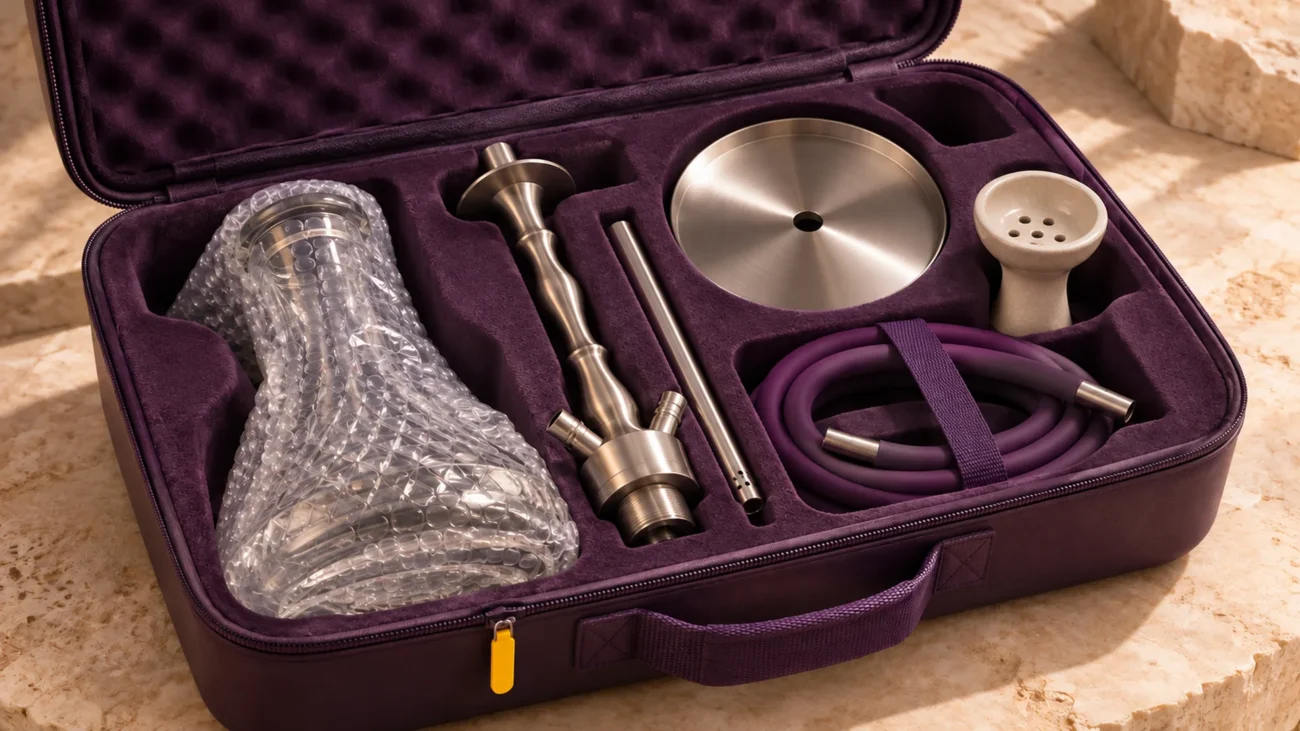
How to Transport a Hookah: Safe Packing for Travel and Moving

Summarize this article with AI
Discover the key points with your preferred tool.
The title, article link and text context are sent to your chosen tool.
The basic rule for transporting a hookah is order: first let the charcoal and ash cool completely and empty them, then pour out the water, take the parts apart, dry them, and pad every fragile part separately. Parts such as the glass base, bowl, and grommets are most at risk of impact and pinching on the road, while the stem and hose are more prone to crushing and moisture. A few minutes of orderly preparation is much easier than hunting for a cracked base or a lost grommet when you arrive.
This guide offers a general packing routine for situations such as travel, moving house, or changing venues. A specific model's removable parts, dimensions, and care instructions vary from manufacturer to manufacturer; the model's own manual always takes priority. This article is for readers aged 18 and over and does not cover carrier rules (airlines, buses, shipping); you need to check those yourself.
Cool and empty it first: why does the order matter?
Packing should never start with the heat source. The moment charcoal, ash, or hot metal parts go into a bag, there's a risk of burns, fire, and damage to the packaging. So the first job is to make everything dry and safe to touch.
- Finish the charcoal and ash Remove any remaining embers with tongs and leave them on a non-flammable surface in a well-ventilated spot; don't test whether they've cooled by touching them.
- Cool the heat management device and ash separately Leave the heat management device, charcoal burner, and tray where they are until they've cooled completely. Only collect the ash in a lidded metal container once you're sure it has cooled.
- Empty the tobacco Remove the tobacco from the bowl; don't put the bowl in water while it's hot.
- Pour out the water from the base Water becomes a source of leaks and odor on the road; don't start packing until the base and hose have been emptied of water.
- Dry the parts A dry exterior doesn't mean the inside is dry too; for details, see the guide to drying hookah parts for more.
Some general fire safety guides note that charcoal and ash can stay hot enough to reignite for days; for example, the Boise Fire Department recommends keeping ash in a lidded metal container away from buildings (Boise Fire Department ash guide). So on the day you leave, it's a healthier plan not to light new charcoal and to keep old ash away from your bag.
Disassembly order and parts to carry separately
Not every hookah comes apart the same way; some connections aren't designed to be opened by the user. Remove the parts the manufacturer's manual says can be separated and leave the rest as they are. If you're not sure, don't force a connection.
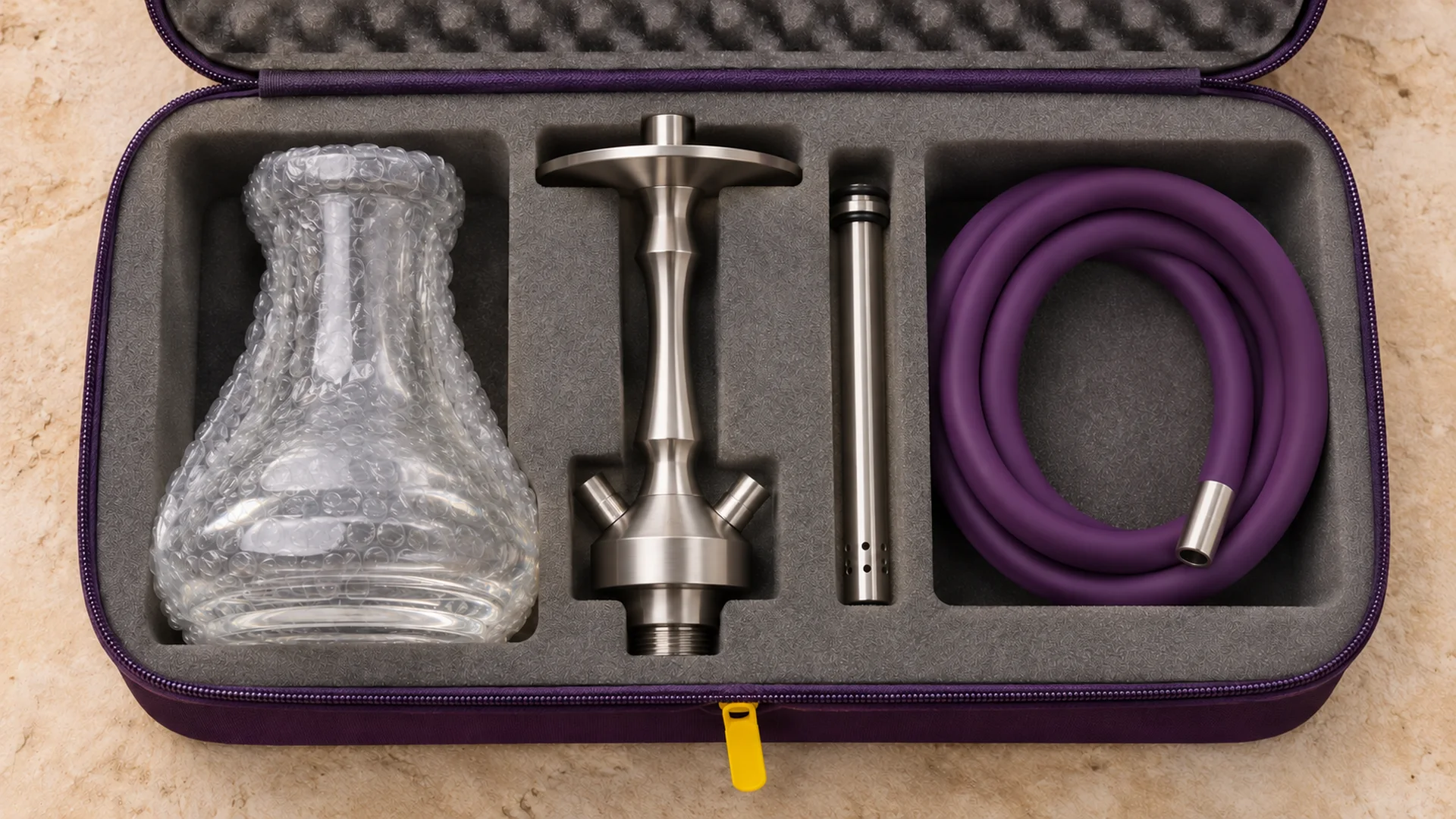
Take a photo of the whole set before taking it apart. The photo makes it easier to put small rings, spacers, and grommets back in the seats they came from when you arrive. A photo alone isn't proof of correct assembly, but it supports your memory.
- Parts to carry separately Parts such as the glass base, bowl, hose, and mouthpiece are wrapped individually. If they go in the same container, there should be padding and dividers between them.
- Stem and downstem Metal parts are heavy; don't place them inside or on top of the glass base. A heavy part shifting on the road can put stress on the glass.
- Small parts Parts such as grommets, rings, screws, and balls go in a small lidded container or bag and are labeled.
- Heat management device, tray, and tongs Once completely cooled and cleaned, with no traces of ash or charcoal, they go in a separate compartment. Ash residue will stain a fabric bag.
If there's limescale buildup inside the base, cleaning it before your trip makes it easier to check for scratches and cracks during transport. For this, see the guide to cleaning limescale from the base for help; follow the instructions for the product you use.
How do you protect each part? Quick table
The table below summarizes general tendencies. Because dimensions and materials vary by model, it makes no numerical claims; for details, the product page and manual are what count.
| Part | Main risk | How to protect it |
|---|---|---|
| Glass base | Impact, pinching, sudden temperature change | Wrap it on its own, clean and dry; carry it in a padded case or compartment, away from heavy parts |
| Bowl | Chipped edges, cracks (especially in ceramic) | Wrap the edges with fabric or foam; don't put weight on it, and clear out any charcoal and tobacco residue |
| Grommets and rings | Loss, crushing, contamination | Store them clean and dry in a small labeled container; keep any spares in a separate compartment |
| Hose | Sharp kinks, internal moisture, odor | Make sure the inner channel is dry and store it in a loose coil; don't bend it tightly |
| Mouthpiece | Contamination, scratching | Carry it in its own bag or a lidded box, separate from the hose |
| Stem and downstem | Dented threads, scratches, weight | Wrap the surface in a cloth and protect the threads and seats from impact; keep the heavy piece at the bottom of the bag in a separate compartment |
| Heat management device, tray, tongs | Ash residue, deformation, scratches | Carry them cold and clean in a separate compartment or a separate bag |
Glass needs a separate warning: sudden temperature changes can create stress in glass, and resistance depends on the type of glass. Washing a base that has been sitting in a cold trunk with hot water right away, or placing a hot part on a cold surface, can increase this risk; written sources describe this in relation to glass containers (American Ceramic Society, thermal stress in glass containers). If you notice a crack or chip after your trip, don't use the base and follow the steps in the guide to cracked glass bases instead.
Bag, hard case, and padding options
The right carrying equipment depends on the hookah's parts, the type of trip, and how often you transport it. In the store, these products are in the Bags and Transport category; confirm which model fits which set from the product description and the manual.
- Hard case Offers more resistant protection against impact and loads placed on top. If there are no internal compartments or foam inserts, parts can move against each other; fill any gaps with clean padding.
- Soft bag or backpack Light, easy to carry, and practical for short distances. Leaving the glass base unpadded in the same compartment as heavy parts is not a good idea; it needs a separate protective layer and compartment.
- Original packaging The product's original box and the foam inside it are often shaped to fit the model. If you still have them, it makes sense to reuse them for travel and moving.
- Improvised padding Towels, fabric, or bubble wrap work fine, as long as they're clean and dry. A wet or dirty cloth can leave odor and marks on a part's surface.
The way you travel also matters. Keeping the glass base with you in your carry-on can reduce knocks from uncontrolled loading and unloading, but size and content restrictions vary by carrier. A padded case should also be considered for parts going into checked baggage.
Carriers such as airlines, bus companies, shipping companies, or ferries don't share the same rules on size, weight, and items like charcoal and tobacco, and these rules can change over time. Before you set off, check the rules of the carrier you'll be using and ask for written confirmation if needed; this article does not give definitive rules.

Step-by-step packing order
Following the order below, instead of tossing parts into the bag one by one, reduces the risk of both damage and loss. The hose and grommets also have their own steps in this list.
- Empty and cool Let the charcoal and ash cool, pour out the water, and remove the tobacco.
- Take a photo Record how the parts are arranged and where the grommets sit.
- Disassemble and dry Only separate the parts the manufacturer allows, and dry all the parts.
- Separate the small parts Put the grommets, rings, and screws in a labeled container.
- Coil the hose loosely Place the hose, with its inner channel dry, in a loose coil without sharp kinks. If you're concerned about odor or mold, see the guide to silicone hose odor and mold for more.
- Wrap the glass Wrap the base in clean fabric or foam and place it in a separate compartment.
- Put heavy parts at the bottom The stem and heavy metal should sit balanced at the bottom, away from the glass.
- Fill the gaps and close Parts shouldn't shift when the bag is moved; give it a gentle shake to test before closing.
If you use spare grommets and rings, you can choose ones that fit your model from the Gaskets and Spare Parts category. Losing a grommet during a trip can make the whole set unusable, so it's wise to carry a spare in a separate place.
Arrival checklist
After your trip, do a round of checks first instead of immediately assembling and using the parts. Noticing damage during assembly is less risky than noticing it during use. This list summarizes the basic steps after transport.
- Bag and box Are all the parts in place, and are there any signs of moisture or water? If there's a wet mark, assess the packaging separately.
- Glass base Look for cracks, chips, or scratches around the rim, neck, and bottom. If there's a suspicious mark, don't use the base.
- Bowl Check whether there are any chips or cracks on the edges.
- Grommets and rings Are they all there? Don't use any that are torn, crushed, or hardened; replace them with new ones.
- Hose Check for kink marks, odor, or moisture. If you can't check the inner channel, clean it before first use.
- Stem and threads Check the threads, seats, and connection surfaces for dents or scratches; don't force them together.
If you won't be using the set for a while, long-term storage calls for a different routine; the guide to long-term storage covers this topic in detail. If you'd like a refresher on the names and functions of the parts, the hookah parts and their names article will help.
Frequently asked questions
Can I carry my hookah in one piece without taking it apart?
This depends on the model's design and manual. In general, separating the glass base and the heavy stem makes for safer packing; however, the manufacturer may not allow the user to open some connections. Follow the manual and don't force anything.
Do I really need to empty the water from the base before transporting it?
Yes, in general you should empty it. Water leaks during the trip, leaves odor, and keeps the parts damp. Emptying and drying the base and hose reduces both leaks and the cleaning workload when you arrive.
Can I carry charcoal and tobacco with me?
The rules for these kinds of items can differ by carrier, route, and country; this article does not give definitive rules. Before you leave, check the carrier's current rules and the regulations at your destination. Never put charcoal or ash in any container before they've cooled.
How should I store the hose?
Store it in a loose coil, without sharp kinks, while the inner channel is dry. A hose left wet or sealed up is prone to odor and mold problems; in that case, refer to the cleaning and drying guide.
What should I do if I see a small scratch on the glass after transport?
It's not always easy to tell a scratch from a crack by eye. If there's a suspicious mark, don't use the base; photograph it and ask the manufacturer or seller to assess it. Gluing it back together doesn't count as an adequate fix.
Sources and scope
This guide is a general packing and checking routine; it does not replace model-specific disassembly and parts information. For carrier rules, international restrictions, and regulations on products such as charcoal and tobacco, contact the carrier you'll be using and the relevant authorities. This article is written for readers aged 18 and over.


Leave a Reply