

What Is a Titanium Hookah Set? Color, Coating, Durability and Care

Summarize this article with AI
Discover the key points with your preferred tool.
The title, article link and text context are sent to your chosen tool.
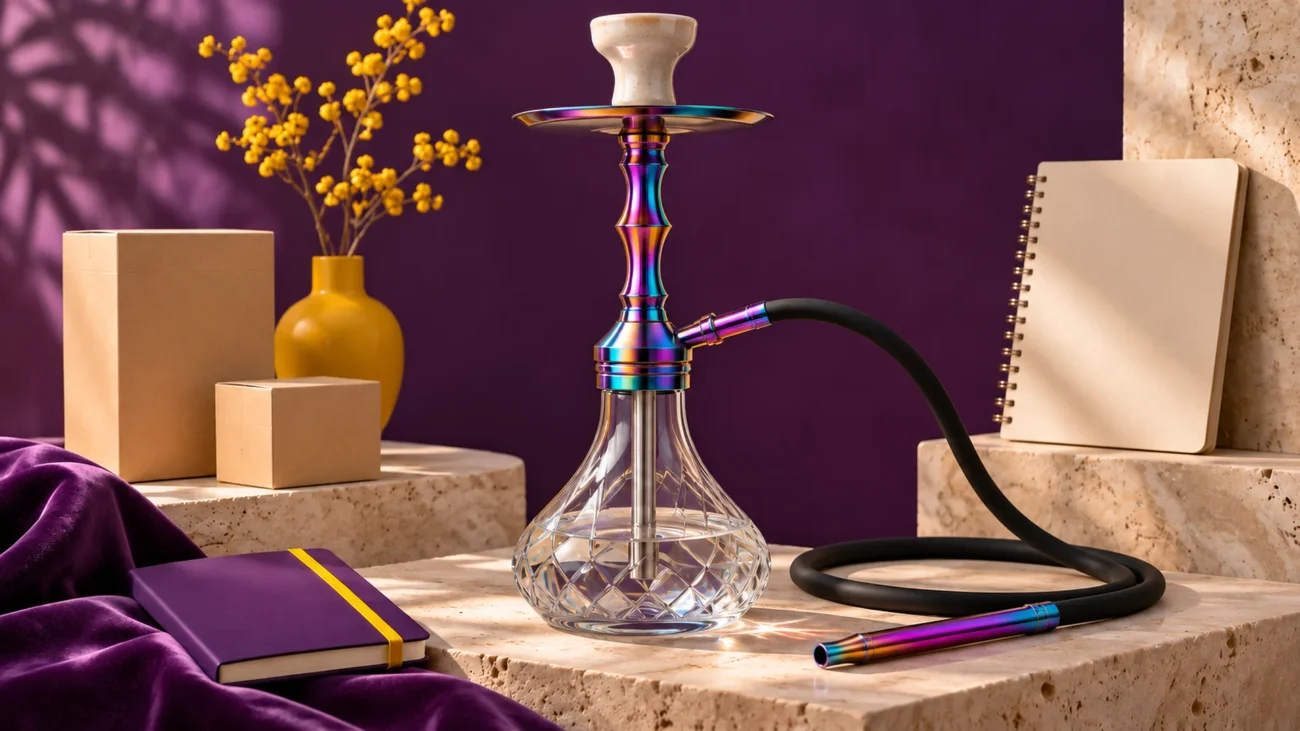
Titanium hookah setis a trade name used in the market mostly for sets whose stem is stainless steel and whose surface is colored in blue, purple, gold, burgundy or rainbow tones. The name alone does not show that the stem is made of a titanium alloy. Only the product page tells you the stem material and how the surface was colored.
This article explains what the name “titanium” means for hookah sets, how colors form on metal surfaces, and how durable a colored surface is and how to care for it. It also reports exactly what the product pages of the models in our shop say. It gives no information about the coloring method or coating thickness that is not on the product page. Hookah is a tobacco product and is not sold or served to anyone under 18.
What does “titanium hookah set” mean?
On sales pages, the word “titanium” can be used to describe two different things. The first is the material: it says the stem is made of titanium or a titanium alloy. The second is the look: it describes the color effect, often seen on titanium items, that shifts between blue, purple and gold on a metal surface depending on the light. With hookah sets, you will usually see the word in the second sense, as a description of color and look.
Among the steel titanium hookah sets category description also states this clearly: the word “titanium” in the category name may not have the same technical meaning for every product; for some models it may refer to a coating or look, and for others to the material description of the product series. That is why you should look at the stem material line on the product page rather than the name.
On the site, this group is a subgroup of the Steel Hookah Sets category. This means these sets should first be judged as steel sets in terms of material. For stainless steel grades and quality differences, our 304 vs 316 article offers a detailed framework.
How do colors form on a metal surface?
Blue, purple and gold tones on metal surfaces are not always made with paint. These colors often come from the way a very thin layer on the surface interacts with light. Because the same look can be achieved with different methods, guessing the method from the color does not give a reliable answer.
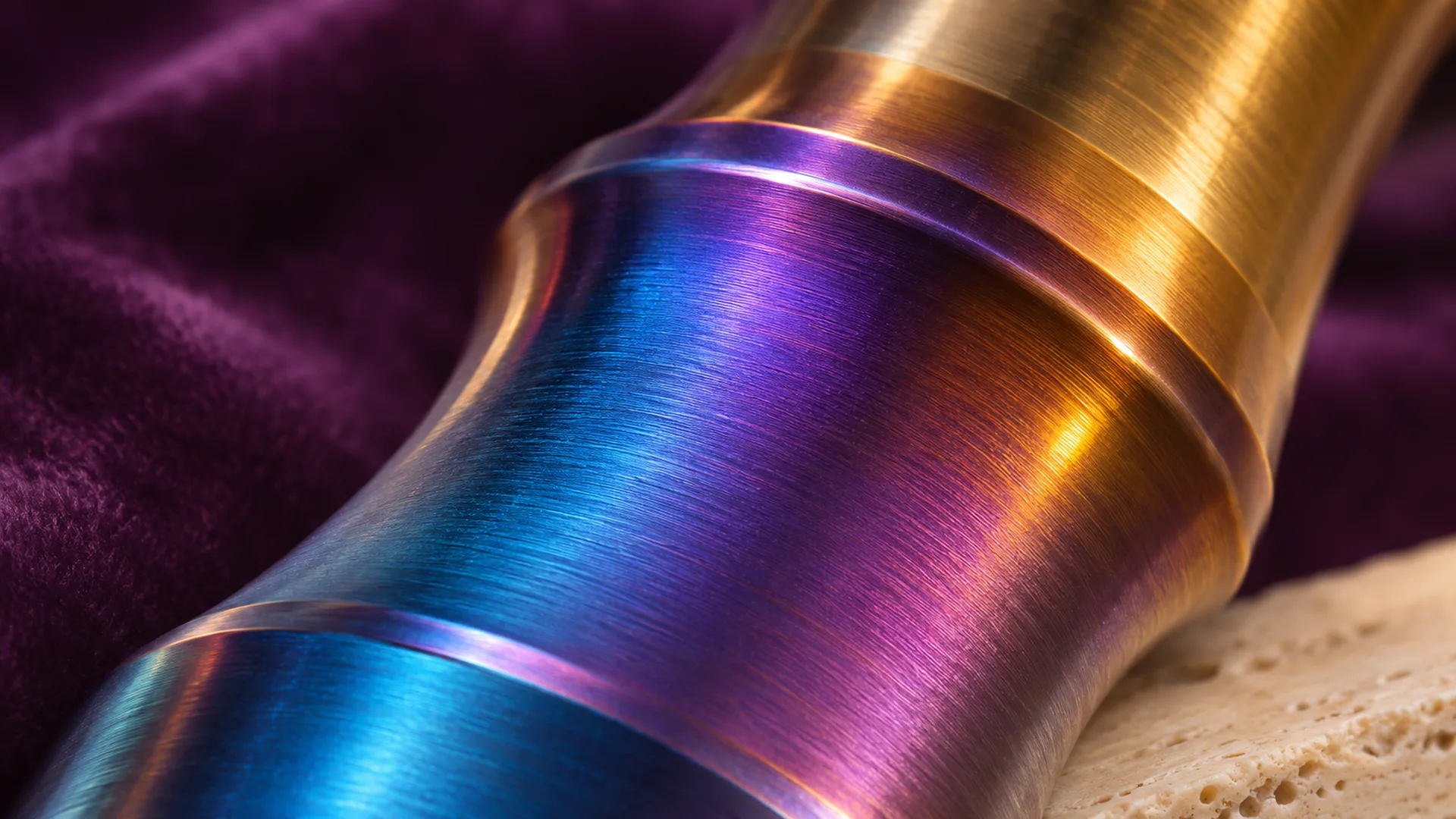
- Thin oxide layer and interference color When titanium is anodized, the color depends on the thickness of the oxide layer, and this thickness is set by the applied voltage. The color comes from interference between light reflected from the oxide surface and light that passes through the layer and reflects off the metal. In other words, there is no paint; the color comes from the thickness of the layer.
- Electrochemical coloring of stainless steel According to the Australian Stainless Steel Development Association (ASSDA), stainless steel can be given bronze, blue, black, gold, purple and green tones with a thin oxide film grown in an acid bath. With this method, the colors shift slightly with the viewing angle because of the interference effect.
- PVD coating In physical vapor deposition (PVD), a thin coating is applied to the surface in a vacuum. According to ASSDA, with this method the color depends on the source material and does not change with the viewing angle. Gold-toned titanium nitride (TiN) is a well-known example of this type of coating; this compound, which is brown in pure form, looks gold when applied as a coating.
| Method | Where does the color come from? | Change with viewing angle | Good to know |
|---|---|---|---|
| Anodizing on titanium | Thickness of the oxide layer | It is an interference color and may look different from different angles | The material itself is titanium |
| Oxide film on stainless steel | A thin film grown under control | Changes slightly | A scratched film cannot be repaired |
| PVD coating | Source material used in the coating | Does not change | Resistant to wear but not indestructible |
| Organic coating or paint | Paint or a cured coating | Does not change | Heat and abrasive cleaning can affect the surface |
The table summarizes general material information. Which method is used on a hookah set can only be known from the manufacturer’s description. A surface showing shifting, rainbow-like tones does not prove the stem is titanium; stainless steel can also be given similar colors.
What do the product pages of YT Shisha steel titanium sets say?
As of November 2026, when this article was written, we read the product pages of the models in the category one by one. On every model that has a description, the stem material is listed as “Stainless Steel.” No product page mentions a titanium alloy stem or a specific coating method. In the product descriptions, color is described as a look.
| Model | Stem material (per product page) | Color and look description | Usage |
|---|---|---|---|
| YT Honey Titanium Chery Set | Stainless steel | Burgundy metallic stem; base, tray and hose head in the same color family; colored glass base | Floor type |
| YT Colour Off Hookah Set | Stainless steel | Metallic colors shifting across the stem, tray and base; rainbow-effect look | Floor type |
| YT Space Cherry Set | Stainless steel | Warm metal tone close to copper, metallic color gradients | Floor type |
| YT Space Gold Set | Stainless steel | Gold-toned metal details, with clear tones | Floor type |
| YT Space Black Set | Stainless steel | Cylindrical form with horizontal rings, black top section, plain glass base | Floor type |
| HUG Venus S.Ş.T. | Stainless steel | Set layout made up of the stem, base and tray | Floor type |
The conclusion from the table is clear: on the sets in this YT Shisha group, “titanium” is a series name that describes the color and look, not the stem material. The product page states the stem material but does not say how the color was achieved. Package contents also vary from model to model; for example, the HUG Venus page states that the hose, bowl and tongs are sold separately.
Durability: what can a colored surface handle, and what can it not?
The durability of a colored metal surface involves two separate things: the durability of the stem underneath and the durability of the color layer on top. For the stem, the steel itself is what matters. The color layer, being very thin, needs extra protection from rubbing, impacts and harsh cleaning tools.
- Wear ASSDA notes that PVD coatings are more wear-resistant than older chemical coloring, but not indestructible. Do not think of the colored surface as a protective shield.
- Scratches and repair According to the same source, an electrochemically colored film cannot be repaired once scratched. A scratch may show the metal underneath in a different tone.
- Thin layer Titanium nitride coatings are kept below 5 micrometers in most applications; thicker coatings are more likely to flake. This is general material information, not a measurement specific to hookah sets.
- Heat The heat management device and bowl area get hot. Not leaving the colored stem near a charcoal burner or burning charcoal is the simplest way to keep the surface looking good.
To tell whether a change you see on a colored surface over time is rust, tarnish or coating loss, you can use the guide to rust, tarnish and coating peeling .

Care: step by step to protect the colored surface
The care notes on the product pages in this category all point the same way: do not use hard sponges, steel wool or abrasive cleaners on the outer surface; wipe coated and decorative areas with a soft cloth. The steps below turn these notes into an everyday routine.
- After use, wait until the hot parts have cooled completely.
- Empty the water from the base; rinse the inner parts that touch water with lukewarm water and clean them with a soft brush of a suitable size.
- Wipe the outer stem with a soft, slightly damp cloth. Do not scrub hard on patterned or color-gradient areas.
- Remove moisture from the connections and let the parts dry completely in a well-ventilated place.
- When storing, keep the colored stem apart so it does not touch other metal parts; when carrying, support the stem and base separately.
What to avoid matters just as much:
- Abrasives Steel wool, hard sponges, scouring powder and polishing pastes can thin the color layer.
- Harsh chemicals The product pages note that using harsh chemicals can damage the look of the surface. To learn which cleaning products should not be used together, see guide to cleaning chemicals for more.
- Dishwasher and long soaking Unless the model explicitly allows it, do not wash the colored stem in a dishwasher or leave it soaking in water.
For general cleaning steps for a stainless steel stem, you can follow our article on how to clean a steel hookah ; on colored surfaces, choose the gentlest of the steps in that article.
Who is it for? Quick decision and buying checklist
A colored steel set makes sense for users who want the look to stand out and are ready to take a little more care with maintenance. The table below matches needs with an assessment.
| Situation | Assessment for a titanium-look set |
|---|---|
| If you want a strong color accent in the room | A good fit; there are burgundy, gold, black and rainbow-effect options |
| If you want the stem to actually be titanium | Check the stem material on the product page; the models in this group in our shop are stainless steel |
| If you tend to scrub hard when cleaning | Be careful; the color layer must be protected from abrasive cleaning |
| If you will carry the set often | Protect the stem separately against scratches |
| If you prefer a plain, single-color metal look | Uncolored steel models may be a better fit |
Ask these questions in order when buying:
- Body material What do the technical specifications say: stainless steel or titanium?
- Color description Is the color on the whole stem or only on some details? Are the base and tray in the same color family?
- Package contents Are the hose, bowl and tongs included, or do they need to be bought separately?
- Usage type Do you have enough floor space for a floor-standing model?
- Photo and screen differences Metallic tones can look different depending on the light and screen settings; compare more than one photo.
Frequently asked questions
Is a titanium hookah set made of pure titanium?
The name does not guarantee it. On the product pages of the models with descriptions in the steel titanium group of our shop, the stem material is listed as stainless steel. Here, “titanium” refers to the color and the series name.
Do rainbow colors fade over time?
That depends on how the color was achieved and on your care habits. According to general material information, thin color layers can be damaged by abrasive cleaning and scratches. Wiping with a soft cloth and avoiding abrasives helps preserve the look.
Can a scratch on a colored surface be fixed?
Usually it cannot be fixed at home. Sources state that an electrochemically colored film cannot be repaired once scratched. Trying a polish may also wear away the color around the scratch.
Is a titanium-look set more durable than a plain steel set?
No such generalization can be made. The steel determines the durability of the stem; the color layer is a surface that needs separate protection. Compare models with the same stem material and connection design.
Why does the color look different from different angles?
With thin oxide layers, color comes from light interference and can change with the viewing angle. With coatings such as PVD, the color usually does not change with angle. That is why small differences in tone between photos and the real look are normal.
Sources and scope
This article is general product information introducing hookah sets sold under the titanium name; it makes no health claims. Information on how colors form and how durable coatings are is drawn from general material sources and is not a measurement made for any specific hookah model. Information about the models in our shop is limited to what their product pages said in November 2026; since the coloring method is not stated on the product page, it is not stated in this article either.
Sources reviewed: ASSDA, Coloured and patterned stainless steel, Wikipedia, Anodizing and Wikipedia, Titanium nitride. ASSDA is an industry association; the text is written from a perspective that promotes the use of stainless steel.



Leave a Reply